Results by title
153 books match the query 'Egypt' and 4 start with l
Letters 1–50
Saint Cyril of Alexandria
Catholic University of America Press, 1987
Liberalism without Democracy
Nationhood and Citizenship in Egypt, 1922–1936Abdeslam M. Maghraoui
Duke University Press, 2006
In the 1920s and 1930s, Egypt’s reformers equated liberal notions of nationhood and citizenship with European civilization and culture. As Maghraoui demonstrates, in their efforts to achieve liberalization, they sought to align Egypt with the West and to dissociate it from the Arab and Islamic worlds. Egypt’s professionals and leading cultural figures attempted to replace the fez with European-style hats; they discouraged literary critics from studying Arabic poetry, claiming it was alien to Egyptian culture. Why did they feel compelled to degrade local cultures in order to accommodate liberal principles?
Drawing on the thought of Lacan, Fanon, Said, and Bhabha, as well as contemporary political theory, Maghraoui points to liberalism’s inherent contradiction: its simultaneous commitments to individual liberty and colonial conquest. He argues that when Egypt’s reformers embraced the language of liberalism as their own, they adopted social prejudices built into that language. Efforts to achieve liberalization played out—and failed—within the realm of culture, not just within the political arena. Opinions voiced through literary works, cartoons, newspaper articles on controversial social issues, and other forms of cultural expression were ultimately more important to the fate of liberalism in Egypt than were questions of formal political participation and representation. Liberalism without Democracy demonstrates the powerful—and under appreciated—role of language and culture in defining citizenship and political community.
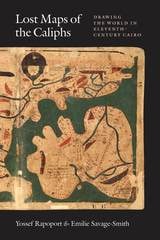
Lost Maps of the Caliphs
Drawing the World in Eleventh-Century CairoYossef Rapoport and Emilie Savage-Smith
University of Chicago Press, 2018
Lost Maps of the Caliphs provides the first general overview of The Book of Curiosities and the unique insight it offers into medieval Islamic thought. Opening with an account of the remarkable discovery of the manuscript and its purchase by the Bodleian Library, the authors use The Book of Curiosities to re-evaluate the development of astrology, geography, and cartography in the first four centuries of Islam. Their account assesses the transmission of Late Antique geography to the Islamic world, unearths the logic behind abstract maritime diagrams, and considers the palaces and walls that dominate medieval Islamic plans of towns and ports. Early astronomical maps and drawings demonstrate the medieval understanding of the structure of the cosmos and illustrate the pervasive assumption that almost any visible celestial event had an effect upon life on Earth. Lost Maps of the Caliphs also reconsiders the history of global communication networks at the turn of the previous millennium. It shows the Fatimid Empire, and its capital Cairo, as a global maritime power, with tentacles spanning from the eastern Mediterranean to the Indus Valley and the East African coast.
As Lost Maps of the Caliphs makes clear, not only is The Book of Curiosities one of the greatest achievements of medieval mapmaking, it is also a remarkable contribution to the story of Islamic civilization that opens an unexpected window to the medieval Islamic view of the world.
Love, Sex, and Desire in Modern Egypt
Navigating the Margins of RespectabilityBy L. L. Wynn
University of Texas Press, 2018
Cairo is a city obsessed with honor and respectability—and love affairs. Sara, a working-class woman, has an affair with a married man and becomes pregnant, only to be abandoned by him; Ayah and Zeid, a respectably engaged couple, argue over whether Ayah’s friend is a prostitute or a virgin; Malak, a European belly dancer who sometimes gets paid for sex, wants to be loved by a man who won’t treat her like a whore just because she’s a dancer; and Alia, a Christian banker who left her abusive husband, is the mistress of a wealthy Muslim man, Haroun, who encourages business by hosting risqué parties for other men and their mistresses.
Set in transnational Cairo over two decades, Love, Sex, and Desire in Modern Egypt is an ethnography that explores female respectability, male honor, and Western theories and fantasies about Arab society. L. L. Wynn uses stories of love affairs to interrogate three areas of classic anthropological theory: mimesis, kinship, and gift. She develops a broad picture of how individuals love and desire within a cultural and political system that structures the possibilities of, and penalties for, going against sexual and gender norms. Wynn demonstrates that love is at once a moral horizon, an attribute that “naturally” inheres in particular social relations, a social phenomenon strengthened through cultural concepts of gift and kinship, and an emotion deeply felt and desired by individuals.