Results by title
87 books match the query 'Emotions' and 4 start with l
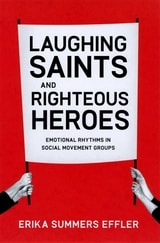
Laughing Saints and Righteous Heroes
Emotional Rhythms in Social Movement GroupsErika Summers Effler
University of Chicago Press, 2010
To explore these questions, Erika Summers Effler undertook three years of ethnographic fieldwork with two groups: anti–death penalty activists STOP and the Catholic Workers, who strive to alleviate poverty. In both communities, members must contend with problems that range from the broad to the intimately personal. Adverse political conditions, internal conflict, and fluctuations in financial resources create a backdrop of daily frustration—but watching an addict relapse or an inmate’s execution are much more devastating setbacks. Summers Effler finds that overcoming these obstacles, recovering from failure, and maintaining the integrity of the group require a constant process of emotional fine-tuning, and she demonstrates how activists do this through thoughtful analysis and a lucid rendering of their deeply affecting stories.
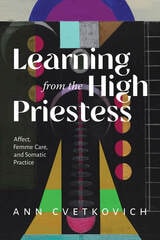
Learning from the High Priestess
Affect, Femme Care, and Somatic PracticeAnn Cvetkovich
Duke University Press, 2026
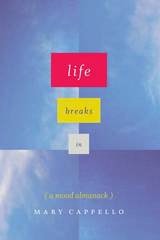
Life Breaks In
A Mood AlmanackMary Cappello
University of Chicago Press, 2016
Some books start at point A, take you by the hand, and carefully walk you to point B, and on and on.
This is not one of those books. This book is about mood, and how it works in and with us as complicated, imperfectly self-knowing beings existing in a world that impinges and infringes on us, but also regularly suffuses us with beauty and joy and wonder. You don’t write that book as a linear progression—you write it as a living, breathing, richly associative, and, crucially, active, investigation. Or at least you do if you’re as smart and inventive as Mary Cappello.
What is a mood? How do we think about and understand and describe moods and their endless shadings? What do they do to and for us, and how can we actively generate or alter them? These are all questions Cappello takes up as she explores mood in all its manifestations: we travel with her from the childhood tables of “arts and crafts” to mood rooms and reading rooms, forgotten natural history museums and 3-D View-Master fairytale tableaux; from the shifting palette of clouds and weather to the music that defines us and the voices that carry us. The result is a book as brilliantly unclassifiable as mood itself, blue and green and bright and beautiful, funny and sympathetic, as powerfully investigative as it is richly contemplative.
“I’m one of those people who mistrusts a really good mood,” Cappello writes early on. If that made you nod in recognition, well, maybe you’re one of Mary Cappello’s people; you owe it to yourself to crack Life Breaks In and see for sure.
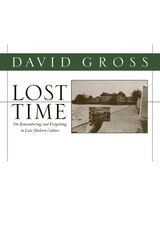
Lost Time
On Remembering and Forgetting in Late Modern CultureDavid Gross
University of Massachusetts Press, 2000
What is the value of memory in human culture? More specifically, what role should remembering—and forgetting—play in our daily lives? These are the central questions that David Gross addresses in this original and thought-provoking book.
For centuries, Gross points out, remembering was considered essential not only to the perpetuation of society but to the maintenance of individual existence. Survival often depended on the memory of how to perform specific tasks, what values to honor, and what personal or collective identity to assume. Remembering, in short, put one in touch with the things that mattered, engendering wholeness and wisdom. Forgetting, on the other hand, led to emptiness, ignorance, and death.
With the advent of modernity, however, doubts about the value of memory grew while the negative implications of forgetting were reevaluated. In many quarters, forgetting came to be defended for the way it frees us from the past, opening the door to new perceptions, new possibilities, and new beginnings.
Now, in late modernity, Gross argues, we find ourselves in an unprecedented situation. For the first time in history, we are able to decide, without the pressure of social or cultural constraints, whether we want to remember or forget and to live our lives accordingly. But which is the better choice? Should we build our lives upon the meanings and values of a faded past? If so, what ought we to remember, and for what purpose? Or should we instead opt to forget what has come before and focus our attention on the present and future, thereby perpetually reinventing ourselves and the world we inhabit? According to Gross, our answers to these questions will determine not only who we are but what we will become as we pass from late modernity into the terra incognita of the “postmodern” age.