Results by title
83 books match the query 'Enlightenment' and 5 start with l
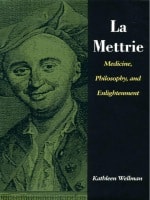
La Mettrie
Medicine, Philosophy, and EnlightenmentKathleen Wellman
Duke University Press, 1992
Julien Offray de la Mettrie, best known as the author of L’Homme machine, appears as a minor character in most accounts of the Enlightenment. But in this intellectual biography by Kathleen Wellman, La Mettrie—physician-philosophe—emerges as a central figure whose medical approach to philosophical and moral issues had a profound influence on the period and its legacy.
Wellman’s study presents La Mettrie as an advocate of progressive medical theory and practice who consistently applied his medical concerns to the reform of philosophy, morals, and society. By examining his training with the Dutch physician Hermann Boerhaave, his satires lampooning the ignorance and venality of the medical profession, and his medical treatises on subjects ranging from vertigo to veneral disease, Wellman illuminates the medical roots of La Mettrie’s philosophy. She shows how medicine encouraged La Mettrie to undertake an impiricist critique of the philosophical tradition and provided the foundation for a medical materialism that both shaped his understanding of the possibilities of moral and social reform and led him to espouse the cause of the philosophers.
Elucidating the medical view of nature, human beings, and society that the Enlightenment and La Mettrie in particular bequethed to the modern world, La Mettrie makes an important contribution to our understanding of both that period and our own.
[more]
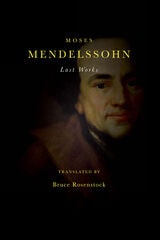
Last Works
Moses Mendelssohn. Translated by Bruce Rosenstock
University of Illinois Press, 2012
Moses Mendelssohn (1729–1786) was the central figure in the emancipation of European Jewry. His intellect, judgment, and tact won the admiration and friendship of contemporaries as illustrious as Johann Gottfried Herder, Gotthold Ephraim Lessing, and Immanuel Kant. His enormously influential Jerusalem (1783) made the case for religious tolerance, a cause he worked for all his life.
Last Works includes, for the first time complete and in a single volume, the English translation of Morning Hours: Lectures on the Existence of God (1785) and To the Friends of Lessing (1786). Bruce Rosenstock has also provided an historical introduction and an extensive philosophical commentary to both texts.
At the center of Mendelssohn's last works is his friendship with Lessing. Mendelssohn hoped to show that he, a Torah-observant Jew, and Lessing, Germany's leading dramatist, had forged a life-long friendship that held out the promise of a tolerant and enlightened culture in which religious strife would be a thing of the past.
Lessing's death in 1781 was a severe blow to Mendelssohn. Mendelssohn wrote his last two works to commemorate Lessing and to carry on the work to which they had dedicated much of their lives. Morning Hours treats a range of major philosophical topics: the nature of truth, the foundations of human knowledge, the basis of our moral and aesthetic powers of judgment, the reality of the external world, and the grounds for a rational faith in a providential deity. It is also a key text for Mendelssohn's readings of Spinoza. In To the Friends of Lessing, Mendelssohn attempts to unmask the individual whom he believes to be the real enemy of the enlightened state: the Schwärmer, the religious fanatic who rejects reason in favor of belief in suprarational revelation.
[more]
Light in Germany
Scenes from an Unknown EnlightenmentT. J. Reed
University of Chicago Press, 2015
Germany’s political and cultural past from ancient times through World War II has dimmed the legacy of its Enlightenment, which these days is far outshone by those of France and Scotland. In this book, T. J. Reed clears the dust away from eighteenth-century Germany, bringing the likes of Kant, Goethe, Friedrich Schiller, and Gotthold Lessing into a coherent and focused beam that shines within European intellectual history and reasserts the important role of Germany’s Enlightenment.
Reed looks closely at the arguments, achievements, conflicts, and controversies of these major thinkers and how their development of a lucid and active liberal thinking matured in the late eighteenth century into an imaginative branching that ran through philosophy, theology, literature, historiography, science, and politics. He traces the various pathways of their thought and how one engendered another, from the principle of thinking for oneself to the development of a critical epistemology; from literature’s assessment of the past to the formulation of a poetic ideal of human development. Ultimately, Reed shows how the ideas of the German Enlightenment have proven their value in modern secular democracies and are still of great relevance—despite their frequent dismissal—to us in the twenty-first century.
Reed looks closely at the arguments, achievements, conflicts, and controversies of these major thinkers and how their development of a lucid and active liberal thinking matured in the late eighteenth century into an imaginative branching that ran through philosophy, theology, literature, historiography, science, and politics. He traces the various pathways of their thought and how one engendered another, from the principle of thinking for oneself to the development of a critical epistemology; from literature’s assessment of the past to the formulation of a poetic ideal of human development. Ultimately, Reed shows how the ideas of the German Enlightenment have proven their value in modern secular democracies and are still of great relevance—despite their frequent dismissal—to us in the twenty-first century.
[more]
Light of Reason, Light of Faith
Joseph Ratzinger and the German EnlightenmentMaurice Ashley Agbaw-Ebai
St. Augustine's Press, 2021
Fr. Maurice Ashley Agbaw-Ebai, a native of Cameroon, has written a fresh, exciting new study of the lifelong engagement of Josef Ratzinger, later Pope Benedict XVI, with the German Enlightenment and its contemporary manifestations and heirs. Contemporary European disdain for organized religion and the rise in secularism on that continent has deep roots in the German Enlightenment. To understand contemporary Europe, one must return to this crucial epoch in its history, to those who shaped the European mind of this era, and to a study of the ideas they espoused and propagated. These ideas, for good or for ill, have taken hold in other parts of the modern world, being incarnated in many minds and institutions in contemporary society and threatening to enthrone a disfigured rationality without faith or a sense of Transcendence.
Ratzinger’s extraordinary and sympathetic understanding of the sources of contemporary secularism equipped him to appreciate the gains of the Enlightenment, while still being a fierce critic of the losses humanity has suffered when reason falsely excludes faith. Fr. Agbaw-Ebai’s account reveals Ratzinger, in relation to his various interlocutors, to be the truly “enlightened” one because he demonstrates a truly balanced understanding of the human mind. To be truly rational one must be able to hold to faith and reason both, reason informed by faith in Jesus Christ.
A particular merit of this book is Agbaw-Ebai’s presentation of Ratzinger’s treatment of the German Enlightenment’s greatest contributors: Kant, Nietzche, Hegel and Habermas, among others. In the postscript George Weigel characterizes what this study accomplishes in the larger framework of scholarship. “[Ratzinger’s] position remains too often misunderstood, and sometimes deliberately misinterpreted, throughout the whole Church. And to misunderstand, or misinterpret, Ratzinger is to misunderstand or misinterpret both the modern history of theology and the Second Vatican Council.” Agbaw-Ebai masterfully positions Ratzinger correctly in the history of ideas, and exhibits why Ratzinger will be remembered as one of its main players. Pure rationalists and true believers are equally indebted to him.
[more]
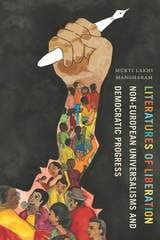
Literatures of Liberation
Non-European Universalisms and Democratic ProgressMukti Lakhi Mangharam
The Ohio State University Press, 2017
The postcolonial spread of democratic ideals such as freedom and equality has taken place all over the world despite the widespread cultural differences that would seem to inhibit such change. In her new book, Literatures of Liberation: Non-European Universalisms and Democratic Progress, Mukti Lakhi Mangharam questions how these “universalisms” came to be and suggests that these elements were not solely the result of Europe-based Enlightenment ideals. Instead, they also arose in context-specific forms throughout the world (particularly in the Global South), relatively independently from Enlightenment concepts. These translatable yet distinct cognitive frameworks, or “contextual universalisms,” as she argues, were central to the spread of modern democratic principles in response to the relentless expansion of capital.
In this way, she posits that these universalisms reconceptualize democratic ideals not as Western imports into precolonial societies but as regional phenomena tied to local relations of power and resistance. In charting these alternative democratic trajectories, Mangharam examines oft-overlooked regional and vernacular literary forms and provides a fresh approach to current theorizations of postcolonial and world literatures.
In this way, she posits that these universalisms reconceptualize democratic ideals not as Western imports into precolonial societies but as regional phenomena tied to local relations of power and resistance. In charting these alternative democratic trajectories, Mangharam examines oft-overlooked regional and vernacular literary forms and provides a fresh approach to current theorizations of postcolonial and world literatures.
[more]