Results by title
60 books match the query 'Environmental justice' and 3 start with l
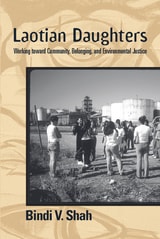
Laotian Daughters
Working toward Community, Belonging, and Environmental JusticeBindi V. Shah
Temple University Press, 2011
Laotian Daughters focuses on second-generation environmental justice activists in Richmond, California. Bindi Shah's pathbreaking book charts these young women's efforts to improve the degraded conditions in their community and explores the ways their activism and political practices resist the negative stereotypes of race, class, and gender associated with their ethnic group.
Using ethnographic observations, interviews, focus groups, and archival data on their participation in Asian Youth Advocates—a youth leadership development project—Shah analyzes the teenagers' mobilization for social rights, cross-race relations, and negotiations of gender and inter-generational relations. She also addresses issues of ethnic youth, and immigration and citizenship and how these shape national identities.
Shah ultimately finds that citizenship as a social practice is not just an adult experience, and that ethnicity is an ongoing force in the political and social identities of second-generation Laotians.
Latinx Environmentalisms
Place, Justice, and the DecolonialSarah D. Wald
Temple University Press, 2019
The whiteness of mainstream environmentalism often fails to account for the richness and variety of Latinx environmental thought. Building on insights of environmental justice scholarship as well as critical race and ethnic studies, the editors and contributors to Latinx Environmentalisms map the ways Latinx cultural texts integrate environmental concerns with questions of social and political justice.
Original interviews with creative writers, including Cherríe Moraga, Helena María Viramontes, and Héctor Tobar, as well as new essays by noted scholars of Latinx literature and culture, show how Latinx authors and cultural producers express environmental concerns in their work. These chapters, which focus on film, visual art, and literature—and engage in fields such as disability studies, animal studies, and queer studies—emphasize the role of racial capitalism in shaping human relationships to the more-than-human world and reveal a vibrant tradition of Latinx decolonial environmentalism.
Latinx Environmentalisms accounts for the ways Latinx cultures are environmental, but often do not assume the mantle of “environmentalism.”
Living beyond the Pale
Environmental Justice and the Roma MinorityRichard Filcák
Central European University Press, 2012