Results by title
313 books match the query 'Environmental policy' and 6 start with l
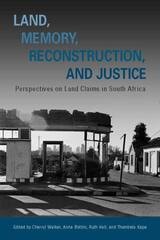
Land, Memory, Reconstruction, and Justice
Perspectives on Land Claims in South AfricaCherryl Walker
Ohio University Press, 2010
Land is a significant and controversial topic in South Africa. Addressing the land claims of those dispossessed in the past has proved to be a demanding, multidimensional process. In many respects the land restitution program that was launched as part of the county’s transition to democracy in 1994 has failed to meet expectations, with ordinary citizens, policymakers, and analysts questioning not only its progress but also its outcomes and parameters.
Land, Memory, Reconstruction, and Justice brings together a wealth of topical material and case studies by leading experts in the field who present a rich mix of perspectives from politics, sociology, geography, social anthropology, law, history, and agricultural economics. The collection addresses both the material and the symbolic dimensions of land claims, in rural and urban contexts, and explores the complex intersection of issues confronting the restitution program, from the promotion of livelihoods to questions of rights, identity, and transitional justice.
A valuable contribution to the field of land and agrarian studies, both in South Africa and internationally, it is undoubtedly the most comprehensive treatment to date of South Africa’s postapartheid land claims process and will be essential reading for scholars and students of land reform for years to come.
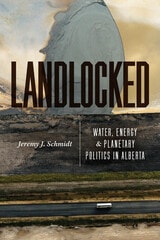
Landlocked
Water, Energy, and Planetary Politics in AlbertaJeremy J. Schmidt
University of Chicago Press, 2026
A study of oil-rich Alberta reveals the entwined relationships among geoscience, governance, and power.
The Canadian province of Alberta holds the world’s fourth-largest reserve of fossil fuels, with oil sands famous for bitumen, a viscous form of petroleum. A critical testing ground for international environmental ideas and energy policies, Alberta pioneered state-led efforts to understand, extract, and sell bitumen. Without natural access to ocean ports, Alberta must negotiate pipeline routes with neighboring provinces and nations to reach global markets. But Alberta is also landlocked in another sense: it is caught in an extractive relationship with oil-rich earth.
In Landlocked, Jeremy J. Schmidt focuses on Alberta’s energy industry, particularly its use of water and oil, to argue for a new way of understanding how political authority is forged and maintained through the environment. Schmidt details how water and oil were enrolled in early state-making projects, such as irrigation, and examines the consequences of Alberta’s efforts to extract value from land, including a series of events in 2013 that released 4.2 million barrels of bitumen into underground environments. By uncovering the ways that geosciences supported activities—from land settlement to the dispossession of Indigenous peoples—that produced environmental policies and approaches to management and governance, he shows that they aren’t merely instruments of state power but central to Alberta’s political identity and legitimacy.
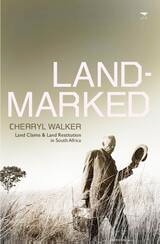
Landmarked
Land Claims and Land Restitution in South AfricaCherryl Walker
Ohio University Press, 2008
The year 2008 is the deadline set by President Mbeki for the finalization of all land claims by people who were dispossessed under the apartheid and previous white governments. Although most experts agree this is an impossible deadline, it does provide a significant political moment for reflection on the ANC government’s program of land restitution since the end of apartheid.
Land reform (and land restitution within that) remains a highly charged issue in South Africa, one that deserves more in–depth analysis. Drawing on her experience as Rural Land Claims Commissioner in KwaZulu–Natal from 1995 to 2000, Professor Cherryl Walker provides a multilayered account of land reform in South Africa, one that covers general critical commentary, detailed case material, and personal narrative. She explores the master narrative of loss and restoration, which has been fundamental in shaping the restitution program; offers a critical overview of the achievements of the program as a whole; and discusses what she calls the “non–programmatic limits to land reform,” including urbanization, environmental constraints and the impact of HIV/AIDS.
Law and the Environment
A Multidisciplinary ReaderRobert Percival
Temple University Press, 1997
Law and the Environment: A Multidisciplinary Reader brings together for the first time some of the most important original work on environmental policy by scientists, ecologists, philosophers, historians, economists, and legal scholars. Each of the book's four parts provides a different focus on the nature and scope of environmental problems and attempts to use public policy to address these concerns. Part I examines how ecology, economics, and ethics analyze environmental problems and why they support collective action to respond to them. Part II examines the history and present state of environmental law, from early attempts to engage the government to current debate over the effectiveness of environmental policy. Part III explores the process by which environmental law gets translated into regulatory policy. Part IV considers the future of environmental law at a time when international environmental concerns have become a major force in global diplomacy and international trade agreements.
In drawing together a wide variety of perspectives on these issues, Robert V. Percival and Dorothy C. Alevizatos offer a comprehensive examination of how society has responded to the difficult challenges posed by environmental problems. The selections provide a rich introduction to the complexities of environmental policy disputes.
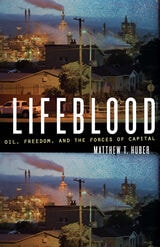
Lifeblood
Oil, Freedom, and the Forces of CapitalMatthew T. Huber
University of Minnesota Press, 2013
If our oil addiction is so bad for us, why don’t we kick the habit? Looking beyond the usual culprits—Big Oil, petro-states, and the strategists of empire—Lifeblood finds a deeper and more complex explanation in everyday practices of oil consumption in American culture. Those practices, Matthew T. Huber suggests, have in fact been instrumental in shaping the broader cultural politics of American capitalism.
How did gasoline and countless other petroleum products become so central to our notions of the American way of life? Huber traces the answer from the 1930s through the oil shocks of the 1970s to our present predicament, revealing that oil’s role in defining popular culture extends far beyond material connections between oil, suburbia, and automobility. He shows how oil powered a cultural politics of entrepreneurial life—the very American idea that life itself is a product of individual entrepreneurial capacities. In so doing he uses oil to retell American political history from the triumph of New Deal liberalism to the rise of the New Right, from oil’s celebration as the lifeblood of postwar capitalism to increasing anxieties over oil addiction.
Lifeblood rethinks debates surrounding energy and capitalism, neoliberalism and nature, and the importance of suburbanization in the rightward shift in American politics. Today, Huber tells us, as crises attributable to oil intensify, a populist clamoring for cheap energy has less to do with American excess than with the eroding conditions of life under neoliberalism.

Local Organic
Food Rhetorics and Community Writing for ImpactVeronica House
Utah State University Press, 2025
Local Organic offers writing and rhetoric faculty and graduate students an ecological methodology to produce, teach, and theorize writing to help communities engage with a wide array of social issues and to work toward individual and community-level impacts.