Results by title
496 books match the query 'Ethnic identity' and 16 start with l
Labor's Lot
The Power, History, and Culture of Aboriginal ActionElizabeth A. Povinelli
University of Chicago Press, 1994
In Labor's Lot, Povinelli shows how everyday activities shape Aboriginal identity and provide cultural meaning. She focuses on the Belyuen women's interactions with the countryside and on Belyuen conflicts with the Australian government over control of local land. Her analysis raises serious questions about the validity of Western theories about labor and culture and their impact on Aboriginal society.
Povinelli's focus on women's activities provides an important counterpoint to recent works centering on male roles in hunter-gatherer societies. Her unique "cultural economy" approach overcomes the dichotomy between the two standard approaches to these studies. Labor's Lot will engage anyone interested in indigenous peoples or in the relationship between culture and economy in contemporary social practice.
Land of the Tejas
Native American Identity and Interaction in Texas, A.D. 1300 to 1700By John Wesley Arnn III
University of Texas Press, 2012
Combining archaeological, historical, ethnographic, and environmental data, Land of the Tejas represents a sweeping, interdisciplinary look at Texas during the late prehistoric and early historic periods. Through this revolutionary approach, John Wesley Arnn reconstructs Native identity and social structures among both mobile foragers and sedentary agriculturalists. Providing a new methodology for studying such populations, Arnn describes a complex, vast, exotic region marked by sociocultural and geographical complexity, tracing numerous distinct peoples over multiple centuries.
Drawing heavily on a detailed analysis of Toyah (a Late Prehistoric II material culture), as well as early European documentary records, an investigation of the regional environment, and comparisons of these data with similar regions around the world, Land of the Tejas examines a full scope of previously overlooked details. From the enigmatic Jumano Indian leader Juan Sabata to Spanish friar Casanas's 1691 account of the vast Native American Tejas alliance, Arnn's study shines new light on Texas's poorly understood past and debunks long-held misconceptions of prehistory and history while proposing a provocative new approach to the process by which we attempt to reconstruct the history of humanity.
Land's Language
On Mapuche Memory, Translation, and the Territorial AporiaEthan Madarieta
Northwestern University Press, 2026
Presenting a new framework for understanding indigeneity and Indigenous peoples’ demands for territorial restitution
Asserting that the work of critical theory today must attend to an epistemic locality rather than the universalizing impulse of its European intellectual genealogy, Ethan Madarieta makes central to his study the literatures and philosophy of the Mapuche peoples of Wallmapu (comprising south-central regions of what are currently known as Chile and Argentina). In doing so, he argues that the primary site of settler and Indigenous antagonisms is not “land,” as is ubiquitously asserted, but the overlapping and incommensurate conceptual orders within which land and body are constituted and accrue meaning.
Land’s Language works to unsettle the stability and universality of how land and body are understood by calling into question what can or will be restored or returned and to whom. Drawing on Latin American and Mapuche historical, philosophical, and literary studies in dialogue with global critical theory and Anglophone critical Indigenous studies, this book demonstrates how Mapuche knowledge and thought, and that of each Indigenous nation across the planet, offer ways to live in ethical relation beyond that of the state and under the wider systemic hegemony of colonial racial capitalism.
Language and Ethnicity among the K'ichee' Maya
Sergio Romero
University of Utah Press, 2015
This book explores the articulation between “accent” and ethnic identification in K’ichee’, a Mayan language spoken by more than one million people in the western highlands of Guatemala. Based on years of ethnographic work, it is the first anthropological examination of the social meaning of dialectal difference in any Mayan language. Romero deconstructs essentialist perspectives on ethnicity in Mesoamerica and argues that ethnic identification among the highland Maya is multiple and layered, the result of a diverse linguistic precipitate created by centuries of colonial resistance.
In K’ichee’, dialect stereotypes—accents—act as linguistic markers embodying particular ethnic registers. K’ichee’ speakers use and recombine their linguistic repertoire—colloquial K’ichee’, traditional K’ichee’ discourse, colloquial Spanish, Standard Spanish, and language mixing—in strategic ways to mark status and authority and to revitalize their traditional culture. The book surveys literary genres such as lyric poetry, political graffiti, and radio broadcasts, which express new experiences of Mayan-ness and anticolonial resistance. It also takes a historical perspective in examining oral and written K’ichee’ discourses from the sixteenth to the twenty-first centuries, including the famous chronicle known as the Popol Vuh, and explores the unbreakable link between language, history, and culture in the Maya highlands.
Language, History, and Identity
Ethnolinguistic Studies of the Arizona TewaPaul V. Kroskrity
University of Arizona Press, 1993
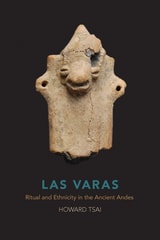
Las Varas
Ritual and Ethnicity in the Ancient AndesHoward Tsai
University of Alabama Press, 2020
Recent popular discourse on nationalism and ethnicity assumes that humans by nature prefer “tribalism,” as if people cannot help but divide themselves along lines of social and ethnic difference. Research from anthropology, history, and archaeology, however, shows that individuals actively construct cultural and social ideologies to fabricate the stereotypes, myths, and beliefs that separate “us” from “them.” Archaeologist Howard Tsai and his team uncovered a thousand-year-old village in northern Peru where rituals were performed to recognize and reinforce ethnic identities.
This site—Las Varas—is located near the coast of Peru in a valley leading into the Andes. Excavations revealed a western entrance to Las Varas for those arriving from the coast and an eastern entryway for those coming from the highlands. Rituals were performed at both of these entrances, indicating that the community was open to exchange and interaction, yet at the same time controlled the flow of people and goods through ceremonial protocols. Using these checkpoints and associated rituals, the villagers of Las Varas were able to maintain ethnic differences between themselves and visitors from foreign lands.
Las Varas: Ritual and Ethnicity in the Ancient Andes reveals a rare case of finding ethnicity relying solely on archaeological remains. In this monograph, data from the excavation of Las Varas are analyzed within a theoretical framework based on current understandings of ethnicity. Tsai’s method, approach, and inference demonstrate the potential for archaeologists to discover how ethnic identities were constructed in the past, ultimately making us question the supposed naturalness of tribal divisions in human antiquity.
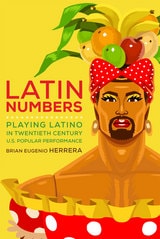
Latin Numbers
Playing Latino in Twentieth-Century U.S. Popular PerformanceBrian Eugenio Herrera
University of Michigan Press, 2015
Latinos and Nationhood
Two Centuries of Intellectual ThoughtNicolás Kanellos
University of Arizona Press, 2023
Over the course of two centuries, these Latino or Hispanic intellectuals were natural-born citizens of the United States, immigrants, or political refugees. Many of these intellectuals, whether citizens or not, strove to embrace and enliven such democratic principles as freedom of speech and of the press, the protection of minorities in the Bill of Rights and in subsequent laws, and the protection of linguistic and property rights, among many others, guaranteed by treaties when the United States incorporated their homelands into the Union.
The first six chapters present the work of lesser-known historical figures—most of whom have been consistently ignored by Anglo- and Euro-centric history and whose works have been widely inaccessible until recently—who were revolutionaries, editors of magazines and newspapers, and speechmakers who influenced the development of a Latino consciousness. The last three chapters deal with three foundational figures of the Chicano Movement, the last two of whom either subverted the concept of nationhood or went beyond it to embrace internationalism in an outreach to humanity as a whole.
Latinos and Nationhood sheds new light on the biographies of Félix Varela, José Alvarez de Toledo y Dubois, Francisco Ramírez, Tomás Rivera, Rolando Hinojosa-Smith, and Gloria E. Anzaldúa, among others.
Latinos in New England
edited by Andrés Torres
Temple University Press, 2006
Latinx Belonging
Community Building and Resilience in the United StatesEdited by Natalia Deeb-Sossa and Jennifer Bickham Mendez
University of Arizona Press, 2022
What does it mean to be Latinx? This pressing question forms the core of Latinx Belonging, which brings together cutting-edge research to discuss the multilayered ways this might be answered.
Latinx Belonging is anchored in the claim that Latinx people are not defined by their marginalization but should instead be understood as active participants in their communities and contributors to U.S. society. The volume’s overarching analytical approach recognizes the differences, identities, and divisions among people of Latin American origin in the United States, while also attending to the power of mainstream institutions to shape their lives and identities. Contributors to this volume view “belonging” as actively produced through struggle, survival, agency, resilience, and engagement.
This work positions Latinxs’ struggles for recognition and inclusion as squarely located within intersecting power structures of gender, race, sexuality, and class and as shaped by state-level and transnational forces such as U.S. immigration policies and histories of colonialism. From the case of Latinxs’ struggles for recognition in the arts, to queer Latinx community resilience during COVID-19 and in the wake of mass shootings, to Indigenous youth’s endurance and survival as unaccompanied minors in Los Angeles, the case studies featured in this collection present a rich and textured picture of the diversity of the U.S. Latinx experience in the twenty-first century.
Contributors
Andrés Acosta
Jack “Trey” Allen
Jennifer Bickham Mendez
Stephanie L. Canizales
Christopher Cuevas
Natalia Deeb-Sossa
Yvette G. Flores
Melanie Jones Gast
Monika Gosin
Pierrette Hondagneu-Sotelo
Nolan Kline
Verónica Montes
Yvonne Montoya
Michael De Anda Muñiz
Suzanne Oboler
Gilda L. Ochoa
Dina G. Okamoto
Marco Antonio Quiroga
Michelle Téllez
Learning to Be Latino
How Colleges Shape Identity PoliticsReyes, Daisy Verduzco
Rutgers University Press, 2018
Drawing on extensive ethnographic observations, Reyes shows how college campuses shape much more than students’ academic and occupational trajectories; they mold students’ ideas about inequality and opportunity in America, their identities, and even how they intend to practice politics.
Legions of Boom
Filipino American Mobile DJ Crews in the San Francisco Bay AreaOliver Wang
Duke University Press, 2015

Little Saigons
Staying Vietnamese in AmericaKarin Aguilar–San Juan
University of Minnesota Press, 2009
Karin Aguilar-San Juan examines the contradictions of Vietnamese American community and identity in two emblematic yet different locales: Little Saigon in suburban Orange County, California (widely described as the capital of Vietnamese America) and the urban "Vietnamese town" of Fields Corner in Boston, Massachusetts. Their distinctive qualities challenge assumptions about identity and space, growth amid globalization, and processes of Americanization.
With a comparative and race-cognizant approach, Aguilar-San Juan shows how places like Little Saigon and Fields Corner are sites for the simultaneous preservation and redefinition of Vietnamese identity. Intervening in debates about race, ethnicity, multiculturalism, and suburbanization as a form of assimilation, this work elaborates on the significance of place as an integral element of community building and its role in defining Vietnamese American-ness.
Staying Vietnamese, according to Aguilar-San Juan, is not about replicating life in Viet Nam. Rather, it involves moving toward a state of equilibrium that, though always in flux, allows refugees, immigrants, and their U.S.-born offspring to recalibrate their sense of self in order to become Vietnamese anew in places far from their presumed geographic home.
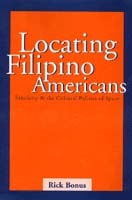
Locating Filipino Americans
Rick Bonus
Temple University Press, 2000
Locating Filipino Americans, an ethnographic study of Filipino American communities in Los Angeles and San Diego, present a multi-disciplinary cultural analysis of the relationship between ethnic identity and social space. Author Rick Bonus argues that alternative community spaces enable Filipino Americans to respond to and resist the ways in which the larger society has historically and institutionally rendered them invisible, silenced, and racialized. Bonus focuses on the "Oriental" stores, the social halls and community centers, and the community newspapers to demonstrate how ethnic identities are publicly constituted and communities are transformed. Delineating the spaces formed by diasporic consciousness, Bonus shows how community members appropriate elements from their former homeland and from their new settlements in ways defined by their critical stances against racism, homogenization, complete assimilation, and exclusionary citizenship. Locating Filipino Americans is one of the few books that offers a grounded approach to theoretical analyses of ethnicity and contemporary culture in the U.S.
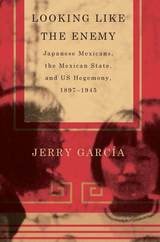
Looking Like the Enemy
Japanese Mexicans, the Mexican State, and US Hegemony, 1897–1945Jerry García
University of Arizona Press, 2014
Japanese citizens were initially lured to Mexico with promises of cheap and productive land in Chiapas. Many of the promises were false, and the immigrants were forced to fan out across the country, especially to the lands along the US border. As Jerry García reveals, they were victims of discrimination based on “difference,” but they also displayed “markers of whiteness” that linked them positively to Europeans and Americans, who were perceived as powerful and socially advanced. And, García reports, many Mexicans looked favorably on the Japanese as hardworking and family-centered.
The book delves deeply into the experiences of the Japanese on both sides of the border during World War II, illuminating the similarities and differences in their treatment. Although some Japanese Mexicans were eventually interned (at the urging of the US government), in general the fear and vitriol that Japanese Americans encountered never reached the same levels in Mexico.
Looking Like the Enemy is an ambitious study of a tumultuous half-century in Mexico. It is a significant contribution to our understanding of the immigrant experience in the Western Hemisphere and to the burgeoning field of borderlands studies.

Loyal but French
The Negotiation of Identity by French-Canadian Descendants in the United StatesMark Paul Richard
Michigan State University Press, 2008
Richard’s work challenges prevailing notions of "assimilation." As he shows, “acculturation” better describes the roundabout process by which some ethnic groups join their host society. He argues that, for more than a century, the French- Canadians in Lewiston, Maine, pursued the twin objectives of ethnic preservation and acculturation. These were not separate goals but rather intertwined processes. Underscored with statistics compiled by the author, Loyal but French portrays the French-Canadian history of Lewiston, from the 1880s through the 1990s, in this light.