67 books match the query 'Exile' and 4 start with l
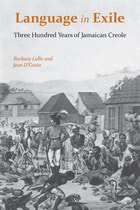
cover of Language in Exile: Three Hundred Years of Jamaican Creole

Language in Exile

Three Hundred Years of Jamaican Creole

Barbara Lalla

University of Alabama Press, 2009

"An important addition to studies of the genesis and life of Jamaican Creole as well as other New World creoles such as Gulla. Highlighting the nature of the nonstandard varieties of British English dialects to which the African slaves were exposed, this work presents a refreshingly cogent view of Jamaican Creole features."
--SECOL Review

"The history of Jamaican Creole comes to life through this book. Scholars will analyze its texts, follow the leads it opens up, and argue about refining its interpretations for a long time to come."
--Journal of Pidgin & Creole Languages

"The authors are to be congratulated on this substantial contribution to our understanding of how Jamaican Creole developed. Its value lies not only in the linguistic insights of the authors but also in the rich trove of texts that they have made accessible."
--English World-Wide

"Provides valuable historical and demographic data and sheds light on the origins and development of Jamaican Creole. Lalla and D'Costa offer interesting insights into Creole genesis, not only through their careful mapping of the migrations from Europe and Africa, which constructed the Jamaican society but also through extensive documentation of early texts. . . . Highly valuable to linguists, historians, anthropologists, psychologists, and anyone interested in the Caribbean or in the history of mankind."
--New West Indian Guide
[more]
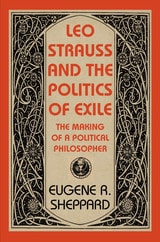
cover of Leo Strauss and the Politics of Exile: The Making of a Political Philosopher

Leo Strauss and the Politics of Exile

The Making of a Political Philosopher

Eugene Sheppard

Brandeis University Press, 2007

Born in rural Hesse, Germany, Leo Strauss (1899–1973) became an active Zionist and philosopher during the tumultuous and fractious Weimar Republic. As Eugene R. Sheppard demonstrates in this groundbreaking and engaging book, Strauss gravitated towards such thinkers as Franz Rosenzweig, Martin Heidegger, and Carl Schmitt as he sought to identify and overcome fundamental philosophical, political, and theological crises. The rise of Nazism impelled Strauss as a young Jewish émigré, first in Europe and then in America, to grapple with—and accommodate his thought to—the pressing challenges of exile. In confronting his own state of exile, Strauss enlisted premodern Jewish thinkers such as Moses Maimonides and Baruch Spinoza who earlier addressed the problem of reconciling their competing loyalties as philosophers and Jews. This is the first study to frame Strauss’s political philosophy around his critique of liberalism and the problem of exile. Sheppard follows Strauss from Europe to the United States, a journey of a conservative Weimar Jew struggling with modern liberalism and the existential and political contours of exile. Strauss sought to resolve the conflicts of a Jew unwilling to surrender loyalty to his ancestral community and equally unwilling to adhere to the strictures of orthodox observance. Strauss saw truth and wisdom as transcending particular religious and national communities, as well as the modern enlightened humanism in which he himself had been nurtured. In his efforts to navigate between the Jewish and the philosophical, the ancient and the modern, Berlin and New York, Strauss developed a distinctively programmatic way of reading and writing “between the lines.” Sheppard recaptures the complexity and intrigue of this project which has been ignored by those who both reject and claim Strauss’s legacy.
[more]
cover of Leon Trotsky: Writings in Exile

Leon Trotsky

Writings in Exile

Leon Trotsky

Pluto Press, 2012

Leon Trotsky was a key political figure of the twentieth century – a leader of the Russian Revolution, founder of the Red Army, author of books on literature, history, morality and politics.

Leon Trotsky: Writings in Exile contains some of his most insightful and penetrating works. Exiled and isolated by Stalin, Trotsky used the only weapon he had left – words. In these writings he defends the 1917 revolution, warns prophetically of fascism and analyses anti-colonial movements in the global south.

This collection gives a sense of the real Trotsky – passionate, humanist, Marxist. It will introduce the writings of one of history's great revolutionaries to a new generation.
[more]
cover of Literature in Exile

Literature in Exile

John Glad, ed.

Duke University Press, 1990

In December 1987 a group of published novelists, poets, and journalists met in Vienna to participate in the Wheatland Conference on Literature. The writers presented papers addressing their common experience—that of being exiled. Each explored different facets of the condition of exile, providing answers to questions such as: What do exiled writers have in common? What is the exile’s obligation to colleagues and readers in the country of origin? Is the effect of changing languages one of enrichment or impoverishment? How does the new society treat the emigre? Following each essay is a peer discussion of the topic addressed.
The volume includes writers whose origins lie in Central Europe, South Africa, Israel, Cuba, Chile, Somalia, and Turkey. Through their testimony of the creative process in exile, we gain insight into the forces which affect the creative process as a whole.

Contributors. William Gass, Yury Miloslavsky, Jan Vladislav, Jiri Grusa, Guillermo Cabrera Infante, Horst Bienek, Edward Limonov, Nedim Gursel, Nuruddin Farah, Jaroslav Vejvoda, Anton Shammas, Joseph Brodsky, Wojciech Karpinski, Thomas Venclova, Yuri Druzhnikov

[more]