50 books match the query 'Experiments' and 3 start with l
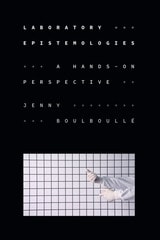
cover of Laboratory Epistemologies: A Hands-On Perspective

Laboratory Epistemologies

A Hands-On Perspective

Jenny Boulboullé

Duke University Press, 2024
In Laboratory Epistemologies: A Hands-On Perspective, Jenny Boulboullé examines the significance of hands-on experiences in contemporary life sciences laboratories. Addressing the relationship between contemplation and manipulation in epistemology, Boulboullé combines participant observations in molecular genetics labs and microbiological cleanrooms with a longue durée study of the history and philosophy of science. She radically rereads Descartes’s key epistemological text Meditations on First Philosophy, reframing the philosopher as a hands-on knowledge maker. With this reading, Boulboullé subverts the pervasive modern conception of the disembodied knower and puts the hands-on experimenter at the heart of life sciences research. In so doing, she contributes a theoretical model for understanding how life processes on cellular and molecular levels are manually produced in today’s techno-scientific spaces. By reassessing the Cartesian legacy and arguing that epistemology should be grounded in the standpoint of a hands-on practitioner, Boulboullé offers the philosophical and historical foundation to understand and study contemporary life sciences research as multisensory embodied practices.
[more]
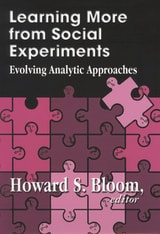
cover of Learning More from Social Experiments: Evolving Analytic Approaches

Learning More from Social Experiments

Evolving Analytic Approaches

Howard S. Bloom

Russell Sage Foundation, 2005
Policy analysis has grown increasingly reliant on the random assignment experiment—a research method whereby participants are sorted by chance into either a program group that is subject to a government policy or program, or a control group that is not. Because the groups are randomly selected, they do not differ from one another systematically. Therefore any differences between the groups at the end of the study can be attributed solely to the influence of the program or policy. But there are many questions that randomized experiments have not been able to address. What component of a social policy made it successful? Did a given program fail because it was designed poorly or because it suffered from low participation rates? In Learning More from Social Experiments, editor Howard Bloom and a team of innovative social researchers profile advancements in the scientific underpinnings of social policy research that can improve randomized experimental studies. Using evaluations of actual social programs as examples, Learning More from Social Experiments makes the case that many of the limitations of random assignment studies can be overcome by combining data from these studies with statistical methods from other research designs. Carolyn Hill, James Riccio, and Bloom profile a new statistical model that allows researchers to pool data from multiple randomized-experiments in order to determine what characteristics of a program made it successful. Lisa Gennetian, Pamela Morris, Johannes Bos, and Bloom discuss how a statistical estimation procedure can be used with experimental data to single out the effects of a program's intermediate outcomes (e.g., how closely patients in a drug study adhere to the prescribed dosage) on its ultimate outcomes (the health effects of the drug). Sometimes, a social policy has its true effect on communities and not individuals, such as in neighborhood watch programs or public health initiatives. In these cases, researchers must randomly assign treatment to groups or clusters of individuals, but this technique raises different issues than do experiments that randomly assign individuals. Bloom evaluates the properties of cluster randomization, its relevance to different kinds of social programs, and the complications that arise from its use. He pays particular attention to the way in which the movement of individuals into and out of clusters over time complicates the design, execution, and interpretation of a study. Learning More from Social Experiments represents a substantial leap forward in the analysis of social policies. By supplementing theory with applied research examples, this important new book makes the case for enhancing the scope and relevance of social research by combining randomized experiments with non-experimental statistical methods, and it serves as a useful guide for researchers who wish to do so.
[more]
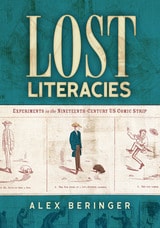
cover of Lost Literacies: Experiments in the Nineteenth-Century US Comic Strip

Lost Literacies

Experiments in the Nineteenth-Century US Comic Strip

Alex Beringer

The Ohio State University Press, 2024

Lost Literacies is the first full-length study of US comic strips from the period prior to the rise of Sunday newspaper comics. Where current histories assume that nineteenth-century US comics consisted solely of single-panel political cartoons or simple “proto-comics,” Lost Literacies introduces readers to an ambitious group of artists and editors who were intent on experimenting with the storytelling possibilities of the sequential strip, resulting in playful comics whose existence upends prevailing narratives about the evolution of comic strips.

Over the course of the nineteenth century, figures such as artist Frank Bellew and editor T. W. Strong introduced sequential comic strips into humor magazines and precursors to graphic novels known as “graphic albums.” These early works reached audiences in the tens of thousands. Their influences ranged from Walt Whitman’s poetry to Mark Twain’s travel writings to the bawdy stage comedies of the Bowery Theatre. Most importantly, they featured new approaches to graphic storytelling that went far beyond the speech bubbles and panel grids familiar to us today. As readers of Lost Literacies will see, these little-known early US comic strips rival even the most innovative modern comics for their diversity and ambition.

[more]