Results by title
64 books match the query 'Georgia' and 3 start with l
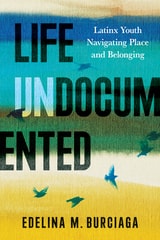
Life Undocumented
Latinx Youth Navigating Place and BelongingEdelina M. Burciaga
University of Arizona Press, 2025
Life Undocumented captures the compelling stories of Latinx undocumented young adults growing up and living in two distinct sociopolitical contexts: California, which provides legal pathways into higher education for undocumented youth, and Georgia, which does not.
The book is about how undocumented young adults in these two contexts navigate the pathway to and through adulthood, and the powerful role state laws and policies play in shaping their prospects for social mobility and their sense of belonging. Edelina M. Burciaga examines how state laws and policies in California and Georgia shape the pathways to adulthood for these individuals. California, with its supportive legal frameworks, contrasts sharply with Georgia’s restrictive environment, highlighting the significant impact of state-level immigration policies.
The book highlights the complexities and contradictions that emerge from these distinct legal ecologies, which include the intersections of federal, state, local, familial, and individual dynamics, and shape the daily lives and future orientations of undocumented young adults. This book underscores the resilience and agency of undocumented youth as they confront and resist the structural constraints imposed by immigration laws, offering a vivid portrayal of their emotional and social journeys. This book is a vital resource for anyone committed to creating equitable and inclusive systems for undocumented students.
[more]

Living with the Georgia Shore
Tonya D. Clayton, Lewis A. Taylor Jr., William J. Cleary, Paul Hosier, Peter H.F. Graber, and Orrin H. Pilkey Sr.
Duke University Press, 1992
The wide sandy beaches, quiet maritime forests, and vast Spartina marshes of the natural Georgia coast create a most spectacular, albeit gentle, Southern beauty. Casual visitors and longtime residents alike have been charmed by this special place. Living with the Georgia Shore provides an essential reference and guide for residents, visitors, developers, planners, and all who are concerned with the conditions and future of Georgia's coastal zone.
Recounting the human and natural history of the islands, the authors look in particular at the phenomenon of coastal erosion and the implications of various responses to this process. In Georgia, as elsewhere in the United States, the future of the shore is in doubt as recreational and residential development demands increase. This book provides guidelines for living with the shore, as opposed to simply living on it. The former requires planning and a wise choice of property or house site. The latter ignores the potential hazards unique to coastal life and may make inadequate allowance for the dramatic changes that can occur on any sandy ocean shore.
Living with the Georgia Shore includes an introduction to each of the Georgia isles, an overview of federal and state coastal land-use regulations, pointers on buying and building at the shore, a hurricane preparation checklist, a history of recent hurricanes in Georgia, an extensive annotated bibliography, and a guide to government agencies and private groups involved in issues of coastal development.
[more]
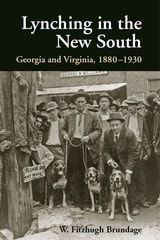
Lynching in the New South
Georgia and Virginia, 1880-1930W. Fitzhugh Brundage
University of Illinois Press, 1993
Lynching was a national crime. But it obsessed the South. W. Fitzhugh Brundage's multidisciplinary approach to the complex nature of lynching delves into the such extrajudicial murders in two states: Virginia, the southern state with the fewest lynchings; and Georgia, where 460 lynchings made the state a measure of race relations in the Deep South. Brundage's analysis addresses three central questions: How can we explain variations in lynching over regions and time periods? To what extent was lynching a social ritual that affirmed traditional white values and white supremacy? And, what were the causes of the decline of lynching at the end of the 1920s?
A groundbreaking study, Lynching in the New South is a classic portrait of the tradition of violence that poisoned American life.
[more]