Results by title
86 books match the query 'Governors' and 5 start with l
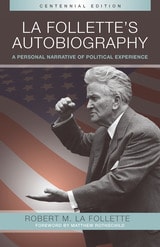
La Follette’s Autobiography
A Personal Narrative of Political ExperiencesRobert M. La Follette; Foreword by Matthew Rothschild
University of Wisconsin Press, 2013
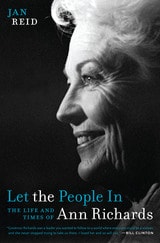
Let the People In
The Life and Times of Ann RichardsBy Jan Reid
University of Texas Press, 2012
Winner, Coral Horton Tullis Memorial Prize, Texas State Historical Association, 2012
Liz Carpenter Award for Research in the History of Women, Texas State Historical Association, 2012
When Ann Richards delivered the keynote of the 1988 Democratic National Convention and mocked President George H. W. Bush—“Poor George, he can’t help it. He was born with a silver foot in his mouth”—she instantly became a media celebrity and triggered a rivalry that would alter the course of American history. In 1990, Richards won the governorship of Texas, upsetting the GOP’s colorful rancher and oilman Clayton Williams. The first ardent feminist elected to high office in America, she opened up public service to women, blacks, Hispanics, Asian Americans, gays, and the disabled. Her progressive achievements and the force of her personality created a lasting legacy that far transcends her rise and fall as governor of Texas.
In Let the People In, Jan Reid draws on his long friendship with Richards, interviews with her family and many of her closest associates, her unpublished correspondence with longtime companion Bud Shrake, and extensive research to tell a very personal, human story of Ann Richards’s remarkable rise to power as a liberal Democrat in a conservative Republican state. Reid traces the whole arc of Richards’s life, beginning with her youth in Waco, her marriage to attorney David Richards, her frustration and boredom with being a young housewife and mother in Dallas, and her shocking encounters with Lyndon Johnson and Jimmy Carter. He follows Richards to Austin and the wild 1970s scene and describes her painful but successful struggle against alcoholism. He tells the full, inside story of Richards’s rise from county office and the state treasurer’s office to the governorship, where she championed gun control, prison reform, environmental protection, and school finance reform, and he explains why she lost her reelection bid to George W. Bush, which evened his family’s score and launched him toward the presidency. Reid describes Richards’s final years as a world traveler, lobbyist, public speaker, and mentor and inspiration to office holders, including Hillary Clinton. His nuanced portrait reveals a complex woman who battled her own frailties and a good-old-boy establishment to claim a place on the national political stage and prove “what can happen in government if we simply open the doors and let the people in.”
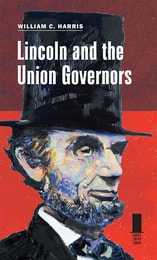
Lincoln and the Union Governors
William C. Harris
Southern Illinois University Press, 2013
Over the course of the Civil War, fifty-nine men served as governors of the twenty-five Union states. Although these state executives were occasionally obstructionist and often disagreed amongst themselves, their overall cooperation and counsel bolstered the policies put forth by Abraham Lincoln and proved essential to the Union’s ultimate victory. In this revealing volume, award-winning historian William C. Harris explores the complex relationship between Lincoln and the governors of the Union states, illuminating the contributions of these often-overlooked state leaders to the preservation of the nation.
Lincoln recognized that in securing the governors’ cooperation in the war he had to tread carefully and, as much as possible, respect their constitutional authority under the federal system of government. Contributing to the success of the partnership, Harris shows, was the fact that almost all of the governors were members of Lincoln’s Republican or Union Party, and most had earlier associated with his Whig party. Despite their support for the war, however, the governors reflected different regional interests, and Lincoln understood and attempted to accommodate these differences in order to maintain a unified war effort.
Harris examines the activities of the governors, who often worked ahead of Lincoln in rallying citizens for the war, organizing state regiments for the Union army, and providing aid and encouragement to the troops in the field. The governors kept Lincoln informed about political conditions in their states and lobbied Lincoln and the War Department to take more vigorous measures to suppress the rebellion. Harris explores the governors’ concerns about many issues, including the divisions within their states over the war and Lincoln’s most controversial policies, especially emancipation and military conscription. He also provides the first modern account of the 1862 conference of governors in Altoona, Pennsylvania, which provided important backing for Lincoln’s war leadership.
By emphasizing the difficult tasks that both the governors and President Lincoln faced in dealing with the major issues of the Civil War, Harris provides fresh insight into the role this dynamic partnership played in preserving the nation’s democratic and constitutional institutions and ending the greatest blight on the republic—chattel slavery.

Lincoln's Rail-Splitter
GOVERNOR RICHARD J. OGLESBYMark A. Plummer
University of Illinois Press, 2001
Like Lincoln, Oglesby was born in Kentucky and spent most of his youth in central Illinois, apprenticing as a lawyer in Springfield and standing for election to the Illinois legislature, Congress, and U.S. Senate. Oglesby participated in the battles of Cerro Gordo and Vera Cruz during the Mexican-American War and made a small fortune in the gold rush of 1849. A superlative speaker, he ran unsuccessfully for Congress in a campaign that featured the Lincoln-Douglas debates of 1858, then was elected to the Illinois senate as Lincoln was being elected president.
When the Civil War came, Oglesby resigned his senate seat to lead a regiment of the Union Army. Critically wounded at the Battle of Corinth, he was promoted to major general before resigning his commission to run successfully for governor of Illinois. Oglesby was at Lincoln's deathbed and led the effort to build the sixteenth president's tomb in Springfield, delivering the major oration at its dedication. In the postwar years, Oglesby drew on his popularity, his association with the martyred Lincoln, and his extraordinary stump-speaking skills to rescue the Illinois Republican Party in a time of political crisis. In his third term as governor, Oglesby faced massive labor unrest in the aftermath of the Haymarket affair.
A mature and thoughtful biography, Lincoln's Rail-Splitter chronicles Oglesby's pivotal contribution to American political life while also providing a sensitive portrait of this able, energetic man.
Lucius Fairchild
Civil War HeroStuart Stotts
Wisconsin Historical Society Press, 2010