Results by title
100 books match the query 'Grammar & Punctuation' and 6 start with l
Learnable Classes of Categorial Grammars
Makoto Kanazawa
CSLI, 1998
This book investigates the learnability of various classes of classical categorial grammars within the Gold paradigm of identification in the limit from positive data. Learning from structure and learning from flat strings are considered. The class of k-valued grammars, for k = 1,2,3,..., is shown to be learnable both from structures and from strings, while the class of least-valued grammars and the class of least-cardinality grammars are shown to be learnable from structures. In proving these learnable results, crucial use is made of a theorem on the concept known as finite elasticity. The learning algorithms used in this work build on Buszkowski and Penn's algorithm for finding categorial grammars from input consisting of functor-argument structures.
[more]
Lectures on Contemporary Syntactic Theories
An Introduction to Government-Binding Theory, Generalized Phrase Structure Grammar, and Lexical-Function GrammarPeter Sells
CSLI, 1985
Sells provides an introduction to the most important aspects of three major contemporary syntactic theories. A strong linguiustic background is not presupposed, and a brief introductory chapter is included for the nonlinguist.
PETER SELLS is a postdoctoral research affliate at CSLI.
1/1/1985
ISBN (Paperback): 0937073148
ISBN (Cloth): 093707313X
Subject: Linguistics; Grammar--Syntax; Government-Binding Theory
[more]
Lectures on Deixis
Charles Fillmore
CSLI, 1997
This volume presents Charles Fillmore's view of the scope of linguistic description, insofar as the field of linguistics touches on questions of the meanings of sentences. Fillmore takes the subject matter of linguistics, in its grammatical, semantic, and pragmatic sub-divisions, to include the full catalog of knowledge that the speakers of a language can be said to possess about the structure of the sentences in their language, and their knowledge about the appropriate use of these sentences. The special explanatory task of linguistics, Fillmore argues, is to discover the principles that underlie such knowledge. He chooses to study the range of information which the speakers of a language possess about the sentences in their language by thoroughly examining one simple English sentence.
[more]
Lexical and Constructional Aspects of Linguistic Explanation
Edited by Gert Webelhuth, Jean-Pierre Koenig, and Andreas Kathol
CSLI, 1999
[more]
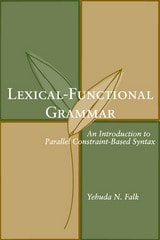
Lexical-Functional Grammar
An Introduction to Parallel Constraint-Based SyntaxYehuda N. Falk
CSLI, 2001
With this textbook, Yehuda N. Falk provides an introduction to the theory of Lexical-Functional Grammar, aimed at both students and professionals who are familiar with other generative theories and now wish to approach LFG. Falk examines LFG's relation to more conventional theories—like Government/Binding or the Minimalism Program—and, in many respects, establishes its superiority.
[more]
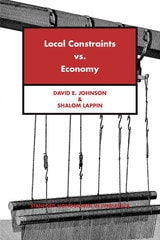
Local Constraints vs. Economy
David E. Johnson and Shalom Lappin
CSLI, 1999
The book offers a detailed critique of the economy-of-derivation model of grammar that has emerged within the framework of Chomsky's Minimalist Program. It looks at the conceptual and computational complexity problems as well as the empirical consequences of both global and local economy principles. The book compares the economy-of-derivation model with a local constraint model of grammar that does not invoke conditions on sets of derivations or on possible operations in a derivation. It argues that the pure local constraint model of grammar avoids the complexity problems resulting from economy-of-derivation principles and provides a more satisfactory explanation of the linguistic facts that economy theorists have cited in support of their approach. The local constraint model also allows for a more natural and empirically well-motivated grammatical architecture than the one postulated by the Minimalist Program.
[more]