Results by title
278 books match the query 'Guide' and 7 start with l
Ladies'-tresses in Your Pocket
A Guide to the Native Ladies'-tresses Orchids, Spiranthes, of the United States and CanadaPaul Martin Brown
University of Iowa Press, 2008
Brown provides general distributional information, time of flowering, and habitat requirements for each species as well as a complete list of hybrids and the many different growth and color forms that can make identifying orchids so intriguing. He includes information on 256 species, 3 additional varieties, and 7 hybrids.
Wild ladies’-tresses occur from British Columbia, with the hooded ladies’-tresses, Spiranthes romanzoffiana, to Florida, with Eaton’s-ladies’-tresses, S. eatonii. The newest species to science, Spiranthes stellata, the starry ladies’-tresses, is featured. Most of these species are easy to identify based upon their general appearance, range, and time of flowering. Answer three simple questions—when, where, and how does it grow? Then compare the living plant with the striking photos in these backpack-friendly laminated guides and consult the keys that Brown has created. Following these steps should enable both professional and amateur naturalists to achieve the satisfaction of identifying specific orchids in their native environment.
Lady's-slippers in Your Pocket
A Guide to the Native Lady's-slipper Orchids, Cypripedium, of the United States and CanadaPaul Martin Brown
University of Iowa Press, 2008
Brown provides general distributional information, time of flowering, and habitat requirements for each species as well as a complete list of hybrids and the many different growth and color forms that can make identifying orchids so intriguing. For the lady’s-slippers he includes information on 12 species, 2 additional varieties, and 6 hybrids.
Wild lady’s-slippers grow from Alaska, with the spotted lady’s-slipper, Cypripedium guttatum, to Texas, with the ivory-lipped lady’s-slipper, C. kentuckiense. Most of these species are easy to identify based upon their general appearance, range, and time of flowering. Answer three simple questions—when, where, and how does it grow? Then compare the living plant with the striking photos in these backpack-friendly laminated guides and consult the keys that Brown has created. Following these steps should enable both professional and amateur naturalists to achieve the satisfaction of identifying specific orchids in their native environment.
Law in the Laboratory
A Guide to the Ethics of Federally Funded Science ResearchRobert P. Charrow
University of Chicago Press, 2010
The National Institutes of Health and the National Science Foundation together fund more than $40 billon of research annually in the United States and around the globe. These large public expenditures come with strings, including a complex set of laws and guidelines that regulate how scientists may use NIH and NSF funds, how federally funded research may be conducted, and who may have access to or own the product of the research.
Until now, researchers have had little instruction on the nature of these laws and how they work. But now, with Robert P. Charrow’s Law in the Laboratory, they have a readable and entertaining introduction to the major ethical and legal considerations pertaining to research under the aegis of federal science funding. For any academic whose position is grant funded, or for any faculty involved in securing grants, this book will be an essential reference manual. And for those who want to learn how federal legislation and regulations affect laboratory research, Charrow’s primer will shed light on the often obscured intersection of government and science.

Library and Information Science
A Guide to Key Literature and SourcesMichael Bemis
American Library Association, 2014
Looking at Fashion
A Guide to Terms, Styles, and TechniquesDebra N. Mancoff
J. Paul Getty Trust, The, 2024
Whether in art or life, fashion makes a statement. It gives form to the temper of the times and the motives of the moment, charting shifts in society, status, technology, and economy. Fashion is shaped by both high and popular culture and reveals the influence of individuals from diverse socioeconomic backgrounds.
Spanning the centuries and representing a global point of view, Looking at Fashion is a guide to the elements that make clothing practical, wearable, stylish, and distinctive. Created for scholars, students, fashionistas, and anyone who wants to expand their understanding of world culture through the history of dress, this book provides a rich and varied lexicon of the vocabulary that describes and explains the most essential components of garments and techniques of clothing construction. Ranging from basic pieces and their individual parts to structure, embellishments, and innovations, Looking at Fashion offers insights into the evolution of dress in terms of style, fit, and design. Gorgeous color illustrations, including paintings, photographs, historical garments, and custom drawings, reveal the interrelationship of fashion and art from antiquity to now.
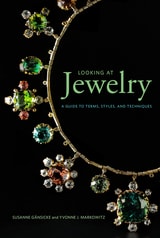
Looking at Jewelry
A Guide to Terms, Styles, and TechniquesSusanne Gänsicke
J. Paul Getty Trust, The, 2019
The fascination with personal adornment is universal. It is a preoccupation that is primal, instinctive, and uniquely human. Jewelry encompasses a seemingly endless number of ornaments produced across time and in all cultures. The range of materials and techniques used in its construction is extraordinary, even revolutionary, with new substances and methods of fabrication added with every generation. In any given society, master artisans have devoted their time, energy, and talent to the fine art of jewelry making, creating some of the most spectacular objects known to humankind.
This volume, geared toward jewelry makers, scholars, scientists, students, and fashionistas alike, begins with a lively introduction that offers a cultural history of jewelry and its production. The main text provides information on the most common, iconic, and culturally significant forms of jewelry and also covers materials, techniques, and manufacturing processes. Containing more than eighty color illustrations, this guide will be invaluable to all those wishing to increase their understanding and enjoyment of the art of jewelry.
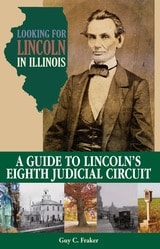
Looking for Lincoln in Illinois
A Guide to Lincoln's Eighth Judicial CircuitGuy C. Fraker
Southern Illinois University Press, 2017
For twenty-three years Abraham Lincoln practiced law on the Eighth Judicial Circuit in east central Illinois, and his legal career is explored in Looking for Lincoln in Illinois: A Guide to Lincoln’s Eighth Judicial Circuit. Guy C. Fraker directs readers and travelers through the prairies to the towns Lincoln visited regularly. Twice a year, spring and fall, Lincoln’s work took him on a journey covering more than four hundred miles. As his stature as a lawyer grew, east central Illinois grew in population and influence, and the Circuit provided Lincoln with clients, friends, and associates who became part of the network that ultimately elevated him to the presidency.
This guidebook to the Circuit features Illinois courthouses, Looking for Lincoln Wayside Exhibits, and other Lincoln points of interest. Fraker guides travelers down the long stretches of quiet country roads that gave Lincoln time to read and think to the locations where Lincoln’s broad range of cases expanded his sense of the economic and social forces changing America.