Results by title
71 books match the query 'Historical Events' and 2 start with l
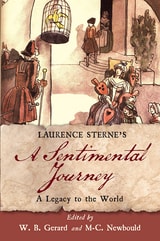
Laurence Sterne’s A Sentimental Journey
A Legacy to the WorldW. B. Gerard
Bucknell University Press, 2021
Laurence Sterne’s A Sentimental Journey through France and Italy continues to be as widely read and admired as upon its first appearance. Deemed more accessible than Sterne’s Life and Opinions of Tristram Shandy, Gentleman, and often assigned as a college text, A Sentimental Journey has received its share of critical attention, but—unlike Tristram Shandy—to date it has not been the subject of a dedicated anthology of critical essays. This volume fills that gap with fresh perspectives on Sterne’s novel that will appeal to students and critics alike. Together with an introduction that situates each essay within A Sentimental Journey’s reception history, and a tailpiece detailing the culmination of Sterne’s career and his death, this volume presents a cohesive approach to this significant text that is simultaneously grounded and revelatory.
[more]
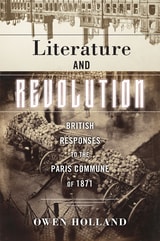
Literature and Revolution
British Responses to the Paris Commune of 1871Owen Holland
Rutgers University Press, 2022
Between March and May 1871, the Parisian Communards fought for a revolutionary alternative to the status quo grounded in a vision of internationalism, radical democracy and economic justice for the working masses that cut across national borders. The eventual defeat and bloody suppression of the Commune resonated far beyond Paris. In Britain, the Commune provoked widespread and fierce condemnation, while its defenders constituted a small, but vocal, minority. The Commune evoked long-standing fears about the continental ‘spectre’ of revolution, not least because the Communards’ seizure of power represented an embryonic alternative to the bourgeois social order.
This book examines how a heterogeneous group of authors in Britain responded to the Commune. In doing so, it provides the first full-length critical study of the reception and representation of the Commune in Britain during the closing decades of the nineteenth century, showing how discussions of the Commune functioned as a screen to project hope and fear, serving as a warning for some and an example to others. Writers considered in the book include John Ruskin, Edward Bulwer-Lytton, Eliza Lynn Linton, Mary Elizabeth Braddon, Anne Thackeray Ritchie, Margaret Oliphant, George Gissing, Henry James, William Morris, Alfred Austin and H.G. Wells. As the book shows, many, but not all, of these writers responded to the Commune with literary strategies that sought to stabilize bourgeois subjectivity in the wake of the traumatic shock of a revolutionary event. The book extends critical understanding of the Commune’s cultural afterlives and explores the relationship between literature and revolution.
This book examines how a heterogeneous group of authors in Britain responded to the Commune. In doing so, it provides the first full-length critical study of the reception and representation of the Commune in Britain during the closing decades of the nineteenth century, showing how discussions of the Commune functioned as a screen to project hope and fear, serving as a warning for some and an example to others. Writers considered in the book include John Ruskin, Edward Bulwer-Lytton, Eliza Lynn Linton, Mary Elizabeth Braddon, Anne Thackeray Ritchie, Margaret Oliphant, George Gissing, Henry James, William Morris, Alfred Austin and H.G. Wells. As the book shows, many, but not all, of these writers responded to the Commune with literary strategies that sought to stabilize bourgeois subjectivity in the wake of the traumatic shock of a revolutionary event. The book extends critical understanding of the Commune’s cultural afterlives and explores the relationship between literature and revolution.
[more]