Results by title
143 books match the query 'History of doctrines' and 7 start with l
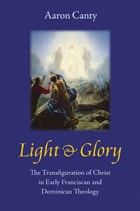
Light and Glory
The Transfiguration of Christ in Early Franciscan and Dominican TheologyAaron Canty
Catholic University of America Press, 2011
Light and Glory offers an engaging comparison of the teachings of seven thirteenth-century theologians -- three Franciscans and four Dominicans -- on the subject of the transfiguration of Christ.
[more]

Logic and Sin in the Writings of Ludwig Wittgenstein
Philip R. Shields
University of Chicago Press, 1992
Philip R. Shields shows that ethical and religious concerns inform even the most technical writings on logic and language, and that, for Wittgenstein, the need to establish clear limitations is both a logical and an ethical demand. Rather than merely saying specific things about theology and religion, major texts from the Tractatus to the Philosophical Investigations express their fundamentally religious nature by showing that there are powers which bear down upon and sustain us. Shields finds a religious view of the world at the very heart of Wittgenstein's philosophy.
"Shields argues that the appearance throughout Wittgenstein's writings of such concepts as ritual, limit, transgression, a change of will, pride, temptation, and judgment implies a relation between religion and the logical aspects of Wittgenstein's philosophy."—Choice
"Of the many recent books about Wittgenstein, Logic and Sin is one of the very few that are well worth having"—Fergus Kerr, Modern Theology
"What Shields has uncovered in Wittgenstein's religious sensibility is something genuine and profound. . . . Shields has not just written an important book on Wittgenstein but an enlightening work that invites further reflection."—Eric O. Springsted, Cross Currents
[more]
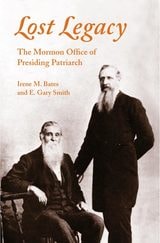
Lost Legacy
THE MORMON OFFICE OF PRESIDING PATRIARCHIrene Bates and E. Gary Smith
University of Illinois Press, 1996
[more]
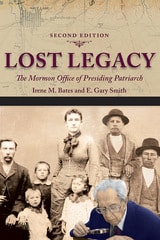
Lost Legacy
The Mormon Office of Presiding PatriarchIrene M. Bates
University of Illinois Press, 2018
Joseph Smith's father, Joseph Smith Sr., first occupied the hereditary office of Presiding Patriarch of the Church of Jesus Christ of Latter-day Saints. Thereafter, it became a focal point for struggle between those appointed and those born to leadership positions. This new edition of Lost Legacy updates the award-winning history of the office. Irene M. Bates and E. Gary Smith chronicle the ongoing tensions around the existence of a Presiding Patriarch as a source of conflict between the Smith family and the rest of the leadership. Their narrative continues through the dawning realization that familial authority was incompatible with the LDS's structured leadership and the decision to abolish the office of Patriarch in 1979. This second edition, revised and supplemented by author E. Gary Smith, includes a new chapter on Eldred G. Smith, the General Authority Emeritus who was the final Presiding Patriarch. It also corrects the text and provides a new preface by E. Gary Smith.
[more]
Love Between Women
Early Christian Responses to Female HomoeroticismBernadette J. Brooten
University of Chicago Press, 1996
Love Between Women examines female homoeroticism and the role of women in the ancient Roman world. Employing an unparalleled range of cultural sources, Brooten finds evidence of marriages between women and establishes that condemnations of female homoerotic practices were based on widespread awareness of love between women.
"An extraordinary accomplishment. . . . A definitive source for all future discussion of homoeroticism and the Bible."—Mary Rose D'Angelo, Harvard Gay & Lesbian Review
"[Brooten's] convincing analysis . . . not only profoundly reshapes our understanding of the past, but it should also shape the way in which that past, particularly the early Christian texts with their immense normative weight, will be used for the future."—Anne L. Clark, Journal of Lesbian Studies
"Love Between Women gives contemporary debates on sexuality a carefully delineated past. It boldly insists upon a different future, one informed by history but not tyrannized by it."—Susan Ackerman, Lambda Book Report
"Fascinating, provocative and lucid. . . . Brooten has made a fundamental contribution to women's and gender studies, gay and lesbian studies, and classics."—Elizabeth A. Castelli, Women's Review of Books
Winner of the Lambda Literary Award for Best Lesbian Studies Book, 1997
[more]
Love Known
Theology and Experience in George Herbert's PoetryRichard Strier
University of Chicago Press, 1983
This book changes the way we read one of the greatest masters of the lyric poem in English. Unlike much recent scholarship on George Herbert, Love Known demonstrates the inseparability of Herbert's theology and poetry. Richard Strier argues persuasively for a strongly Protestant Herbert who shared Luther's sense of the primacy of the doctrine of justification by faith. Cutting across traditional lines, the book is the first sustained study of the theological basis of Herbert's poetry, pointing out connections between Herbert and the Protestant "left" of his own and the following era.
In each chapter, Strier closely analyzes a coherent group of Herbert's lyrics to reveal the theological motives of their movements and design. When placed in a theological context, the poems come into focus in a remarkable way: many hitherto puzzling or unnoticed details are clarified, some neglected poems emerge into prominence, and familiar poems like "Love" (III) and "The Collar" take on new cogency. The chapters build on one another , moving from the darker implications of "faith alone," the insistence on the pervasiveness of sin and pride, to the comforting implications of the doctrine, the assertion of the possibility of freedom from anxiety, and the defense of individual experience.
Love Known thus offers not only a new historical approach to Herbert, but a new appreciation of the relationship between the psychological realism and human appeal of the lyrics and their theological core.
[more]
Love and Saint Augustine
Hannah Arendt
University of Chicago Press, 1995
Hannah Arendt's classic philosophical study, which Kirkus called “a revelation”
Hannah Arendt began her scholarly career with an exploration of Saint Augustine's concept of caritas, or neighborly love, written under the direction of Karl Jaspers and the influence of Martin Heidegger. After her German academic life came to a halt in 1933, Arendt carried her dissertation into exile in France, and years later took the same battered and stained copy to New York. During the late 1950s and early 1960s, as she was completing or reworking her most influential studies of political life, Arendt was simultaneously annotating and revising her dissertation on Augustine, amplifying its argument with terms and concepts she was using in her political works of the same period. The disseration became a bridge over which Arendt traveled back and forth between 1929 Heidelberg and 1960s New York, carrying with her Augustine's question about the possibility of social life in an age of rapid political and moral change.
In Love and Saint Augustine, Joanna Vecchiarelli Scott and Judith Chelius Stark make this important early work accessible for the first time. Here is a completely corrected and revised English translation that incorporates Arendt's own substantial revisions and provides additional notes based on letters, contracts, and other documents as well as the recollections of Arendt's friends and colleagues during her later years.
In Love and Saint Augustine, Joanna Vecchiarelli Scott and Judith Chelius Stark make this important early work accessible for the first time. Here is a completely corrected and revised English translation that incorporates Arendt's own substantial revisions and provides additional notes based on letters, contracts, and other documents as well as the recollections of Arendt's friends and colleagues during her later years.
[more]