Results by title
51 books match the query 'Holocaust survivors' and 4 start with l
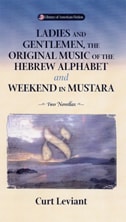
Ladies & Gentleman, The Original Music
Of The Hebrew Alphabet And Weekend In MustarraCurt Leviant
University of Wisconsin Press, 2002
"Ladies and Gentlemen, the Original Music of the Hebrew Alphabet" is set in Budapest during the Communist era. The story focuses on the tenuous seesaw between Dr. Isaac Gantz, a musicologist, and engineer Ferdinand Friedman, a Holocaust survivor who believes that he possesses one of the greatest manuscripts of the ages, a Rosetta Stone of Judaica. Friedman is willing to share it—but there is a "but." In pursuing this prize, Gantz enters a world of strange human relationships filled with doubts and surprises. A vibrant cast of characters adds dimension to this gripping story in which Jewish folklore, music, and history coalesce.
"Weekend in Mustara" unfolds on the fictional island of Mustara in southern Europe, a mountainous, totalitarian country that tolerates Judaism. Its few Jews cling to their heritage, embodied in their beautiful but sparsely attended synagogue and their museum, where a great memorial book is inscribed with the names of all Mustara Jews martyred during World War II. A scholar of medieval Hebrew manuscripts comes to the island, searching for traces of Yehuda Halevi, the great Hebrew poet of the Spanish Golden Age. He is soon enmeshed among elusive personalities and tangled loyalties, but only when he finds himself displaced in time—in a kind of theater of the absurd—are the purposes of his journey finally realized.
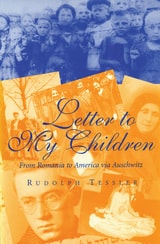
Letter to My Children
From Romania to America via AuschwitzRudolph Tessler
University of Missouri Press, 1999
"Sixty-seven members of my family—my mother, her father, my three sisters, three of my brothers, aunts, uncles, and cousins—were murdered at Auschwitz."
As Rudolph Tessler's mother stepped from the train in Auschwitz, shortly before she was sent to the gas chamber, she heard "Hello, Esther." In a polite tone, a young German SS officer greeted her as he would any old friend. His family lived down the road from the Tessler family in Viseu, their hometown in northern Romania. They, like the rest of the town, admired Esther for her wonderful cooking, particularly the delicious cakes she brought them each Christmas. Now he ushered her and six of her children to their deaths.Throughout Letter to My Children, Tessler offers vivid glimpses of the senselessness that surrounded him during World War II. Of the thousands packed in trains and transported from Viseu to Auschwitz, just a small group survived to see liberation. Among the survivors were Tessler, his father, and two of his brothers. This is the amazing story of their experiences as Hasidic Jews caught in the chaos and terror of the Holocaust.
Tessler's upbringing had emphasized community and family devotion—traits not forgotten in the concentration camps, where he and his family members often rescued one another from certain death. Few fathers and sons survived the concentration camps together. In spite of the odds, Tessler and his brother Buroch managed to stick together, sharing their father's labor assignments to protect him from death, preserving not only their family bond but also their spirituality. Tessler's father, always a source of strength and guidance to his family, provided counsel to many prisoners in the camp and eventually assumed the role of rabbi.
Despite an environment in which their captors tried to reduce them to animals, Tessler's remaining family and seven other Jews from Viseu made a special effort to observe their faith. Bending rules in ways that risked their lives, they worked together to smuggle wheat, grind it into flour, and bake matzos to distribute for Passover. The group also secretly gathered to pray on the eve of Rosh Hashanah. These religious observances offered some comfort in the camp.
In addition to vividly portraying the daily struggles of camp life, Letter to My Children follows Tessler beyond liberation, recounting his days as a displaced person struggling for a new life in the midst of the devastation of postwar Europe, as an American immigrant striving to rebuild his family and succeed in business, and as a philanthropist for education and health care. Recalling the age-old way of life in Viseu that was erased by the Holocaust, this inspiring story conveys the hope, determination, and perseverance that made Tessler a survivor.
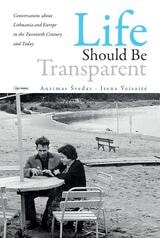
Life should be Transparent
Conversations about Lithuania and Europe in the Twentieth Century and TodayAurimas Svedas
Central European University Press, 2020
This book of thirteen conversations introduces us to the life of an exceptional person—theatre critic, Germanist, and long-time chair of the Open Lithuania Fund board—Irena Veisaitė. The dialogue between Lithuanian historian Aurimas Švedas and a woman who reflects deeply on her experiences reveals both one individual’s historically dramatic life and the fate of Europe and Lithuania in the twentieth century.
Through the complementary lenses of history and memory, we confront with Veisaitė the horrific events of the Holocaust, which brought about the end of the Lithuanian Jewish world. We also meet an array of world-class cultural figures, see fragments of legendary theatre performances, and hear meaningful words that were spoken or heard decades ago.
This book’s interlocutors do not so much seek to answer the question “What was it like?” but instead repeatedly ask each other: “What, how, and why do we remember? What is the meaning of our experiences? How can history help us to live in the present and create the future? How do we learn to understand and forgive?”
A series of Veisaitė’s texts, statements, and letters, presented at the end of the book suggest further ways of answering these questions.
Listening to Survivors
Four Decades of Holocaust Memorial Week at Oregon State UniversityKatherine E. Hubler
Oregon State University Press, 2024
Historian Katherine Hubler has arranged these recollections thematically in chapters centered on discrimination, refuge, resistance, rescue, and transitional justice. These themes align with Oregon’s Holocaust and Genocide Education learning concepts, discussion questions accompany each chapter to facilitate use in classrooms, and the introduction situates the speakers’ diverse experiences within the broader context of World War Two and the Nazis’ genocidal project.
Intended to bring the history of the Holocaust to all Oregonians, Listening to Survivors honors the legacy of outreach work of local survivors and serves as a reminder of the state’s connection to the Holocaust and commitment to genocide education and prevention.