Results by title
125 books match the query 'Human-animal relationships' and 5 start with l
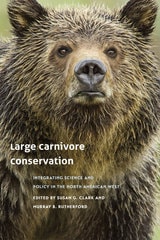
Large Carnivore Conservation
Integrating Science and Policy in the North American WestEdited by Susan G. Clark and Murray B. Rutherford
University of Chicago Press, 2014
In combining real-world examples with discussions of conservation and policy theory, Large Carnivore Conservation not only explains how traditional management approaches have failed to meet the needs of all parties, but also highlights examples of innovative, successful strategies and provides practical recommendations for improving future conservation efforts.

Little Hawk and the Lone Wolf
A MemoirRaymond Kaquatosh
Wisconsin Historical Society Press, 2014
After his father’s death, eight-year-old Ray was sent to an Indian boarding school in Keshena. There he experienced isolation and despair, but also comfort and kindness. Upon his return home, Ray remained a lonely boy in a full house until he met and befriended a lone timber wolf. The unusual bond they formed would last through both their lifetimes. As Ray grew into a young man, he left the reservation more frequently. Yet whenever he returned—from school and work, from service in the Marines, and finally from postwar Wausau with his future wife—the wolf waited.
In this rare first-person narrative of a Menominee Indian’s coming of age, Raymond Kaquatosh shares a story that is wise and irreverent, often funny, and in the end, deeply moving.
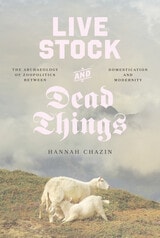
Live Stock and Dead Things
The Archaeology of Zoopolitics between Domestication and ModernityHannah Chazin
University of Chicago Press, 2024
In Live Stock and Dead Things, Hannah Chazin combines zooarchaeology and anthropology to challenge familiar narratives about the role of nonhuman animals in the rise of modern societies. Conventional views of this process tend to see a mostly linear development from hunter-gatherer societies, to horticultural and pastoral ones, to large-scale agricultural ones, and then industrial ones. Along the way, traditional accounts argue that owning livestock as property, along with land and other valuable commodities, introduced social inequality and stratification. Against this, Chazin raises a provocative question: What if domestication wasn’t the origin of instrumentalizing nonhuman animals after all?
Chazin argues that these conventional narratives are inherited from conjectural histories and ignore the archaeological data. In her view, the category of “domestication” flattens the more complex dimensions of humans’ relationship to herd animals. In the book’s first half, Chazin offers a new understanding of the political possibilities of pastoralism, one that recognizes the powerful role herd animals have played in shaping human notions of power and authority. In the second half, she takes readers into her archaeological fieldwork in the South Caucasus, which sheds further light on herd animals’ transformative effect on the economy, social life, and ritual. Appealing to anthropologists and archaeologists alike, this daring book offers a reconceptualization of human-animal relationships and their political significance.
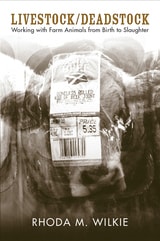
Livestock/Deadstock
Working with Farm Animals from Birth to SlaughterAuthored by Rhoda M. Wilkie
Temple University Press, 2010
The connection between people and companion animals has received considerable attention from scholars. In her original and provocative ethnography Livestock/Deadstock, sociologist Rhoda Wilkie asks, how do the men and women who work on farms, in livestock auction markets, and slaughterhouses, interact with—or disengage from—the animals they encounter in their jobs?
Wilkie provides a nuanced appreciation of how those men and women who breed, rear, show, fatten, market, medically treat, and slaughter livestock, make sense of their interactions with the animals that constitute the focus of their work lives. Using a sociologically informed perspective, Wilkie explores their attitudes and behaviors to explain how agricultural workers think, feel, and relate to food animals.
Livestock/Deadstock looks at both people and animals in the division of labor and shows how commercial and hobby productive contexts provide male and female handlers with varying opportunities to bond with and/or distance themselves from livestock. Exploring the experiences of stockpeople, hobby farmers, auction workers, vets and slaughterers, she offers timely insight into the multifaceted, gendered, and contradictory nature of human roles in food animal production.
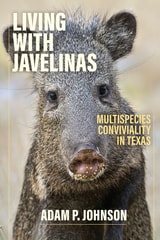
Living with Javelinas
Multispecies Conviviality in TexasAdam P. Johnson
University of Texas Press, 2026
An ethnography on how both humans and javelinas can thrive in shared space.
As human settlements expand into formerly wild lands, coexistence with wildlife is no longer optional––it’s a daily negotiation. In Living with Javelinas, Adam Johnson explores what it means to share space and adapt in a more-than-human world. Often mistaken for wild pigs, javelinas unsettle the boundaries between nuisance and neighbor. Johnson traces the other species that shape their lives––feral hogs, prickly pear, mountain cedar––and examines how folklore, perception, and memory influence human–javelina encounters. Drawing on ethnographic, ecological, and ethological research across Texas, he shows how coexistence becomes a practical, albeit often uneasy, conviviality.
In much of Texas, decades of hunting have made javelinas wary. Through extended time with rancher Roger Gray, who encounters and feeds javelinas daily, Johnson reveals how repeated contact can foster a mutually responsive relationship. Bringing anthropology into dialogue with ecology, Living with Javelinas argues that coexistence is not harmony but an ongoing adjustment. In a time of ecological strain, situated acts of accommodation point toward more ethical and sustainable ways of living together.