433 books match the query 'Immigrants' and 13 start with l
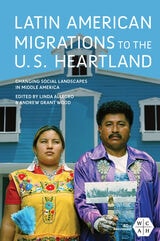
cover of Latin American Migrations to the U.S. Heartland: Changing Social Landscapes in Middle America

Latin American Migrations to the U.S. Heartland

Changing Social Landscapes in Middle America

Edited by Linda Allegro and Andrew Grant Wood

University of Illinois Press, 2019

This collection examines Latina/o immigrants and the movement of the Latin American labor force to the central states of Oklahoma, Kansas, Nebraska, Arkansas, Missouri, and Iowa. Contributors look at outside factors affecting migration, including corporate agriculture, technology, globalization, and government. They also reveal how cultural affinities like religion, strong family ties, farming, and cowboy culture attract these newcomers to the Heartland. Throughout, essayists point to how hostile neoliberal policy reforms have made it difficult for Latin American immigrants to find social and economic stability.

Filled with varied and eye-opening perspectives, Latin American Migrations to the U.S. Heartland reveals how identities, economies, and geographies are changing as Latin Americans adjust to their new homes, jobs, and communities.

Contributors: Linda Allegro, Tisa M. Anders, Scott Carter, Caitlin Didier, Miranda Cady Hallett, Edmund Hamann, Albert Iaroi, Errol D. Jones, Jane Juffer, László J. Kulcsár, Janelle Reeves, Jennifer F. Reynolds, Sandi Smith-Nonini, and Andrew Grant Wood.
[more]
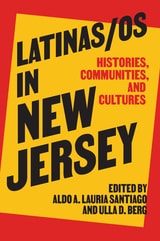
cover of Latinas/os in New Jersey: Histories, Communities, and Cultures

Latinas/os in New Jersey

Histories, Communities, and Cultures

Aldo A. Lauria Santiago

Rutgers University Press, 2025

Since the 1890s, New Jersey has attracted hundreds of thousands of Caribbean and Latin American migrants. The state’s rich economic history, high-income suburbs, and strong public sector have all contributed to attracting, retaining, and setting the stage for Latin American and Caribbean immigrants and secondary-step migrants from New York City. Since the 1980s, however, Latinos have developed a more complex presence in the state’s political landscape and institutions. The emergence of Latino-majority towns and cities and coalition politics facilitated the election of Latino mayors, council persons, and many social and community leaders, as well as the election of statewide officers. This collection brings together innovative and empirically grounded scholarship from different disciplines and interdisciplinary fields of study and addresses topics including the demographic history of Latinos in the state, Latino migration from gateway cities to suburban towns, Latino urban enclaves, Latino economic and social mobility, Latino students and education, the New Jersey Dream Act and in-state tuition act organizing, Latinos and criminal justice reform, Latino electoral politics and leadership, and undocumented communities. 

Contributors: Yamil Avivi; Jennifer Ayala; Ulla D. Berg; Giovani Burgos; Elsa Candelario; Laura Curran; Lilia Fernández; Ismael García Colón; Olga Jiménez de Wagenheim; Benjamin Lapidus; Aldo A. Lauria Santiago; Johana Londoño; Kathleen Lopez; Giancarlo Muschi; Melanie Z. Plasencia; Ana Y. Ramos-Zayas; Elena Sabogal; Raymond Sanchez Mayers; William Suárez Gómez; Alex F. Trillo; Daniela Valdez; Anil Venkatesh; Lyna L. Wiggins
[more]
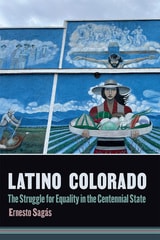
cover of Latino Colorado: The Struggle for Equality in the Centennial State

Latino Colorado

The Struggle for Equality in the Centennial State

Ernesto Sagás

University Press of Colorado, 2026

Mexican Americans and other Latinos make up more than 22 percent of Colorado’s population, play a vital role in its major economic sectors, and are becoming a political force to be reckoned with. Yet most official histories of the state mention them only in passing. Latino Colorado fills this gap in the literature by examining the multifaceted experience of Latinos in Colorado from the nineteenth century to the present, from the old Hispano families of southern Colorado to the new arrivals, and from metro Denver to the state’s rural areas of the Western Slope and Eastern Plains.
 
Author Ernesto Sagás also explores the ways in which Latinos—as a racialized, subordinate group—have historically interacted with Colorado’s Anglo society in carving out their own spaces while struggling for social and legal equality. He presents a demographic and socioeconomic profile of Latinos in Colorado based on field research and the latest US Census data to dispel common stereotypes while also pointing out areas of concern for state policymakers.
 
Latino Colorado sheds light on this marginalized community and advances the understanding of the state’s racialized dynamics. It is about everyone in the American West—Anglos, Latinos, and others—and how they interact with and continue to (re)define one another in real and imagined ways in the most mythologized of American regions.
 
[more]
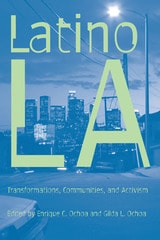
cover of Latino Los Angeles: Transformations, Communities, and Activism

Latino Los Angeles

Transformations, Communities, and Activism

Edited by Enrique C. Ochoa and Gilda L. Ochoa

University of Arizona Press, 2005
As the twenth-first century begins, Latinas/os represent 45 percent of the residents of Los Angeles County, making them the largest racial/ethnic group in the region. At the same time, the shift from manufacturing to a service-based economy in the area has contributed to a decline in good-paying jobs, significantly impacting working class families. These transformations have created a backlash that has included state propositions impacting Latinas/os and escalating anti-immigrant rhetoric—and Latina/os of all backgrounds are making their voices heard. Until recently, most research on Latinas/os in the U.S. has ignored historical and contemporary dynamics in Latin America, just as scholars of Latin America have generally stopped their studies at the border. This volume roots Los Angeles in the larger arena of globalization, exploring the demographic changes that have transformed the Latino presence in LA from primarily Mexican-origin to one that now includes peoples from throughout the hemisphere. Bringing together scholars from a range of disciplines, it combines historical perspectives with analyses of power and inequality to consider how Latinas/os are responding to exclusionary immigration, labor, and schooling practices and actively creating communities. The contributors examine Latina/o Los Angeles in the context of historical, economic and social factors that have shaped the region. The first section provides contexts for understanding Latina/o migration, with chapters focusing on such factors as U.S. economic and military domination, labor and economic integration in the Americas, and Los Angeles’ economic history. The second section considers how various Latina/o groups have settled and formed communities and interacted with the existing Mexican-origin populations, showing how Zapotecs, Salvadorans, and other peoples are remaking urban demographics. The final section on labor organizing and political activism examines the role of Latina/o immigrants in such actions as the janitors’ strike and also considers the contemporary role of students in political activism. The volume concludes with an up-to-date compilation of contemporary scholarship on immigration, the economy, schools, neighborhoods, gender and activism as they relate to Central American and Mexican immigrants. Reflecting a range of methodologies—statistical, historical, ethnographic, and participatory research—this collection is relevant not only to ethnic studies but also to broader concerns in political science, sociology, history, economics, and urban studies. In addition, some chapters focus explicitly on women, and gender issues are interwoven throughout the text. Latino Los Angeles is an important work that contributes to contemporary scholarship on transnationalism as it reexamines the changing face of America’s largest western metropolis.
[more]
cover of Latinos in Michigan

Latinos in Michigan

David A. Badillo

Michigan State University Press, 2003
The history of Latinos in Michigan is one of cultural diversity, institutional formation, and an ongoing search for leadership in the midst of unique, often intractable circumstances. Latinos have shared a vision of the American Dream--made all the more difficult by the contemporary challenge of cultural assimilation. The complexity of their local struggles, moreover, reflects far-reaching developments on the national stage, and suggests the outlines of a common identity. While facing adversity as rural and urban immigrants, exiles, and citizens, Latinos have contributed culturally, economically, and socially to many important developments in Michigan's history.
[more]
cover of Latvians in Michigan

Latvians in Michigan

Silvija D. Meija

Michigan State University Press, 2005

Latvians have contributed to the cultural mosaic and economy of Michigan far more than one might imagine. There are three large Latvian communities in Michigan—Kalamazoo, Detroit, and Grand Rapids—with several smaller enclaves elsewhere in the state. An underlying goal of Latvians who now live in Michigan, as well as other parts of the United States and Canada, is to maintain their language and culture. More than five thousand Latvians came to Michigan after World War II, found gainful employment, purchased homes, and became a part of the Michigan population. Most sought to reeducate themselves and struggled to educate their children in Michigan’s many colleges and universities. Latvians in Michigan examines Latvia and its history, and describes how World War II culminated in famine, death, and eventual flight from their homeland by many Latvian refugees. After the war ended, most Latvian emigrants eventually made their way to Sweden or Germany, where they lived in displaced persons camps. From there, the emigrants were sponsored by individuals or organizations and they moved once again to other parts of the world. Many came to the United States, where they established new roots and tried to perpetuate their cultural heritage while establishing new lives.
[more]
cover of Like Grass before the Scythe: The Life and Death of Sgt. William Remmel 121st New York Infantry

Like Grass before the Scythe

The Life and Death of Sgt. William Remmel 121st New York Infantry

William Remmel

University of Alabama Press, 2007

Uncommonly articulate letters from a young German-American soldier with the Union forces
 
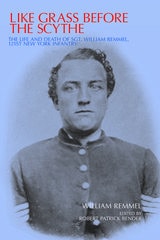
Sergeant William Remmel was a German immigrant who had settled with his parents and family in far upstate New York. His letters collected in Like Grass before the Scythe cover more than two full years of his service and provide details on military and social history in the eastern theater of operations and on the experience of the home front in upstate New York among a largely immigrant, working-class family and community.
 
Remmel wrote in English and apparently his parents responded in German. In addition to the important material on an immigrant family’s experience, Remmel also deals with the question of slavery, illness and hospital care (when he was wounded), the problem of hard war/total war, as well as the campaigns of Chancellorsville, Gettysburg, and the Shenandoah Valley in 1864.
 
[more]
cover of Limits of Citizenship: Migrants and Postnational Membership in Europe

Limits of Citizenship

Migrants and Postnational Membership in Europe

Yasemin Nuhoglu Soysal

University of Chicago Press, 1994

In many Western countries, rights that once belonged solely to citizens are being extended to immigrants, a trend that challenges the nature and basis of citizenship at a time when nation-states are fortifying their boundaries through restirictive border controls and expressions of nationalist ideologies. In this book, Yasemin Soysal compares the different ways European nations incorporate immigrants, how these policies evolved, and how they are influenced by international human rights discourse.

Soysal focuses on postwar international migration, paying particular attention to "guestworkers." Taking an in-depth look at France, Germany, the Netherlands, Sweden, Switzerland, and the United Kingdom, she identifies three major patterns that reflect the varying emphasis particular states place on individual versus corporate groups as the basis for incorporation. She finds that the global expansion and intensification of human rights discourse puts nation-states under increasing outside pressure to extend membership rights to aliens, resulting in an increasingly blurred line between citizen and noncitizen. Finally, she suggests a possible accommodation to these shifts: specifically, a model of post-national membership that derives its legitimacy from universal personhood, rather than national belonging.

This fresh approach to the study of citizenship, rights, and immigration will be invaluable to anyone involved in issues of human rights, international migration, and transnational cultural interactions, as well as to those who study the contemporary transformation of the nation-state, nationalism, and globalization.
[more]
cover of Lincoln and the Immigrant

Lincoln and the Immigrant

Jason H. Silverman

Southern Illinois University Press, 2015

Between 1840 and 1860, America received more than four and a half million people from foreign countries as permanent residents, including a huge influx of newcomers from northern and western Europe, hundreds of thousands of Mexicans who became U.S. citizens with the annexation of Texas and the Mexican Cession, and a smaller number of Chinese immigrants. While some Americans sought to make immigration more difficult and to curtail the rights afforded to immigrants, Abraham Lincoln advocated for the rights of all classes of citizens. In this succinct study, Jason H. Silverman investigates Lincoln’s evolving personal, professional, and political relationship with the wide variety of immigrant groups he encountered throughout his life, revealing that Lincoln related to the immigrant in a manner few of his contemporaries would or could emulate.

From an early age, Silverman shows, Lincoln developed an awareness of and a tolerance for different peoples and their cultures, and he displayed an affinity for immigrants throughout his legal and political career. Silverman reveals how immigrants affected not only Lincoln’s day-to-day life but also his presidential policies and details Lincoln’s opposition to the Know Nothing Party and the antiforeign attitudes in his own Republican Party, his reliance on German support for his 1860 presidential victory, his appointment of political generals of varying ethnicities, and his reliance on an immigrant for the literal rules of war.

Examining Lincoln's views on the place of the immigrant in America’s society and economy, Silverman’s pioneering work offers a rare new perspective on the renowned sixteenth president.
[more]
cover of Lithuanians in Michigan

Lithuanians in Michigan

Marius K. Grazulis

Michigan State University Press, 2009

In Lithuanians in Michigan Marius Grazulis recounts the history of an immigrant group that has struggled to maintain its identity. Grazulis estimates that about 20 percent of the 1.6 million Lithuanians who immigrated to the United States arrived on American shores between 1860 and 1918.
     While first-wave immigrants stayed mostly on the east coast, by 1920 about one-third of newly immigrated Lithuanians lived in Michigan, working in heavy industry and mining.
     With remarkable detail, Grazulis traces the ways these groups have maintained their ethnic identity in Michigan in the face of changing demographics in their neighborhoods and changing interests among their children, along with the challenges posed by newly arriving "modern" Lithuanian immigrants, who did not read the same books, sing the same songs, celebrate the same holidays, or even speak the same language that previous waves of Lithuanian immigrants had preserved in America. Anyone interested in immigrant history will find Lithuanians in Michigan simultaneously familiar, fascinating, and moving.
[more]
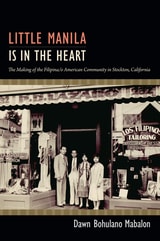
cover of Little Manila Is in the Heart: The Making of the Filipina/o American Community in Stockton, California

Little Manila Is in the Heart

The Making of the Filipina/o American Community in Stockton, California

Dawn Bohulano Mabalon

Duke University Press, 2013

In the early twentieth century—not long after 1898, when the United States claimed the Philippines as an American colony—Filipinas/os became a vital part of the agricultural economy of California's fertile San Joaquin Delta. In downtown Stockton, they created Little Manila, a vibrant community of hotels, pool halls, dance halls, restaurants, grocery stores, churches, union halls, and barbershops. Little Manila was home to the largest community of Filipinas/os outside of the Philippines until the neighborhood was decimated by urban redevelopment in the 1960s. Narrating a history spanning much of the twentieth century, Dawn Bohulano Mabalon traces the growth of Stockton's Filipina/o American community, the birth and eventual destruction of Little Manila, and recent efforts to remember and preserve it.

Mabalon draws on oral histories, newspapers, photographs, personal archives, and her own family's history in Stockton. She reveals how Filipina/o immigrants created a community and ethnic culture shaped by their identities as colonial subjects of the United States, their racialization in Stockton as brown people, and their collective experiences in the fields and in the Little Manila neighborhood. In the process, Mabalon places Filipinas/os at the center of the development of California agriculture and the urban West.
[more]
cover of Living and Dying in São Paulo: Immigrants, Health, and the Built Environment in Brazil

Living and Dying in São Paulo

Immigrants, Health, and the Built Environment in Brazil

Jeffrey Lesser

Duke University Press, 2025

There is a saying in Brazil: “Mosquitoes are democratic: they bite the rich and the poor alike.” Why then is bad health---from violence to respiratory disease, from malaria to dengue---dispersed unevenly across different social and national groups? In Living and Dying in São Paulo, Jeffrey Lesser focuses on the Bom Retiro neighborhood to explore such questions by examining the competing visions of well-being in Brazil among racialized immigrants and policymakers and health officials. He analyzes the fraught relationship between Bom Retiro residents and the state and health care agencies that have overseen community sanitation efforts since the mid-nineteenth century, drawing out the connected systems of the built environment, public health laws and practices, and citizenship. Lesser employs the concept of “residues” to outline how continuing historical material, legislative, and social legacies structure contemporary daily life and health outcomes in the neighborhood. In so doing, Lesser creates a dialogue between the past and the present, showing how the relationship between culture and disease is both layered and interconnected.
[more]
cover of Loyal but French: The Negotiation of Identity by French-Canadian Descendants in the United States

Loyal but French

The Negotiation of Identity by French-Canadian Descendants in the United States

Mark Paul Richard

Michigan State University Press, 2008

By focusing on patterns of immigration and acculturation in a small industrial city in the northeastern United States, Mark Paul Richard offers a noteworthy look at the ways in which French-Canadians negotiated their identity in the United States and provides new insights into the ways in which immigrants "Americanize."
     Richard’s work challenges prevailing notions of "assimilation." As he shows, “acculturation” better describes the roundabout process by which some ethnic groups join their host society. He argues that, for more than a century, the French- Canadians in Lewiston, Maine, pursued the twin objectives of ethnic preservation and acculturation. These were not separate goals but rather intertwined processes. Underscored with statistics compiled by the author, Loyal but French portrays the French-Canadian history of Lewiston, from the 1880s through the 1990s, in this light.
    With a wealth of data, the insights of a professional historian, and the sensitivity of a "local," Richard offers a new conceptualization of ways that immigrants become "Americans."
[more]