Results by title
456 books match the query 'India' and 17 start with l
Landscapes In India
A Sinha
University Press of Colorado, 2006
Landscapes of Accumulation
Real Estate and the Neoliberal Imagination in Contemporary IndiaLlerena Guiu Searle
University of Chicago Press, 2016
In Landscapes of Accumulation, Llerena Guiu Searle examines India’s booming developments and offers a nuanced ethnographic treatment of late capitalism. India’s land, she shows, is rapidly transforming from a site of agricultural and industrial production to an international financial resource. Drawing on intensive fieldwork with investors, developers, real estate agents, and others, Searle documents the new private sector partnerships and practices that are transforming India’s built environment, as well as widely shared stories of growth and development that themselves create self-fulfilling prophecies of success. As a result, India’s cities are becoming ever more inaccessible to the country’s poor. Landscapes of Accumulation will be a welcome contribution to the international study of neoliberalism, finance, and urban development and will be of particular interest to those studying rapid—and perhaps unsustainable—development across the Global South.

Late Colonial Sublime
Neo-Epics and the End of RomanticismG. S. Sahota
Northwestern University Press, 2018
By bringing together distinct literary canons—both metropolitan and colonial, hegemonic and subaltern, Western and Eastern, all of which took shape upon the common realities of imperial capitalism—Late Colonial Sublime takes an original dialectical approach. It experiments with fragments, parallaxes, and constellational form to explore the aporias of modernity as well as the possible futures they may signal in our midst. A bold intervention into contemporary debates that synthesizes a wealth of sources, this book will interest readers and scholars in world literature, critical theory, postcolonial criticism, and South Asian studies.

Laughing Matters
Comic Tradition in IndiaLee Siegel
University of Chicago Press, 1987
This question, so solemnly posed by the young Buddha, first led Lee Siegel to examine the hitherto unexplored realm of Indian comedy. Laughing Matters is Siegel's account of two intersecting journeys: a search for comic traditions created and preserved in Sanskrit literature and a journey through modern India in quest of a laughter that persists across time and culture.
Hearing a boisterous and bawdy voice from India's past, Siegel has provided original and highly entertaining translations of Sanskrit literature that reveal a sparkling sensibility embedded in the texts. These translations are integrated with a detailed analysis of the types and structures of India's mirth. Siegel develops an original theory of comedy and laughter, applying it to reveal the humor in the ancient works. Defining sacred and profane comedy and the "taste" and "erotics" of laughter, he delineates two main Indian categories of comedy—laughter at others and laughter at oneself—which are roughly parallel to the Western traditions of satire and humor. He examines these categories in all of their forms and functions: satires of manners, social satire, and religious satire; and human and divine comedy. Siegel concludes by presenting his perceptions of humor in modern India as seen through cartoons, movies, books, and social gatherings.
Laughing Matters is both a serious and a hilarious study of the Indian comic sense of life—a vision formed in the convergence of the bitter insight of satire and the sweet outlook of humor. Past and present, the contextual and the universal, scholarship and the picaresque, are all interwoven in this original treatise on the aesthetics of comedy and the psychology of laughter.
Law and the Economy in Colonial India
Tirthankar Roy and Anand V. Swamy
University of Chicago Press, 2021
Tirthankar Roy and Anand V. Swamy trace the beginnings of the current Indian legal system to the years of British colonial rule. They show how India inherited an elaborate legal system from the British colonial administration, which incorporated elements from both British Common Law and indigenous institutions. In the case of property law, especially as it applied to agricultural land, indigenous laws and local political expediency were more influential in law-making than concepts borrowed from European legal theory. Conversely, with commercial law, there was considerable borrowing from Europe. In all cases, the British struggled with limited capacity to enforce their laws and an insufficient knowledge of the enormous diversity and differentiation within Indian society. A disorderly body of laws, not conducive to production and trade, evolved over time. Roy and Swamy’s careful analysis not only sheds new light on the development of legal institutions in India, but also offers insights for India and other emerging countries through a look at what fosters the types of institutions that are key to economic growth.
Law and the Economy in a Young Democracy
India 1947 and BeyondTirthankar Roy and Anand V. Swamy
University of Chicago Press, 2022
Economists have long lamented how the inefficiency of India's legal system undermines the country’s economic capacity. How has this come to be? The prevailing explanation is that the postcolonial legal system is understaffed and under-resourced, making adjudication and contract enforcement slow and costly.
Taking this as given, Law and the Economy in a Young Democracy examines the contents and historical antecedents of these laws, including how they have stifled economic development. Economists Roy and Swamy argue that legal evolution in independent India has been shaped by three factors: the desire to reduce inequality and poverty; the suspicion that market activity, both domestic and international, can be detrimental to these goals; and the strengthening of Indian democracy over time, giving voice to a growing fraction of society, including the poor.
Weaving the story of India's heralded economic transformation with its social and political history, Roy and Swamy show how inadequate legal infrastructure has been a key impediment to the country's economic growth during the last century. A stirring and authoritative history of a nation rife with contradictions, Law and the Economy in a Young Democracy is essential reading for anyone seeking to understand India's current crossroads—and the factors that may keep its dreams unrealized.
Learning to Live with the Past
Krishna Kumar
Seagull Books, 2023
How does education shape political rivalry and hostility? The Partition of the Indian subcontinent in 1947—the violence that followed it, and its living legacy of rival nationalisms—has made a deep and pervasive impact on education in both India and Pakistan. In Learning to Live with the Past, educationist Krishna Kumar dwells on the complex terrain every history teacher has to navigate: how to make the past come alive without running the risk of creating a desire to lose this “pastness.”
Substantiating this question with a wealth of experiences gained from his extensive research on history textbooks, as well as his interactions with students and teachers in both countries, Kumar explores the integral function the discipline of history plays in the project of nation-building. To help children learn to live with the past, Kumar amplifies the need for spaces that create possibilities for inquiries into a “longer” common heritage shared by South Asia without necessarily denying a national narrative or encouraging an urge to undo the past.
Liberalization's Children
Gender, Youth, and Consumer Citizenship in Globalizing IndiaRitty A. Lukose
Duke University Press, 2009
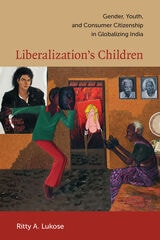
Moving beyond elite figurations of globalizing Indian youth, Lukose draws on ethnographic research to examine how non-elite college students in the southern state of Kerala mediate region, nation, and globe. Kerala sits at the crossroads of development and globalization. Held up as a model of left-inspired development, it has also been transformed through an extensive and largely non-elite transnational circulation of labor, money, and commodities to the Persian Gulf and elsewhere. Focusing on fashion, romance, student politics, and education, Lukose carefully tracks how gender, caste, and class, as well as colonial and postcolonial legacies of culture and power, affect how students navigate their roles as citizens and consumers. She explores how mass-mediation and an expanding commodity culture have differentially incorporated young people into the structures and aspirational logics of globalization.

Lifelines
The Traffic of TraumaHarris Solomon
Duke University Press, 2022

Limiting Secularism
The Ethics of Coexistence in Indian Literature and FilmPriya Kumar
University of Minnesota Press, 2008
With a backdrop of religious violence and escalating regional tensions in South Asia, Priya Kumar’s Limiting Secularism probes the urgent topic of secularism and tolerance in Indian culture and life. Kumar explores Partition as the founding trauma of the Indian nation-state and traces the consequences of its marking off of “Indian” from “Pakistani” and the positioning of Indian Muslims as strangers within the nation.
Kumar unpacks the implications of the Nehruvian doctrine of tolerance-with all of its resonances of condescension and inequality-and asks whether more ethical cohabitation can replace the “arrogant compulsive tolerance” of the state and the majority. Informed by Jacques Derrida’s recent work on hospitality and living together, Kumar argues for the emergence of an “ethics of coexistence” in Indian fiction and film. Considering narratives ranging from the cosmopolitan English novels of Rushdie and Ghosh to literature in South Asian languages as well as recent Hindi cinema, Kumar demonstrates that these fictions are important resources for reimagining tolerance and coexistence.
Distinctive and timely in its investigation of secularism and communalism, Limiting Secularism works to envision the radical possibilities of going beyond tolerance to living well together.
Priya Kumar is associate professor of English at the University of Iowa.

Living Class in Urban India
Dickey, Sara
Rutgers University Press, 2016
Many Americans still envision India as rigidly caste-bound, locked in traditions that inhibit social mobility. In reality, class mobility has long been an ideal, and today globalization is radically transforming how India’s citizens perceive class. Living Class in Urban India examines a nation in flux, bombarded with media images of middle-class consumers, while navigating the currents of late capitalism and the surges of inequality they can produce.
This book is also freely available online as an open-access digital edition, published with the support of the National Endowment for the Humanities.

Living Worth
Value and Values in Global Pharmaceutical MarketsStefan Ecks
Duke University Press, 2022
Living without the Dead
Loss and Redemption in a Jungle CosmosPiers Vitebsky
University of Chicago Press, 2017
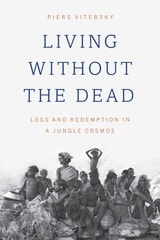
Today, young Sora are rejecting the worldview of their ancestors and switching their allegiance to warring sects of fundamentalist Christianity or Hinduism. Communion with ancestors is banned as sacred sites are demolished, female shamans are replaced by male priests, and debate with the dead gives way to prayer to gods. For some, this shift means liberation from jungle spirits through literacy, employment, and democratic politics; others despair for fear of being forgotten after death.
How can a society abandon one understanding of reality so suddenly and see the world in a totally different way? Over forty years, anthropologist Piers Vitebsky has shared the lives of shamans, pastors, ancestors, gods, policemen, missionaries, and alphabet worshippers, seeking explanations from social theory, psychoanalysis, and theology. Living without the Dead lays bare today’s crisis of indigenous religions and shows how historical reform can bring new fulfillments—but also new torments and uncertainties.
Vitebsky explores the loss of the Sora tradition as one for greater humanity: just as we have been losing our wildernesses, so we have been losing a diverse range of cultural and spiritual possibilities, tribe by tribe. From the award-winning author of The Reindeer People, this is a heartbreaking story of cultural change and the extinction of an irreplaceable world, even while new religious forms come into being to take its place.
Logics of Empowerment
Development, Gender, and Governance in Neoliberal IndiaAradhana Sharma
University of Minnesota Press, 2008
A critical look at the globally dominant development strategy of “empowerment”
Celebratory news features about India’s thriving middle class tell only part of the story of the country’s recent economic rise, frequently glossing over the 300 million Indians who live on the margins and struggle to survive under economic liberalization. How do those cast out of their country’s successes perceive and respond to their position and mobilize against disempowerment?
In Logics of Empowerment, Aradhana Sharma takes up these questions, focusing on the work of an innovative women’s program called Mahila Samakhya that is part governmental and part nongovernmental and strives to empower those rural Indian women who have been pushed aside. She details the awkward ideological articulations and paradoxical outcomes of this unique activist-cum-government organizational structure and usage of empowerment. Bringing much-needed specificity to the study of neoliberalism, Logics of Empowerment fosters a deeper understanding of development and politics in contemporary India.
Long Live the Counter-Revolution
Hawa Hawa' and Other StoriesNabarun Bhattacharya
Seagull Books, 2022
In this wildly inventive collection of Nabarun Bhattacharya’s stories, we meet characters such as a trigger-happy cop in an authoritarian police state, a man who holds on to a piece of rope from a deadly noose, a retired revolutionary thrilled by delusions of grandeur, and people working for a corporation that arranges lavish suicides for a price. Ranging from scathing satires of society to surreal investigations of violence and love, these stories are also a window onto the political and social climate in Bengal, tracing both pan-Indian developments like the 1975 Emergency and local ones like militant-leftist Naxalism and the decades-long Communist reign in the state. Expertly translated from the Bengali, Hawa Hawa and Other Stories is a journey through the mind of one of the most daring countercultural writers of India, one with particular resonance in these chaotic times.

Love and Reparation
A Theatrical Response to the Section 377 Litigation in IndiaDanish Sheikh
Seagull Books, 2021
On September 6, 2018, a decades-long battle to decriminalize queer intimacy in India came to an end. The Supreme Court of India ruled that Section 377, the colonial anti-sodomy law, violated the country’s constitution. “LGBT persons,” the Court said, “deserve to live a life unshackled from the shadow of being ‘unapprehended felons.’” But how definitive was this end? How far does the law’s shadow fall? How clear is the line between the past and the future? What does it mean to live with full sexual citizenship?
In Love and Reparation, Danish Sheikh navigates these questions with a deft interweaving of the legal, the personal, and the poetic. The two plays in this volume leap across court transcripts, affidavits (real and imagined), archival research, and personal memoir. Through his re-staging, Sheikh crafts a genre-bending exploration of a litigation battle, and a celebration of defiant love that burns bright in the shadow of the law.
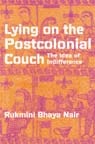
Lying On The Postcolonial Couch
The Idea Of IndifferenceRukmini Bhaya Nair
University of Minnesota Press, 2002
Exposes the complicity of language and its uses in the colonial project
A revealing look into the long afterlife of colonial conquest, Lying on the Postcolonial Couch offers an original, overarching concept that informs—and helps to explain—the workings of postcoloniality. This concept, "indifference," is a play on the key critical term "difference." Indifference is a cognitive stance invented during the colonial period for the purpose of organizing the complex domain of the Indian subcontinent, one that created its own brand of poetics. Considering postcoloniality as a symptomatic condition, this book proposes a cure involving a return to buried memories of colonial trauma before the phenomenon itself succumbs to the absolute indifference of the slowly gathering amnesia of the new millennium.
Rukmini Bhaya Nair traces a paper trail beginning in 1757 with the Battle of Plassey, winding through the contentious Mutiny of 1857, and ending with Salman Rushdie’s Satanic Verses predicament. Along this trail, she uncovers hidden residues of feeling, from guilt and mistrust to wonder and pleasure, and analyzes the linguistic pillars that hold up the institution of bureaucratic indifference that she exposes.