Results by title
200 books match the query 'Indians of Mexico' and 5 start with l
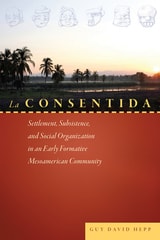
La Consentida
Settlement, Subsistence, and Social Organization in an Early Formative Mesoamerican CommunityGuy David Hepp
University Press of Colorado, 2019
La Consentida explores Early Formative period transitions in residential mobility, subsistence, and social organization at the site of La Consentida in coastal Oaxaca, Mexico. Examining how this site transformed during one of the most fundamental moments of socioeconomic change in the ancient Americas, the book provides a new way of thinking about the social dynamics of Mesoamerican communities of the period.
Guy David Hepp summarizes the results of several seasons of fieldwork and laboratory analysis under the aegis of the La Consentida Archaeological Project, drawing on various forms of evidence—ground stone tools, earthen architecture, faunal remains, human dental pathologies, isotopic indicators, ceramics, and more— to reveal how transitions in settlement, subsistence, and social organization at La Consentida were intimately linked. While Mesoamerica is too diverse for research at a single site to lay to rest ongoing debates about the Early Formative period, evidence from La Consentida should inform those debates because of the site’s unique ecological setting, its relative lack of disturbance by later occupations, and because it represents the only well-documented Early Formative period village in a 300-mile stretch of Mexico’s Pacific coast.
One of the only studies to closely document multiple lines of evidence of the transition toward a sedentary, agricultural society at an individual settlement in Mesoamerica, La Consentida is a key resource for understanding the transition to settled life and social complexity in Mesoamerican societies.
Legacies of The Basin of Mexico
Carlos E. Cordova
University Press of Colorado, 2023
More than four decades after that book’s publication, the fourteen contributions in this volume review and analyze its theoretical and methodological influence in light of recent research across disciplines. Among a spectrum of authors representing several generations are those who participated directly in the Basin of Mexico surveys—including the late Jeffrey R. Parsons—as well as those who have been actively working on recent projects in the basin and neighboring regions.
Providing a broad and multidisciplinary perspective of the present and future state of research in the area, The Legacies of The Basin of Mexico will be of interest to Mesoamerican and Latin American archaeologists as well as geographers, geologists, historians, and specialists in the study of past environments.
Contributors: Guillermo Acosta Ochoa, Aleksander Borejsza, Destiny Crider, Charles Frederick, Raúl García-Chávez, Larry Gorenflo, Angela Huster, Georgina Ibarra Arzave, Charles Kolb, Frank Lehmkuhl, Abigail Meza Peñaloza, Emily McClung de Tapia, John K. Millhauser, Deborah Nichols, Jeffrey R. Parsons, Serafin Sánchez Pérez, Philipp Schulte, Sergey Sedov, Elizabeth Solleiro Rebolledo, Daisy Valera Fenández, Federico Zertuche
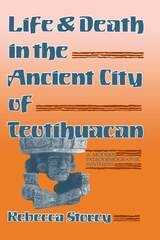
Life and Death in the Ancient City of Teotihuacan
A Modern Paleodemographic SynthesisRebecca Storey
University of Alabama Press, 1992
Cities arose independently in both the Old World and in the pre-Columbian New World. Lacking written records, many of these New World cities can be studied only through archaeology, including the earliest pre-Columbian city, Teotihuacan, Mexico, one of the largest cities of its time (150 B.C. to A.D. 750). Thus, an important question is how similar New World cities are to their Old World counterparts.
Before recent times, the dense populations of cities made them unhealthy places because of poor sanitation and inadequate food supplies. Storey's research shows clearly that although Teotihuacan was a very different environment and culture from 17th-century London, these two great cities are comparable in terms of health problems and similar death rates.
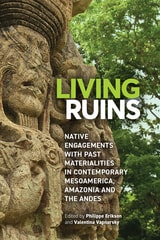
Living Ruins
Native Engagements with Past Materialities in Contemporary Mesoamerica, Amazonia, and the AndesPhilippe Erikson
University Press of Colorado, 2022
Ten case studies from the Maya region, Amazonia, and the Andes detail and contextualize narratives, rituals, and a range of practices and attitudes toward different kinds of vestiges. The chapters engage with recently debated issues such as regimes of historicity and knowledge, cultural landscapes, conceptions of personhood and ancestrality, artifacts, and materiality. They focus on Indigenous perspectives rather than mainstream narratives such as those mediated by UNESCO, Hollywood, travel agents, and sometimes even academics. The contributions provide critical analyses alongside a multifaceted account of how people relate to the place/time nexus, expanding our understanding of different ontological conceptualizations of the past and their significance in the present.
Living Ruins adds to the lively body of work on the invention of tradition, Indigenous claims on their lands and history, “retrospective ethnogenesis,” and neo-Indianism in a world where tourism, NGOs, and Western essentialism are changing Indigenous attitudes and representations. This book is significant to anyone interested in cultural heritage studies, Amerindian spirituality, and Indigenous engagement with archaeological sites in Latin America.
Contributors: Cedric Becquey, Laurence Charlier Zeineddine, Marie Chosson, Pablo Cruz, Philippe Erikson, Antoinette Molinié, Fernando Santos-Granero, Emilie Stoll, Valentina Vapnarsky, Pirjo Kristiina Virtanen
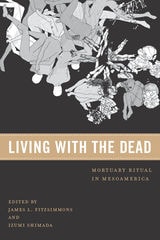
Living with the Dead
Mortuary Ritual in MesoamericaEdited by James L. Fitzsimmons and Izumi Shimada
University of Arizona Press, 2011
This book results from a symposium organized by the editors for an annual meeting of the Society for American Archaeology. The contributors employ historical sources, comparative art history, anthropology, and sociology, as well as archaeology and anthropology, to uncover surprising commonalities across cultures, including the manner in which the dead were politicized, the perceptions of reciprocity between the dead and the living, and the ways that the dead were used by the living to create, define, and renew social as well as family ties. In exploring larger issues of a “good death” and the transition from death to ancestry, the contributors demonstrate that across Mesoamerica death was almost never accompanied by the extinction of a persona; it was more often the beginning of a social process than a conclusion.