Results by title
173 books match the query 'Ireland' and 6 start with l
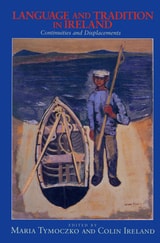
Language and Tradition in Ireland
Continuities and DisplacementsMaria Tymoczko
University of Massachusetts Press, 2003
If language and culture are intimately connected, then cultures involving people who speak more than one language must have special characteristics, as well as particular social issues to negotiate. What are the challenges faced by a people with two or more languages as their heritage? How does that multiple heritage affect cultural forms, including literature and the arts? How does linguistic difference influence the conceptualization and writing of history? And if the meeting of languages within a people has involved contestation and power, how are those conflicts negotiated?
This volume uses the tools of critical theory to explore such questions with respect to the complex, multilingual history of Ireland. Avoiding the simplistic polarized oppositions popular with cultural nationalists, the contributors examine the nexus of language, tradition, and authority in Ireland that has created such a rich, multivalent culture.
Although the linguistic interface of Irish and English has dominated cultural negotiations in Ireland over the last five hundred years, the island has an even longer history of linguistic and cultural exchange. Arguing that tradition is never static, the essays in this volume challenge the concept of a monolithic cultural origin, while insisting on the importance of inherited discourses in the continuity of culture through time and across linguistic difference. The chapters cover a broad range of topics from early Irish narratives and Latin hagiography to literary works by such writers as Yeats, Joyce, Friel, Montague, and McGahern, as well as other cultural forms, including traditional Irish music. Several chapters address issues of politics and power, from the role of interpreters in the relations between linguistic communities in Ireland to the politicization of language in Northern Ireland since the 1980s. Taken together, the essays illuminate scholarly domains as varied as postcolonial theory, the relationship between language and nation, the nature of tradition, and Irish literature of all periods.
In addition to the editors, contributors include Michael Cronin, Joanne Findon, Helen Fulton, Declan Kiberd, Jeremy Lowe, Gordon McCoy and Camille O'Reilly, Catherine McKenna, Cóilín Owens, Thomas Dillon Redshaw, and Sally K. Sommers Smith.
Language, Power, and Resistance
Mainstreaming Deaf EducationElizabeth S. Mathews
Gallaudet University Press, 2017
The research upon which this book is based examined the implications that mainstreaming has for the tensions between the hegemonic medical model of deafness and the social model of Deafness. This volume explores how different types of power are used in the deaf education system to establish, maintain, and also resist medical views of deafness. Mathews frames this discussion as one of power relations across parents, children, and professionals working within the system. She looks at how various forms of power are used to influence decisions, to resist decisions, and to shape the structure and delivery of deaf education. The author’s findings are a significant contribution to the debates on inclusive education for DHH students and will resonate in myriad social and geographic contexts.

Language, Resistance and Revival
Republican Prisoners and the Irish Language in the North of IrelandFeargal Mac Ionnrachtaigh
Pluto Press, 2013
Language, Resistance and Revival tells the untold story of the truly groundbreaking linguistic and educational developments that took place among Republican prisoners in Long Kesh prison from 1972-2000.
During a period of bitter struggle between Republican prisoners and the British state, the Irish language was taught and spoken as a form of resistance during incarceration. The book unearths this story for the first time and analyses the rejuvenating impact it had on the cultural revival in the nationalist community beyond the prison walls.
Based on unprecedented interviews, Feargal Mac Ionnrachtaigh explores a key period in Irish history through the original and 'insider' accounts of key protagonists in the contemporary Irish language revival.

Latin American and Caribbean Library Resources in the British Isles
A DirectoryAlan Biggins and Valerie Cooper
University of London Press, 2001
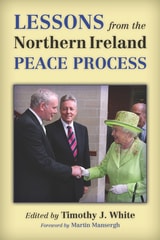
Lessons from the Northern Ireland Peace Process
Edited by Timothy J. White; Foreword by Martin Mansergh
University of Wisconsin Press, 2013
Love in the Lav
A Social Biography of Same-Sex Desire in Ireland, 1922-1972Averill Earls
Temple University Press, 2025
Earls uses courtroom testimonies, police records, and family history archives as well as “educated speculation” to show how structures governing male same-sex desire in Ireland played out on the bodies of the men who desired men, the teen boys who sold sex to men, and the way the Catholic-nationalist ethos shaped the Gardaí who policed them.
Love in the Lav examines the experiences of people such as cabbie James Hand, who was put on trial for gross indecency, to provide a window into the queer working-class subculture of 1930s Dublin. Earls also focuses on issues of consent, especially with teens, and the unregulated queer Irish world of public figures, including Micheál Mac Liammóir, Hilton Edwards, Ronald Brown, and John Broderick.
By examining twentieth-century Ireland through the lived experiences of ordinary same-sex-desiring Irish men who were relegated to obscurity by Irish society, Earls reveals the contradictions, possibilities, and magnitude of postcolonial Irish Catholic nationalism.
In the series Sexuality Studies