Results by title
110 books match the query 'Italian' and 8 start with l
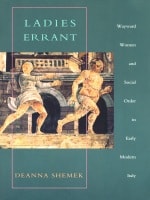
Ladies Errant
Wayward Women and Social Order in Early Modern ItalyDeanna Shemek
Duke University Press, 1998
Seeing errancy as an act of resistance rather than of error, Shemek carries her study beyond the didactic and prescriptive literature on femininity in early modern Italy to an arena in which theories about femininity are considered jointly with real and fictional instances of women’s waywardness. As prostitutes, warriors, lovers, and poets, the women of Shemek’s study are found in canonical texts, marginal works, and popular artistic activity, appearing, for instance, in literature, paintings, legal proceedings, and accounts of public festivals. By juxtaposing these varied places of errancy—from Ariosto’s chivalric Orlando furioso to the prostitutes’ race in the Palio di San Giorgio—Shemek points to the important contact between elite and popular cultures in early modernity, revealing the strength and flexibility of a gender boundary fundamental to early modern conceptions of social order.
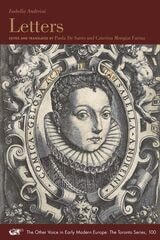
Letters
Isabella Andreini
Iter Press, 2023
Isabella Andreini (1562–1604) was a commedia dell’arte diva who toured Italy and France as part of the Compagnia dei Comici Gelosi. Letters is a collection of epistles written by Andreini in fictional, anonymous, male, and female voices, a “hermaphroditic” alternation of gender unlike any that had been seen in letter writing to that time. In her letters, Andreini remade the humanistic epistolary genre into a distinctive fusion of literary and dramatic performance. The guise of epistolary intimacy cedes to a knowing artificiality, which allows for the emergence of Andreini’s modern critique of the gendered self as a uniform entity. The collection centers on love and examines—from surprising perspectives—pertinent issues such as death, the birth of a girl, prostitution, patriarchal marital practices, love in old age, courtiership, country and city life, human nature, and defenses and critiques of both sexes.
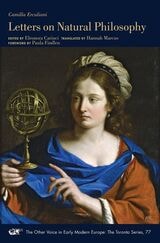
Letters on Natural Philosophy
The Scientific Correspondence of a Sixteenth-Century Pharmacist, with Related TextsCamilla Erculiani
Iter Press, 2020
This edition presents the first full English translation of Erculiani’s book and other relevant texts, bringing to light the cultural context and scientific thought of this unique natural philosopher.
Letters to Francesco Datini
Margherita Datini
Iter Press, 2012
—Jane Tylus
Professor of Italian Studies and vice provost for academic affairs, New York University
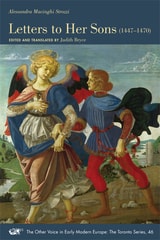
Letters to Her Sons, 1447–1470
Alessandra Macinghi Strozzi
Iter Press, 2016
The seventy-three surviving letters written by Florentine widow, Alessandra Macinghi Strozzi (c.1406–1471), to her distant sons first appeared in print well over a century ago, but are here translated into English in their entirety for the first time. Whether for the professional historian or for the general reader interested in Renaissance Florence, they constitute a most precious testimony regarding both private and public life in the mid-fifteenth century, with themes ranging from familial relations, motherhood, marriage, and aspects of material culture to the harsh realities of political exile meted out by the Medici to their perceived opponents, these latter including her husband and, subsequently, her sons.
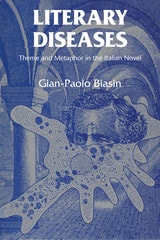
Literary Diseases
Theme and Metaphor in the Italian NovelBy Gian-Paolo Biasin
University of Texas Press, 1975
Disease—real or imagined, physical or mental—is a common theme in Western literature and is often a symbol of modern alienation. In Literary Diseases, a comprehensive analysis of the metaphorical and symbolic force of disease in modern Italian literature, Gian-Paolo Biasin expands the geography of the discussion of this important theme. Using as a backdrop the perspective of European experiences of the previous hundred years, Biasin analyzes the theme of disease as a reflection of certain sociological and historical phenomena in modern European novels, as a metaphor for the world visions of selected Italian novelists, and especially as a vehicle for understanding the nature and function of fiction itself.
The core of Biasin’s study is found in his discussion of the works of four major Italian writers. In his criticism of the novels of Giovanni Verga, who stood at the center of many complex developments in the nineteenth century, he examines the antecedents of modern Italian prose. He then scrutinizes the works of Italo Svevo and Luigi Pirandello, who together inaugurated the modern novel in Italy. Of particular interest is his exploration of their critical use of psychoanalysis and madness climaxed by apocalyptic visions. He then discusses the prose of Carlo Emilio Gadda, which epitomizes the problems of the avant-garde in its experimentalism and expressionism.
Biasin utilizes a broad spectrum of critical approaches—from sociology, psychoanalysis, and different trends in modern French, American, and Italian literary criticism—in shaping his own methodology, which is a thematic and structural symbolism. He concludes that disease in literature should be considered as a metaphor for writing (écriture) and as a cognitive instrument that calls into question the anthropocentric values of Western culture. The book, with its textual comparisons and unusual supporting examples, constitutes a significant methodological contribution as well as a major survey of modern Italian prose, and will allow the reader to see traditional landmarks in European fiction in a new light.
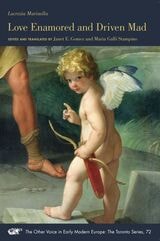
Love Enamored and Driven Mad
Lucrezia Marinella
Iter Press, 2020
The Other Voice in Early Modern Europe - The Toronto Series, volume 72
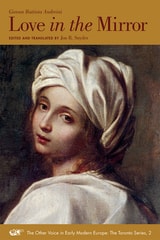
Love in the Mirror
A Bilingual EditionGiovan Battista Andreini
Iter Press, 2009
Originally published in 1622, Love in the Mirror tells the unforgettable and path-breaking story of a passionate love affair between two women in early modern Florence. Despite the risk of social sanctions, Florinda and Lidia freely consent to love each other “breast to breast and mouth to mouth,” with some surprising consequences for the institution of marriage.
This bilingual edition of the play introduces the English-speaking reader to one of the most remarkable creative artists of the Baroque age, Giovan Battista Andreini (1576–1654). Actor, playwright, and son of the first great diva of the European stage, Isabella Andreini, Giovan Battista was renowned in his lifetime as an avant-garde theatrical innovator. While drawing on the Italian commedia dell’arte, his comedies go far beyond its limits in order— like Calderón, Corneille and Shakespeare—to subvert traditional views of the relationship between art and life, representation and reality.
Love in the Mirror, which was lost from view for centuries, is here translated for the first time into a highly accessible and fully annotated English version. The volume includes a wideranging introduction to this experimental comic masterpiece, as well as to the life and works of G.B. Andreini.