Results by title
73 books match the query 'Jazz musicians' and 6 start with l
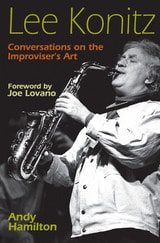
Lee Konitz
Conversations on the Improviser's ArtAndy Hamilton
University of Michigan Press, 2007
“Meticulously researched, detailed and documented, this long awaited overview justly establishes Konitz as one of the most consistently brilliant, adventurous and original improvisers in the jazz tradition—a genius as rare as Bird himself.”
—John Zorn
“Hamilton’s work may well mark the inception of a format new to writing on Western music, one which avoids both the self-aggrandizing of autobiography and the stylized subjectification of biography.”
—The Wire
“An extraordinary approach to a biography, with the man himself speaking for extended sessions. The main vibration I felt from Lee’s words was total honesty, almost to a fault. Konitz shows himself to be an acute observer of the scene, full of wisdom and deep musical insights, relevant to any historical period regardless of style. The asides by noted musicians are beautifully woven throughout the pages. I couldn’t put the book down—it is the definition of a living history.”
—David Liebman
The preeminent altoist associated with the “cool” school of jazz, Lee Konitz was one of the few saxophonists of his generation to forge a unique sound independent of the influence of Charlie Parker. In the late 1940s, Konitz began his career with the Claude Thornhill band, during which time he came into contact with Miles Davis, with whom he would later work on the legendary Birth of the Cool sessions. Konitz is perhaps best known through his association with Lennie Tristano, under whose influence much of his sound evolved, and for his work with Stan Kenton and Warne Marsh. His recordings have ranged from cool bop to experimental improvisation and have appeared on such labels as Prestige, Atlantic, Verve, and Polydor.
Crafted out of numerous interviews between the author and his subject, the book offers a unique look at the story of Lee Konitz’s life and music, detailing Konitz’s own insights into his musical education and his experiences with such figures as Miles Davis, Stan Kenton, Warne Marsh, Lennie Tristano, Charles Mingus, Bud Powell, and Bill Evans.
Andy Hamilton is a jazz pianist and contributor to major jazz and contemporary music magazines. He teaches philosophy, and the history and aesthetics of jazz, at Durham University in the United Kingdom. He is also the author of the book Aesthetics and Music (Continuum 2007).
Joe Lovano is a Grammy Award–winning tenor saxophonist. His most recent album is Streams of Expression.
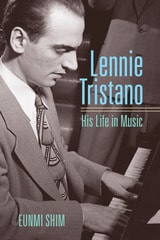
Lennie Tristano
His Life in MusicEunmi Shim
University of Michigan Press, 2007
“In Lennie Tristano: His Life in Music, Shim has provided a comprehensive biographical and analytical account of one of jazz’s most important and most frequently misunderstood figures. Her insights into Tristano’s personality are well nuanced, and the focus on his teaching makes a unique contribution to the history of jazz. This vividly written study is likely to become a standard work.”
—Brian Priestley, author of Chasin’ the Bird: The Life and Legacy of Charlie Parker and coauthor of The Rough Guide to Jazz
“Eunmi Shim’s book is clearly a labor of love. Her thorough examination of Tristano’s teaching is particularly important, for no one previously has assembled the thoughts of so many former students. Her illuminating transcriptions of, and commentaries on, Tristano’s solos are also valuable. Lennie Tristano is an important contribution to the literature on jazz.”
—Thomas Owens, author of Bebop: The Music and Its Players
“Comprehensive, objective, and acute in its judgments, this is the biography of Lennie Tristano we have been waiting for.”
—Larry Kart, author of Jazz in Search of Itself
Lennie Tristano occupies a rare position not only in jazz history but in the history of twentieth-century music. Emerging from an era when modernism was the guiding principle in art, Tristano explored musical avenues that were avant-garde even by modernism’s experimental standards. In so doing, he tested and transcended the boundaries of jazz.
In 1949, years before musicians such as Ornette Coleman and Cecil Taylor took credit for the movement, Tristano made the first recordings of “free jazz,” a new kind of group improvisation based on spontaneous interaction among band members without any regard for predetermined form, harmony, or rhythm. Then, in the 1950s, Tristano broke new ground by his use of multitracking.
Tristano was also a pioneer in the teaching of jazz, devoting the latter part of his career almost exclusively to music instruction. He founded a jazz school—the first of its kind—among whose students were saxophonists Warne Marsh and Lee Konitz, and pianist Sal Mosca.
With its blend of oral history, archival research, and musical analysis, Lennie Tristano sheds new light on the important role Tristano played in the jazz world and introduces this often-overlooked musician to a new generation of jazz aficionados.
Eunmi Shim received her Ph.D. in musicology from the University of Illinois at Urbana-Champaign and is now Assistant Professor of Music at Worcester Polytechnic Institute. This is her first book.
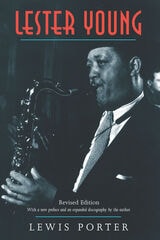
Lester Young
Lewis Porter
University of Michigan Press, 2005
". . . a schematic of unparalleled insight and detail."
---Down Beat
"A monumental work."
---Dizzy Gillespie
". . . a major contribution to jazz scholarship . . . for its illumination of Lester Young's music and for setting the biographical record straight."
---Dan Morgenstern
Several new biographies of Lester Young have been published in the years since Lewis Porter's Lester Young first appeared, but none have supplanted or even attempted the in-depth study that Porter brings to his subject's music. With the same care and scholarship that characterized his John Coltrane, Porter analyzes the music that made Lester Young "the most original tenor sax in jazz."
In addition to helping us understand Lester Young's playing and stylistic evolution, Porter's analysis demonstrates that Young's playing at the end of his career did not mark a serious decline over his earlier style, as many critics have claimed.
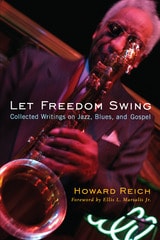
Let Freedom Swing
Collected Writings on Jazz, Blues, and GospelHoward Reich
Northwestern University Press, 2010
Each section of Let Freedom Swing composes a suite, focusing on either a person, place, or scene. Reich gives new life to the standards with his profiles and elegies for such giants as Gershwin, Ellington, and Sinatra. A profile of Louis Armstrong brings out the often angry side of Satchmo but also reveals a more remarkable musician and human being.
His open-mindedness makes Reich a particularly astute observer of the experimental and new, from Ornette Coleman to Chicago experimentalist Ken Vandermark. And his observations about street music open our ears to the songs of everyday life. Reich’s fearlessness is evident in his writing about daunting subjects, such as the New Orleans music scene after Katrina, the lost legacy of jazz in Panama, and the complicated legacy of "race music" in America.
Howard Reich combines a deep enthusiasm for music, a breadth of knowledge, and an ability to share his world with his readers, and Let Freedom Swing is essential reading for anyone interested in the continuing vitality of jazz, gospel, blues, and American music in general.
Lonesome Roads and Streets of Dreams
Place, Mobility, and Race in Jazz of the 1930s and '40sAndrew S. Berish
University of Chicago Press, 2012
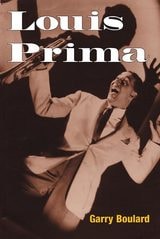
Louis Prima
Garry Boulard
University of Illinois Press, 1998
Louis Prima infused the grit and grace of Dixieland jazz with swing and big band sounds, the first whiffs of rock 'n' roll, and a vaudevillian stage presence. Garry Boulard pens the biography of the underrated jazz musician, Las Vegas mainstay, and popular entertainer.
A native of New Orleans, Prima was a Guy Lombardo protégé known as "The Italian Satchmo" who became the country's new jazz sensation at New York's Famous Door in the 1930s. He went on to success as a big band leader before virtually creating the lounge act as a Las Vegas nightclub staple. Employing and later marrying singer Keely Smith, Prima rode high with a series of hit songs and smash albums in the Fifties. But Boulard also looks past the over-the-top stage antics to restore Prima's legacy as an overlooked jazz musician and vocalist, and as a bandleader with an uncanny ability to fuse disparate styles into music that kept audiences cheering and dancing for decades.