Results by title
356 books match the query 'Jewish Studies' and 13 start with l
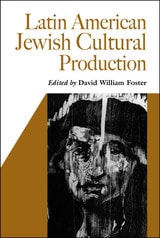
Latin American Jewish Cultural Production
David William Foster
Vanderbilt University Press, 2008
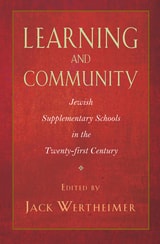
Learning and Community
Jewish Supplementary Schools in the Twenty-First CenturyJack Wertheimer
Brandeis University Press, 2009
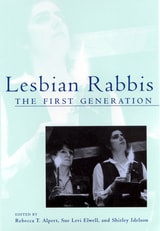
Lesbian Rabbis
The First GenerationRebecca T. Alpert, Sue Levi Elwell, and Shirley Idelson
Rutgers University Press, 2001
Lesbian Rabbis: The First Generation documents a monumental change in Jewish life as eighteen lesbian rabbis reflect on their experiences as trailblazers in Judaism's journey into an increasingly multicultural world. In frank and revealing essays, the contributors discuss their decisions to become rabbis and describe their experiences both at the seminaries and in their rabbinical positions. They also reflect on the dilemma whether to conceal or reveal their sexual identities to their congregants and superiors, or to serve specifically gay and lesbian congregations. The contributors consider the tensions between lesbian identity and Jewish identity, and inquire whether there are particularly "lesbian" readings of traditional texts. These essays also ask how the language of Jewish tradition touches the lives of lesbians and how lesbianism challenges traditional notions of the Jewish family.
"'Today I am completely 'out' personally and professionally, and yet I have learned that the 'coming out' process never ends. Even today, I find myself in professional situations in which yet again I must reveal that I am a lesbian, yet again I must prove myself worthy of functioning professionally in the 'straight' world. I still encounter moments of awkwardness, some hostility, and some sense of exclusion as I negotiate the pathways of my professional life."-Rabbi Leila Gal Berner, from Lesbian Rabbis: The First Generation
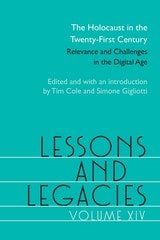
Lessons and Legacies XIV
The Holocaust in the Twenty-First Century; Relevance and Challenges in the Digital AgeEdited and with an introduction by Tim Cole and Simone Gigliotti
Northwestern University Press, 2021
The Holocaust in the Twenty-First Century: Relevance and Challenges in the Digital Age challenges a number of key themes in Holocaust studies with new research. Essays in the section “Tropes Reconsidered” reevaluate foundational concepts such as Primo Levi’s gray zone and idea of the muselmann. The chapters in “Survival Strategies and Obstructions” use digital methodologies to examine mobility and space and their relationship to hiding, resistance, and emigration. Contributors to the final section, “Digital Methods, Digital Memory,” offer critical reflections on the utility of digital methods in scholarly, pedagogic, and public engagement with the Holocaust.
Although the chapters differ markedly in their embrace or eschewal of digital methods, they share several themes: a preoccupation with the experiences of persecution, escape, and resistance at different scales (individual, group, and systemic); methodological innovation through the adoption and tracking of micro- and mezzohistories of movement and displacement; varied approaches to the practice of Saul Friedländer’s “integrated history”; the mainstreaming of oral history; and the robust application of micro- and macrolevel approaches to the geographies of the Holocaust. Taken together, these chapters incorporate gender analysis, spatial thinking, and victim agency into Holocaust studies. In so doing, they move beyond existing notions of perpetrators, victims, and bystanders to portray the Holocaust as a complex and multilayered event.
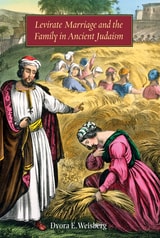
Levirate Marriage and the Family in Ancient Judaism
Dvora E. Weisberg
Brandeis University Press, 2009
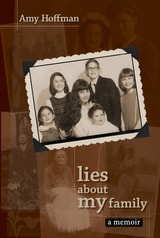
Lies About My Family
A MemoirAmy Hoffman
University of Massachusetts Press, 2013
All of Amy Hoffman's grandparents came to the United States during the early twentieth century from areas in Poland and Russia that are now Belarus and Ukraine. Like millions of immigrants, they left their homes because of hopeless poverty, looking for better lives or at the least a chance of survival. Because of the luck, hard work, and resourcefulness of the earlier generations, Hoffman and her five siblings grew up in a middle-class home, healthy, well fed, and well educated. An American success story? Not quite—or at least not quite the standard version. Hoffman's research in the Ellis Island archives along with interviews with family members reveal that the real lives of these relatives were far more complicated and interesting than their documents might suggest.
Hoffman and her siblings grew up as observant Jews in a heavily Catholic New Jersey suburb, as political progressives in a town full of Republicans, as readers in a school full of football players and their fans.
As a young lesbian, she distanced herself from her parents, who didn't understand her choice, and from the Jewish community, with its organization around family and unquestioning Zionism. However, both she and her parents changed and evolved, and by the end of this engaging narrative, they have come to new understandings, of themselves and one another.
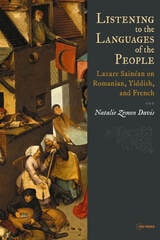
Listening to the Languages of the People
Lazare Sainéan on Romanian, Yiddish, and FrenchNatalie Zemon Davis
Central European University Press, 2022
This tale of great achievements and great disappointments offers a fresh perspective on the interplay between scholarship and political sentiment in the late nineteenth and early twentieth centuries.
Lazăr Șăineanu (1859-1934), linguist and folklorist, was a pioneer in his native Romania, seeking out the popular elements in culture along with high literary ones. He was among the first to publish a study of Yiddish as a genuine language, and he uncovered Turkish features in Romanian language and customs. He also made an index of hundreds of Romanian folktales. Yet when he sought Romanian citizenship and a professorship, he was blocked by powerful figures who thought Jews could not be Romanians and who fancied the origins of Romanian culture to be wholly Latin. Faced with anti-Semitism, some of his friends turned to Zionism. Instead he tried baptism, which brought him only mockery and shame.
Hoping to find a polity to which he could belong, Șăineanu moved with his family to Paris in 1900 and became Lazare Sainéan. There he made innovative studies of French popular speech and slang, culminating in his great work on the language of Rabelais. Once again, he was contributing to the development of a national tongue. Even then, while welcomed by literary scholars, Sainéan was unable to get a permanent university post. Though a naturalized citizen of France, he felt himself a foreigner, an “intruder,” into his old age.

Live and Be Well
A Celebration of Yiddish Culture in AmericaVicki Gold Levi
Rutgers University Press, 2000
Like a warm family album, this lively book heralds and documents the rich and vibrant traditions of Yiddish-speaking immigrants and their children in “the golden land,” from the first arrivals to the Second World War.
Meet the famous, the infamous, and the unknown—from hotelier Jenny Grossinger to mobster Jake “Greasy Thumb” Guzik to Moses Solomon, the would-be “Jewish Babe Ruth;” from anarchist Emma Goldman to entertainer Eddie Cantor.
Share the struggles and the triumphs of the labor unions, of Yiddish playwrights and poets. Enter the sweatshops of New York’s Lower East Side and the first Jewish settlements in Los Angeles and Chicago. Taste pastrami from Canter’s Deli in Los Angeles, knishes from Yonah Shimmel’s in New York City, and the famous “smookmit” of the Montreal ghetto.
Lavishly illustrated with photos, cartoons, theater posters, and song sheets, here is a book to delight and inform. It is a joyous celebration of life.
Living with Antisemitism
Modern Jewish ResponsesJehuda Reinharz
Brandeis University Press, 1988
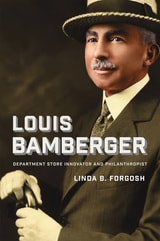
Louis Bamberger
Department Store Innovator and PhilanthropistLinda B. Forgosh
Brandeis University Press, 2016
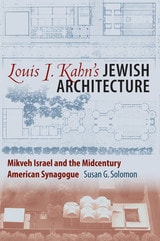
Louis I. Kahn’s Jewish Architecture
Mikveh Israel and the Midcentury American SynagogueSusan G. Solomon
University Press of New England, 2009
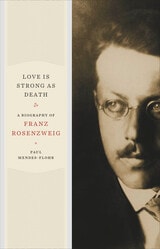
Love Is Strong as Death
A Biography of Franz RosenzweigPaul Mendes-Flohr
University of Chicago Press, 2026
Franz Rosenzweig (1886–1929) was one of the central figures of the Jewish cultural and intellectual renaissance in Weimar Germany. His masterwork, The Star of Redemption (1921), is a classic of existential thought and Jewish philosophy, and his considerable legacy also includes his collaboration with Martin Buber on a key translation of the Hebrew Bible into German and the establishment of an education center in Frankfurt that brought together the most important young German-Jewish intellectuals of its time.
Rosenzweig’s personal biography is no less fascinating than his ideas and accomplishments. Drawing on unprecedented access to Rosenzweig’s unpublished personal correspondence, Paul Mendes-Flohr skillfully weaves together the threads of Rosenzweig’s life to give us a moving portrait of this towering figure—from his near-conversion to Christianity to his tragic diagnosis with ALS. Mendes-Flohr also closely explores Rosenzweig’s relationship with Margrit Huessy, who was a vital intellectual partner for Rosenzweig, as well as a muse and lover. He worked out many of his ideas about love both in conversation and consort with her, and Mendes-Flohr shows the importance of intimacy—both romantic and platonic—in the development of Rosenzweig’s thought.
Love Is Strong as Death provides a unique and insightful look at one of the most important modern Jewish thinkers.
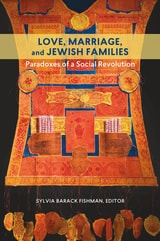
Love, Marriage, and Jewish Families
Paradoxes of a Social RevolutionEdited by Sylvia Barack Fishman
Brandeis University Press, 2015