Results by title
187 books match the query 'Justice' and 7 start with l
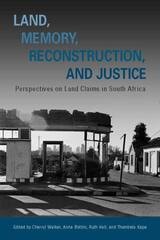
Land, Memory, Reconstruction, and Justice
Perspectives on Land Claims in South AfricaCherryl Walker
Ohio University Press, 2010
Land is a significant and controversial topic in South Africa. Addressing the land claims of those dispossessed in the past has proved to be a demanding, multidimensional process. In many respects the land restitution program that was launched as part of the county’s transition to democracy in 1994 has failed to meet expectations, with ordinary citizens, policymakers, and analysts questioning not only its progress but also its outcomes and parameters.
Land, Memory, Reconstruction, and Justice brings together a wealth of topical material and case studies by leading experts in the field who present a rich mix of perspectives from politics, sociology, geography, social anthropology, law, history, and agricultural economics. The collection addresses both the material and the symbolic dimensions of land claims, in rural and urban contexts, and explores the complex intersection of issues confronting the restitution program, from the promotion of livelihoods to questions of rights, identity, and transitional justice.
A valuable contribution to the field of land and agrarian studies, both in South Africa and internationally, it is undoubtedly the most comprehensive treatment to date of South Africa’s postapartheid land claims process and will be essential reading for scholars and students of land reform for years to come.
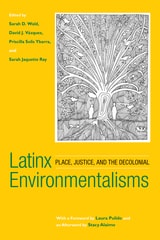
Latinx Environmentalisms
Place, Justice, and the DecolonialSarah D. Wald
Temple University Press, 2019
The whiteness of mainstream environmentalism often fails to account for the richness and variety of Latinx environmental thought. Building on insights of environmental justice scholarship as well as critical race and ethnic studies, the editors and contributors to Latinx Environmentalisms map the ways Latinx cultural texts integrate environmental concerns with questions of social and political justice.
Original interviews with creative writers, including Cherríe Moraga, Helena María Viramontes, and Héctor Tobar, as well as new essays by noted scholars of Latinx literature and culture, show how Latinx authors and cultural producers express environmental concerns in their work. These chapters, which focus on film, visual art, and literature—and engage in fields such as disability studies, animal studies, and queer studies—emphasize the role of racial capitalism in shaping human relationships to the more-than-human world and reveal a vibrant tradition of Latinx decolonial environmentalism.
Latinx Environmentalisms accounts for the ways Latinx cultures are environmental, but often do not assume the mantle of “environmentalism.”

Law and Justice in the 1950s
Case Studies From a Neglected DecadeEdited by Fiona Cownie and Rosemary Auchmuty
University of London Press, 2026
The 1950s were a decade of considerable legal development in England and Wales, despite often being regarded as very conservative in contrast to the more radical 1960s and 1970s. This collection illustrates the breadth of those developments, providing a sociolegal perspective on a range of topics across criminal, property, family, commercial, environmental, and public law, as well as legal education.
Drawing on case studies from the Great London Smog in 1952, the treatment of women in the Wolfenden Report, divorce law reform, the takeover battle for the Savoy Hotel in 1953, law on the radio, and more, this book throws new light on current debates about the relationship between law and issues of justice, inclusion, and equality in different spheres of activity.
Written for historians and legal specialists alike, Law and Justice in the 1950s explores the stories behind the laws in this neglected decade. In revealing the historical context, arguments, and controversies raised at the time and the different perspectives of the parties involved, it offers a greater understanding of why we have the law we have now and of these issues as they continue to be played out in the early twenty-first century.

Liberty, Equality, and Justice
Civil Rights, Women’s Rights, and the Regulation of Business, 1865–1932Ross Evans Paulson
Duke University Press, 1997
Surveying a crucial period in the formation of the modern state and society, Paulson examines the prevailing conflicts of the time and the limitations of various attempts to institute reform, radical change, or ritualistic renewal of American society. His reading of existing scholarship highlights contested social constructs, clashing priorities, changing meanings of key terms, and shifting institutional dynamics in light of their contributions to a complex tragedy in which all parties fell short of the demands for democratic mutuality. Along with discussions of the movements and manipulations of presidential, congressional, and judicial politics, he integrates the experiences of diverse populations—including African Americans, women, Asian immigrants, Native Americans, and working people—and offers a new interpretation of the ways in which social change and political events interact to reframe the many possibilities of American society.
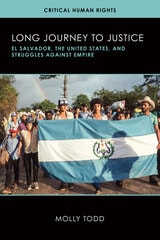
Long Journey to Justice
El Salvador, the United States, and Struggles against EmpireMolly Todd
University of Wisconsin Press, 2023
Drawing on two decades of work with former refugees from El Salvador as well as unprecedented access to private archives and oral histories, Molly Todd’s compelling history provides the first in-depth look at “grassroots sistering.” This model of citizen diplomacy emerged in the mid-1980s out of relationships between a few repopulated villages in Chalatenango, El Salvador, and US cities.
Todd shows how the leadership of Salvadorans and left-leaning activists in the US concerned with the expansion of empire as well as the evolution of human rights–related discourses and practices created a complex dynamic of cross-border activism that continues today.
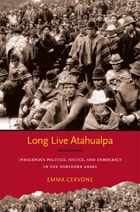
Long Live Atahualpa
Indigenous Politics, Justice, and Democracy in the Northern AndesEmma Cervone
Duke University Press, 2012
Cervone describes how the Inca Atahualpa contested racial subordination by intervening in matters of resource distribution, justice, and cultural politics. Considering local indigenous politics and indigenous mobilization at the national and international levels, she explains how, beginning in the 1960s, state-led modernization created political openings by generating new economic formations and social categories. Long Live Atahualpa sheds new light on indigenous peoples operating at the crossroads of global capitalism and neoliberal reforms as they redefine historically rooted relationships of subordination.
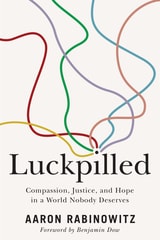
Luckpilled
Compassion, Justice, and Hope in a World Nobody DeservesAaron Rabinowitz
Rutgers University Press, 2027
What if everything we experience comes down to luck? Humans have struggled with anxiety about the pervasiveness of luck since the concept first arose in ancient societies, and attempts to address the problem have shaped the modern world. Yet the problem of luck has persisted because resolving it requires letting go of a tenacious group of deeply rooted illusions centered on the need to feel that people mostly get what they deserve.
In Luckpilled: Compassion, Justice, and Hope in a World Nobody Deserves, Aaron Rabinowitz combines cutting-edge work on the philosophy, psychology, politics, and pedagogy of luck to argue that we are better off embracing the pervasiveness of luck and abandoning harmful illusions that preserve an unjust status-quo. Using the luckpilling techniques offered in this book can help readers to cultivate compassion, empathy, gratitude and humility, as well as a stronger connection to activities they find meaningful.