Results by title
99 books match the query 'Kinship' and 4 start with l
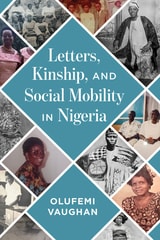
Letters, Kinship, and Social Mobility in Nigeria
Olufemi Vaughan
University of Wisconsin Press, 2023
In 2003, Olufemi Vaughan received from his ninety-five-year-old father, Abiodun, a trove of more than three thousand letters written by four generations of his family in Ibadan, Nigeria, between 1926 and 1994. The people who wrote these letters had emerged from the religious, social, and educational institutions established by the Church Missionary Society, the preeminent Anglican mission in the Atlantic Nigerian region following the imposition of British colonial rule. Abiodun, recruited to be a civil servant in the colonial Department of Agriculture, became a leader of a prominent family in Ibadan, the dominant Yoruba city in southern Nigeria. Reading deeply in these letters, Vaughan realized he had a unique set of sources to illuminate everyday life in modern Nigeria.
Letter writing was a dominant form of communication for Western-educated elites in colonial Africa, especially in Nigeria. Exposure to the modern world and a growing sense of nationalism were among the factors that led people to begin exchanging letters, particularly in their interactions with British colonial authorities. Through careful textual analysis and broad contextualization, Vaughan reconstructs dominant storylines, including themes such as kinship, social mobility, Western education, modernity, and elite consolidation in colonial and post-colonial Nigeria. Vaughan brings his prodigious skills as an interdisciplinary scholar to bear on this wealth of information, bringing to life a portrait, at once intimate and expansive, of a community during a transformative period in African history.
Letter writing was a dominant form of communication for Western-educated elites in colonial Africa, especially in Nigeria. Exposure to the modern world and a growing sense of nationalism were among the factors that led people to begin exchanging letters, particularly in their interactions with British colonial authorities. Through careful textual analysis and broad contextualization, Vaughan reconstructs dominant storylines, including themes such as kinship, social mobility, Western education, modernity, and elite consolidation in colonial and post-colonial Nigeria. Vaughan brings his prodigious skills as an interdisciplinary scholar to bear on this wealth of information, bringing to life a portrait, at once intimate and expansive, of a community during a transformative period in African history.
[more]

Like Family
Narratives of Fictive KinshipMargaret K. Nelson
Rutgers University Press, 2020
For decades, social scientists have assumed that “fictive kinship” is a phenomenon associated only with marginal peoples and people of color in the United States. In this innovative book, Nelson reveals the frequency, texture and dynamics of relationships which are felt to be “like family” among the white middle-class. Drawing on extensive, in-depth interviews, Nelson describes the quandaries and contradictions, delight and anxiety, benefits and costs, choice and obligation in these relationships. She shows the ways these fictive kinships are similar to one another as well as the ways they vary—whether around age or generation, co-residence, or the possibility of becoming “real” families. Moreover she shows that different parties to the same relationship understand them in some similar – and some very different – ways. Theoretically rich and beautifully written, the book is accessible to the general public while breaking new ground for scholars in the field of family studies.
[more]
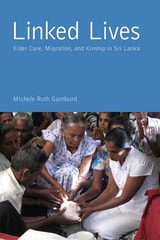
Linked Lives
Elder Care, Migration, and Kinship in Sri LankaMichele Ruth Gamburd
Rutgers University Press, 2021
When youth shake off their rural roots and middle-aged people migrate for economic opportunities, what happens to the grandparents left at home? Linked Lives provides readers with intimate glimpses into homes in a Sri Lankan Buddhist village, where elders wisely use their moral authority and their control over valuable property to assure that they receive both physical and spiritual care when they need it. The care work that grandparents do for grandchildren allows labor migration and contributes to the overall well-being of the extended family. The book considers the efforts migrant workers make to build and buy houses and the ways those rooms and walls constrain social activities. It outlines the strategies elders employ to age in place, and the alternatives they face in local old folks’ homes. Based on ethnographic work done over a decade, Michele Gamburd shows how elders face the challenges of a rapidly globalizing world.
[more]
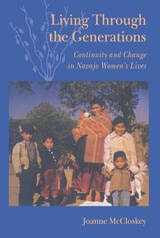
Living Through the Generations
Continuity and Change in Navajo Women’s LivesJoanne McCloskey
University of Arizona Press, 2007
Navajo women’s lives reflect the numerous historical changes that have transformed “the Navajo way.” At the same time, in their behavior, beliefs, and values, women preserve the legacy of Navajo culture passed down through the generations. By comparing and contrasting three generations of Navajo women—grandmothers, mid-life mothers, and young mothers—similarities and differences emerge in patterns of education, work, family life, and childbearing. Women’s roles as mothers and grandmothers are central to their respected position in Navajo society. Mothers bestow membership in matrilineal clans at birth and follow the example of the beloved deity Changing Woman. As guardians of cultural traditions, grandmothers actively plan and participate in ceremonies such as the Kinaaldá, the puberty ceremony, for their granddaughters.
Drawing on ethnographic interviews with 77 women in Crownpoint, New Mexico, and surrounding chapters in the Eastern Navajo Agency, Joanne McCloskey examines the cultural traditions evident in Navajo women’s lives. Navajo women balance the demands of Western society with the desire to preserve Navajo culture for themselves and their families.
Drawing on ethnographic interviews with 77 women in Crownpoint, New Mexico, and surrounding chapters in the Eastern Navajo Agency, Joanne McCloskey examines the cultural traditions evident in Navajo women’s lives. Navajo women balance the demands of Western society with the desire to preserve Navajo culture for themselves and their families.
[more]