99 books match the query 'Knowledge, Theory of' and 3 start with l
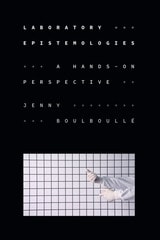
cover of Laboratory Epistemologies: A Hands-On Perspective

Laboratory Epistemologies

A Hands-On Perspective

Jenny Boulboullé

Duke University Press, 2024
In Laboratory Epistemologies: A Hands-On Perspective, Jenny Boulboullé examines the significance of hands-on experiences in contemporary life sciences laboratories. Addressing the relationship between contemplation and manipulation in epistemology, Boulboullé combines participant observations in molecular genetics labs and microbiological cleanrooms with a longue durée study of the history and philosophy of science. She radically rereads Descartes’s key epistemological text Meditations on First Philosophy, reframing the philosopher as a hands-on knowledge maker. With this reading, Boulboullé subverts the pervasive modern conception of the disembodied knower and puts the hands-on experimenter at the heart of life sciences research. In so doing, she contributes a theoretical model for understanding how life processes on cellular and molecular levels are manually produced in today’s techno-scientific spaces. By reassessing the Cartesian legacy and arguing that epistemology should be grounded in the standpoint of a hands-on practitioner, Boulboullé offers the philosophical and historical foundation to understand and study contemporary life sciences research as multisensory embodied practices.
[more]
cover of Learning in Depth: A Simple Innovation That Can Transform Schooling

Learning in Depth

A Simple Innovation That Can Transform Schooling

Kieran Egan

University of Chicago Press, 2011

For generations, schools have aimed to introduce students to a broad range of topics through curriculum that ensure that they will at least have some acquaintance with most areas of human knowledge by the time they graduate. Yet such broad knowledge can’t help but be somewhat superficial—and, as Kieran Egan argues, it omits a crucial aspect of true education: deep knowledge.

Real education, Egan explains, consists of both general knowledge and detailed understanding, and in Learning in Depth he outlines an ambitious yet practical plan to incorporate deep knowledge into basic education. Under Egan’s program, students will follow the usual curriculum, but with one crucial addition: beginning with their first days of school and continuing until graduation, they will eachalso study one topic—such as apples, birds, sacred buildings, mollusks,circuses, or stars—in depth. Over the years, with the help and guidance of their supervising teacher, students will expand their understanding of their one topic and build portfolios of knowledge that grow and change along with them. By the time they graduate each student will know as much about his or her topic as almost anyone on earth—and in the process will have learned important, even life-changing lessons about the meaning of expertise, the value of dedication, and the delight of knowing something in depth.

Though Egan’s program may be radical in its effects, it is strikingly simple to implement—as a number of schools have already discovered—and with Learning in Depth as a blueprint, parents, educators, and administrators can instantly begin taking the first steps toward transforming our schools and fundamentally deepening their students’ minds.
[more]
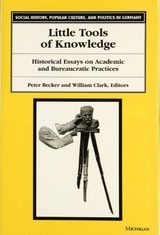
cover of Little Tools of Knowledge: Historical Essays on Academic and Bureaucratic Practices

Little Tools of Knowledge

Historical Essays on Academic and Bureaucratic Practices

Peter Becker and William Clark, Editors

University of Michigan Press, 2001

This volume brings historians of science and social historians together to consider the role of "little tools"--such as tables, reports, questionnaires, dossiers, index cards--in establishing academic and bureaucratic claims to authority and objectivity. From at least the eighteenth century onward, our science and society have been planned, surveyed, examined, and judged according to particular techniques of collecting and storing knowledge. Recently, the seemingly self-evident nature of these mundane epistemic and administrative tools, as well as the prose in which they are cast, has demanded historical examination. The essays gathered here, arranged in chronological order by subject from the late seventeenth to the late twentieth century, involve close readings of primary texts and analyses of academic and bureaucratic practices as parts of material culture. The first few essays, on the early modern period, largely point to the existence of a "juridico-theological" framework for establishing authority. Later essays demonstrate the eclipse of the role of authority per se in the modern period and the emergence of the notion of "objectivity." Most of the essays here concern the German cultural space as among the best exemplars of the academic and bureaucratic practices described above. The introduction to the volume, however, is framed at a general level; the closing essays also extend the analyses beyond Germany to broader considerations on authority and objectivity in historical practice. The volume will interest scholars of European history and German studies as well as historians of science. Peter Becker is Professor of Central European History, European University Institute. William Clark is Lecturer in History and Philosophy of Science, Cambridge University.
[more]