171 books match the query 'Labor unions' and 12 start with l
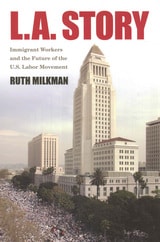
cover of L.A. Story: Immigrant Workers and the Future of the U.S. Labor Movement

L.A. Story

Immigrant Workers and the Future of the U.S. Labor Movement

Ruth Milkman

Russell Sage Foundation, 2006
Sharp decreases in union membership over the last fifty years have caused many to dismiss organized labor as irrelevant in today's labor market. In the private sector, only 8 percent of workers today are union members, down from 24 percent as recently as 1973. Yet developments in Southern California—including the successful Justice for Janitors campaign—suggest that reports of organized labor's demise may have been exaggerated. In L.A. Story, sociologist and labor expert Ruth Milkman explains how Los Angeles, once known as a company town hostile to labor, became a hotbed for unionism, and how immigrant service workers emerged as the unlikely leaders in the battle for workers' rights. L.A. Story shatters many of the myths of modern labor with a close look at workers in four industries in Los Angeles: building maintenance, trucking, construction, and garment production. Though many blame deunionization and deteriorating working conditions on immigrants, Milkman shows that this conventional wisdom is wrong. Her analysis reveals that worsening work environments preceded the influx of foreign-born workers, who filled the positions only after native-born workers fled these suddenly undesirable jobs. Ironically, L.A. Story shows that immigrant workers, who many union leaders feared were incapable of being organized because of language constraints and fear of deportation, instead proved highly responsive to organizing efforts. As Milkman demonstrates, these mostly Latino workers came to their service jobs in the United States with a more group-oriented mentality than the American workers they replaced. Some also drew on experience in their native countries with labor and political struggles. This stock of fresh minds and new ideas, along with a physical distance from the east-coast centers of labor's old guard, made Los Angeles the center of a burgeoning workers' rights movement. Los Angeles' recent labor history highlights some of the key ingredients of the labor movement's resurgence—new leadership, latitude to experiment with organizing techniques, and a willingness to embrace both top-down and bottom-up strategies. L.A. Story's clear and thorough assessment of these developments points to an alternative, high-road national economic agenda that could provide workers with a way out of poverty and into the middle class.
[more]
cover of Labor Histories: Class, Politics, and the Working-Class Experience

Labor Histories

Class, Politics, and the Working-Class Experience

Edited by Eric Arnesen, Julie Greene, and Bruce Laurie

University of Illinois Press, 1998

Is class outmoded as a basis for understanding labor history? This collection emphatically answers, "No!" These thirteen essays delve into subjects like migrant labor, religion, ethnicity, agricultural history, and gender. Written by former students of preeminent labor figure and historian David Montgomery, the works advance the argument that class remains indispensable to the study of working Americans and their place in the broad drama of our shared national history.
[more]
cover of Labor Leaders in America

Labor Leaders in America

Edited by Melvyn Dubofsky and Warren Van Tine

University of Illinois Press, 1987

Here are the life stories of the men and women who led the labor movement in America from Reconstruction to recent times, from William H. Sylvis, the first major labor leader, to Cesar Chavez, who organized California's farm workers in the 1960s. In each profile, a leading authority provides a profile of the figure's life and work. Taken together, these short biographies provide a broad overview of the American labor movement that will appeal to students, interested readers, and specialists. Profiles include: William H. Sylvis, Terence V. Powderly, Samuel Gompers, Eugene V. Debs, William D. "Big Bill" Haywood, William Green, Rose Schneiderman, John L. Lewis, Sidney Hillman, Philip Murray, A. Philip Randolph, Walter Reuther, Jimmy Hoffa, George Meany, and Cesar Chavez
[more]
cover of Labor and Democracy in Namibia, 1971–1996

Labor and Democracy in Namibia, 1971–1996

Gretchen Bauer

Ohio University Press, 1998

In this compelling study of labor and nationalism during and after Namibia's struggle for liberation, Gretchen Bauer addresses the very difficult task of consolidating democracy in an independent Namibia. Labor and Democracy in Namibia, 1971-1996 argues that a vibrant and autonomous civil society is crucial to the consolidation of new democracies, and it identifies trade unions, in particular, as especially important organizations of civil society. In Namibia, however, trade unions have emerged from the liberation struggle and the first years of independence in a weakened state. Dr. Bauer gives a lucid explanation for this phenomenon by tracing the origins and evolution of the trade unions in Namibia and discusses the implications thereof for the future of democracy in Namibia.

Based on material not widely available before independence in 1990, this study takes a critical look at the nationalist movement in Namibia. Through the use of dozens of interviews with political leaders, trade unionists, community activists, and others, Bauer offers the controversial suggestion that there are many within the nationalist movement (now the ruling party in government) who would rather not see a strong trade union movement (or any other potential rival) emerge in independent Namibia.

[more]
cover of Labor in Crisis: THE STEEL STRIKE OF 1919

Labor in Crisis

THE STEEL STRIKE OF 1919

David Brody

University of Illinois Press, 1965

Conceived as a prologue to the 1930s industrial-union triumph in steel, Labor in Crisis explains the failure of unionization before the New Deal era and the reasons for mass-production unionism's eventual success.
Widely regarded as a failure, the great 1919 steel strike had both immediate and far-reaching consequences that are important to the history of American labor. It helped end the twelve-hour day, dramatized the issues of the rights to organize and to engage in collective bargaining, and forwarded progress toward the passage of the Wagner Act, which, in turn, helped trigger John L. Lewis's decision to launch the CIO.
 
[more]
cover of Labor's Outcasts: Migrant Farmworkers and Unions in North America, 1934-1966

Labor's Outcasts

Migrant Farmworkers and Unions in North America, 1934-1966

Andrew J. Hazelton

University of Illinois Press, 2022
In the mid-twentieth century, corporations consolidated control over agriculture on the backs of Mexican migrant laborers through a guestworker system called the Bracero Program. The National Agricultural Workers Union (NAWU) attempted to organize these workers but met with utter indifference from the AFL-CIO. Andrew J. Hazelton examines the NAWU's opposition to the Bracero Program against the backdrop of Mexican migration and the transformation of North American agriculture. His analysis details growers’ abuse of the program to undercut organizing efforts, the NAWU's subsequent mobilization of reformers concerned by those abuses, and grower opposition to any restrictions on worker control. Though the union's organizing efforts failed, it nonetheless created effective strategies for pressuring growers and defending workers’ rights. These strategies contributed to the abandonment of the Bracero Program in 1964 and set the stage for victories by the United Farm Workers and other movements in the years to come.
[more]
cover of Labor's Story In The United States

Labor's Story In The United States

Philip Nicholson

Temple University Press, 2004
In this, the first broad historical overview of labor in the United States in twenty years, Philip Nicholson examines anew the questions, the villains, the heroes, and the issues of work in America. Unlike recent books that have covered labor in the twentieth century, Labor's Story in the United States looks at the broad landscape of labor since before the Revolution. In clear, unpretentious language, Philip Yale Nicholson considers American labor history from the perspective of institutions and people: the rise of unions, the struggles over slavery, wages, and child labor, public and private responses to union organizing. Throughout, the book focuses on the integral relationship between the strength of labor and the growth of democracy, painting a vivid picture of the strength of labor movements and how they helped make the United States what it is today. Labor's Story in the United States will become an indispensable source for scholars and students.
[more]
cover of Labor's Time: Shorter Hours, The Uaw, And The

Labor's Time

Shorter Hours, The Uaw, And The

Jonathan Cutler

Temple University Press, 2004

The movement for a shorter workweek that once defined the labor movement in the United States was largely displaced by the new corporatist structure of organized labor in the post-New Deal era. Labor's Time examines the changes that occurred within organized labor and traces their influence on the decline of the shorter hours movement. Focusing on the internal union politics of the influential United Automobile Workers and Local 600, its chapter at Henry Ford's massive River Rouge factory, Jonathan Cutler demonstrates how an all-but-forgotten interracial movement for a shorter workweek during the 1950s and 1960s became a casualty of an increasingly top-heavy union bureaucracy that lost touch with the desires, fears, and aspirations of rank and file workers and dug its own grave in the process. Jonathan Cutler examines the political context in which the shorter hours movement emerged within Local 600 in the 1940s, then chronicles the attempts by Walter Reuther, the head of the UAW, to suppress it. Cutler also reviews the role the Communist Party played in the controversy. Finally, he documents the UAW response to rank and file pressure for a shorter workweek, and how the local's own organizational flaws allowed Reuther and the national union to wrest control from the dissidents. Fresh and boldly written, Labor's Time recreates a moment when unions—as a movement, not as an amalgam of leaders—could have transformed the landscape of work in the United States.
[more]
cover of Labour and the Challenges of Globalization: What Prospects for Transnational Solidarity?

Labour and the Challenges of Globalization

What Prospects for Transnational Solidarity?

Andreas Bieler, Ingemar Lindberg and Devan Pillay

Pluto Press, 2008

This book examines the main challenges facing the world labor force and possible responses from trade unions.


The working classes across the world are feeling the effects of globalization and the race to the bottom that it encourages. Core jobs for workers in the developed world are being outsourced to countries where pay and conditions are terrible and union membership is often forbidden. Much of the work of the world economy is now taking place in a burgeoning informal sector, making worldwide organization of labor very difficult.


Case studies from 11 different countries, including China, Germany, Canada and South Africa, illustrate what is happening and show how workers and trade unions can successfully adapt to the neoliberal world.
[more]
cover of Life, Work, and Rebellion in the Coal Fields: The Southern West Virginia Miners, 1880-1922 2nd Edition

Life, Work, and Rebellion in the Coal Fields

The Southern West Virginia Miners, 1880-1922 2nd Edition

David Corbin

West Virginia University Press, 2015

Between 1880 and 1922, the coal fields of southern West Virginia witnessed two bloody and protracted strikes, the formation of two competing unions, and the largest armed conflict in American labor history—a week-long battle between 20,000 coal miners and 5,000 state police, deputy sheriffs, and mine guards. These events resulted in an untold number of deaths, indictments of over 550 coal miners for insurrection and treason, and four declarations of martial law. Corbin argues that these violent events were collective and militant acts of aggression interconnected and conditioned by decades of oppression. His study goes a long way toward breaking down the old stereotypes of Appalachian and coal mining culture. This second edition contains a new preface and afterword by author David A. Corbin.
[more]
cover of Linked Labor Histories: New England, Colombia, and the Making of a Global Working Class

Linked Labor Histories

New England, Colombia, and the Making of a Global Working Class

Aviva Chomsky

Duke University Press, 2008

Exploring globalization from a labor history perspective, Aviva Chomsky provides historically grounded analyses of migration, labor-management collaboration, and the mobility of capital. She illuminates the dynamics of these movements through case studies set mostly in New England and Colombia. Taken together, the case studies offer an intricate portrait of two regions, their industries and workers, and the myriad links between them over the long twentieth century, as well as a new way to conceptualize globalization as a long-term process.

Chomsky examines labor and management at two early-twentieth-century Massachusetts factories: one that transformed the global textile industry by exporting looms around the world, and another that was the site of a model program of labor-management collaboration in the 1920s. She follows the path of the textile industry from New England, first to the U.S. South, and then to Puerto Rico, Japan, Mexico, Central America, the Caribbean, and Colombia. She considers how towns in Rhode Island and Massachusetts began to import Colombian workers as they struggled to keep their remaining textile factories going. Most of the workers eventually landed in service jobs: cleaning houses, caring for elders, washing dishes.

Focusing on Colombia between the 1960s and the present, Chomsky looks at the Urabá banana export region, where violence against organized labor has been particularly acute, and, through a discussion of the AFL-CIO’s activities in Colombia, she explores the thorny question of U.S. union involvement in foreign policy. In the 1980s, two U.S. coal mining companies began to shift their operations to Colombia, where they opened two of the largest open-pit coal mines in the world. Chomsky assesses how different groups, especially labor unions in both countries, were affected. Linked Labor Histories suggests that economic integration among regions often exacerbates regional inequalities rather than ameliorating them.
[more]
cover of Live Wire: Women and Brotherhood in the Electrical Industry

Live Wire

Women and Brotherhood in the Electrical Industry

Authored by Fran Moccio

Temple University Press, 2010

Belonging to a union can bring higher wages, fringe benefits, greater job security and, sometimes, training. But unions—still known as "brotherhoods"—often remain rigidly segregated by gender, despite the fact that sexual harassment and discrimination in employment are illegal. Live Wire is an in-depth case study of Local 3 of the International Brotherhood of Electrical Workers, arguably the most powerful and influential building trades local in the United States. Francine Moccio brings to life forty years of public policy failure that has resulted in restricted opportunities for women in skilled blue-collar jobs.

Live Wire is a unique foray into the gender dynamics of one trade and one union in historical depth, based on extensive primary, secondary, and archival research. It contributes much-needed research about sex segregation in blue-collar occupations, particularly in unions and fraternal organizations. And it provides important insights into complex interactions of work, union, and family life.

[more]