Results by title
128 books match the query 'Language and languages' and 11 start with l
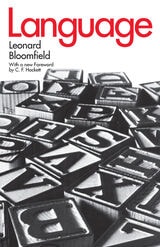
Language
Leonard Bloomfield
University of Chicago Press, 1984
The book quickly became the primary text for the American descriptivist school of linguistics. Bloomfield’s clear, systematic methodology and focus on observable language data laid the groundwork for a new era in linguistic theory. His work, which covers a wide range of topics, from phonology and morphology to syntax and semantics, provides a comprehensive framework for understanding how language functions as a structured system.
Through twelve detailed chapters, Bloomfield explores topics such as the sounds of language, the structure of words, and the organization of sentences. His emphasis on structuralism and the empirical study of language has had a profound impact on the discipline, making Language an essential reference for anyone interested in the history and development of linguistic theory.
As both an introduction for newcomers and a resource for more advanced students, Language continues to be a crucial text in understanding the scientific study of language and its ongoing evolution.
Language Beyond Postmodernism
Saying and Thinking in Gendlin PhilosophyDavid Kleinberg-Levin
Northwestern University Press, 1997
Language and Power in the Early Middle Ages
Patrick J. Geary
Brandeis University Press, 2013
Language and Sexuality
Contesting Meaning in Theory and PracticeEdited by Kathryn Campbell-Kibler, Robert J. Podesva, Sarah Roberts, and Andrew
CSLI, 2001
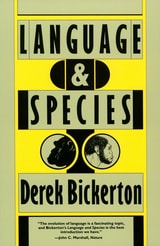
Language and Species
Derek Bickerton
University of Chicago Press, 1992
"You are drawn into [Bickerton's] appreciation of the dominant role language plays not only in what we say, but in what we think and, therefore, what we are."—Robert Wright, New York Times Book Review
"The evolution of language is a fascinating topic, and Bickerton's Language and Species is the best introduction we have."—John C. Marshall, Nature
Language and the Rise of the Algorithm
Jeffrey M. Binder
University of Chicago Press, 2022
A wide-ranging history of the algorithm.
Bringing together the histories of mathematics, computer science, and linguistic thought, Language and the Rise of the Algorithm reveals how recent developments in artificial intelligence are reopening an issue that troubled mathematicians well before the computer age: How do you draw the line between computational rules and the complexities of making systems comprehensible to people? By attending to this question, we come to see that the modern idea of the algorithm is implicated in a long history of attempts to maintain a disciplinary boundary separating technical knowledge from the languages people speak day to day.
Here, Jeffrey M. Binder offers a compelling tour of four visions of universal computation that addressed this issue in very different ways: G. W. Leibniz’s calculus ratiocinator; a universal algebra scheme Nicolas de Condorcet designed during the French Revolution; George Boole’s nineteenth-century logic system; and the early programming language ALGOL, short for algorithmic language. These episodes show that symbolic computation has repeatedly become entangled in debates about the nature of communication. Machine learning, in its increasing dependence on words, erodes the line between technical and everyday language, revealing the urgent stakes underlying this boundary.
The idea of the algorithm is a levee holding back the social complexity of language, and it is about to break. This book is about the flood that inspired its construction.
Language
A Right and a Resource: Approaches to Linguistic Human RightsTibor Várady
Central European University Press, 2000
Linguistic Human Rights (LHR) is a fast growing new area of study combining the principles of national and international law with the study of language as a central dimension of ethnicity. Implementation of these principles is aimed at ensuring that no state or society violates these basic rights.
This path breaking study broadens our knowledge of the important role of language in minority rights and in social and political struggles for LHRs. Exploring the interactions of linguistic diversity, biodiversity, the free market and human rights, the contributors present case studies to highlight such issues as Kurdish satellite TV attempting to create a virtual state on the air through trying to achieve basic LHR’s for Kurds in Turkey; the implementation of LHRs in the Baltic states; language rights activism in Canada; the spread of English as an international language; and the obstacles met in education by Roma and the Deaf in Hungary because of lack of appropriate LHRs.
Language: A Right and a Resource is a valuable multi-disciplinary text which can be used in a variety of different areas of study in the legal profession, linguistics, cultural and political studies.
Linguistic Diversity in Space and Time
Johanna Nichols
University of Chicago Press, 1992
"An awe-inspiring book, unequalled in scope, originality, and the range of language data considered."—Anna Siewierska, Linguistics
"Fascinating. . . . A brilliant pioneering study."—Journal of Indo-European Studies
"A superbly reasoned book."—John A. C. Greppin, Times Literary Supplement
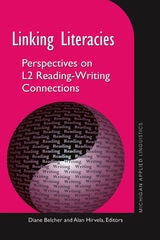
Linking Literacies
Perspectives on L2 Reading-Writing ConnectionsDiane Belcher and Alan Hirvela, Editors
University of Michigan Press, 2001
Linking Literacies provides the most up to date theoretical overview of the connection between reading and writing in second language acquisition. Belcher and Hirvela have brought together the definitive collection of developments in reading-writing relations research and pedagogy. Papers are organized into these parts:
Ground Practice: Theory, Research, and History
In the Classroom: Teaching Reading as Writing and Writing as Reading
(E)Merging Literacies and the Challenge of Textual Ownership
Technology-Assisted Reading and Writing.
In addition to examining the ways in which L1 influences have affected the development of L2 reading-writing theory and pedagogy, Linking Literacies looks at how L2 reading-writing scholarship has created an identity separate of an L1 framework. Linking Literacies examines a broad range of questions and concerns within the structure of L2 reading-writing connections and L2 academic literacy through discussions of theory, research, and
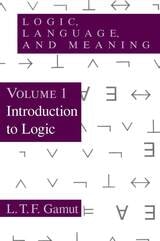
Logic, Language, and Meaning, Volume 1
Introduction to LogicL. T. F. Gamut
University of Chicago Press, 1990
Volume 1, Introduction to Logic, begins with a historical overview and then offers a thorough introduction to standard propositional and first-order predicate logic. It provides both a syntactic and a semantic approach to inference and validity, and discusses their relationship. Although language and meaning receive special attention, this introduction is also accessible to those with a more general interest in logic.
In addition, the volume contains a survey of such topics as definite descriptions, restricted quantification, second-order logic, and many-valued logic. The pragmatic approach to non-truthconditional and conventional implicatures are also discussed. Finally, the relation between logic and formal syntax is treated, and the notions of rewrite rule, automation, grammatical complexity, and language hierarchy are explained.
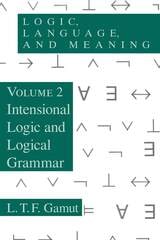
Logic, Language, and Meaning, Volume 2
Intensional Logic and Logical GrammarL. T. F. Gamut
University of Chicago Press, 1990