Results by title
75 books match the query 'Latin' and 7 start with l
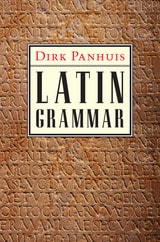
Latin Grammar
Dirk Panhuis
University of Michigan Press, 2006
Back Cover
Through clear structuring of language phenomena, Panhuis provides a reference that integrates traditional linguistic knowledge with linguistic innovation and didactic clarity. This concise reference, ideal for students and instructors of Latin in high schools and colleges, will supplant the out-dated grammars of Allen & Greenough and Hale & Buck.
Dirk Panhuis graduated in classical philology at the State University of Ghent, Belgium, in 1963 and obtained his PhD in linguistics at the University of Michigan, Ann Arbor, in 1981. He has been assistant and academic secretary of the Institut Supérieur Pédagogique in Kananga (Democratic Republic of Congo) and a teaching assistant at the University of Michigan. He taught classical languages in high schools of the Flemish Community in and around Louvain (Belgium) until his retirement in 2002.
"Panhuis brings a very welcome linguistic orientation to the study of Latin, an approach not found in the older traditional grammars currently used at the college level. Among the features likely to prove most helpful for students is the presentation of information in clear and easily readable charts and grids, and the explanations accompanying the English translations, allowing students to see clearly how to render a Latin structure into English both literally and idiomatically."
Back Cover continued
—Deborah Ross, Department of Classical Studies, University of Michigan
"This innovative grammar incorporates current viewpoints of syntax and semantics, making it a unique tool, especially for the study of sentence structure."—Philip Baldi, Professor of Linguistics and Classics, Pennsylvania State University
"In his Latin Grammar, Panhuis artfully integrates traditional description and modern analysis. It will provide intermediate and advancing Latin students mature help in understanding Latin syntax and offers material on the dynamics of text which is unique for an introductory reference tool. Not to be overlooked is its value as a resource to those who teach Latin."
—Charles Elerick, Professor of Languages and Linguistics, The University of Texas at El Paso
Latin and Greek in American Education
With Symposia on the Value of Humanistic StudiesEdited by Francis W. Kelsey
University of Michigan Press, 1911
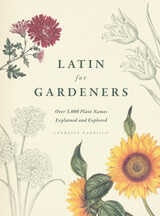
Latin for Gardeners
Over 3,000 Plant Names Explained and ExploredLorraine Harrison
University of Chicago Press, 2012
Since Latin became the standard language for plant naming in the eighteenth century, it has been intrinsically linked with botany. And while mastery of the classical language may not be a prerequisite for tending perennials, all gardeners stand to benefit from learning a bit of Latin and its conventions in the field. Without it, they might buy a Hellebores foetidus and be unprepared for its fetid smell, or a Potentilla reptans with the expectation that it will stand straight as a sentinel rather than creep along the ground.
An essential addition to the gardener’s library, this colorful, fully illustrated book details the history of naming plants, provides an overview of Latin naming conventions, and offers guidelines for pronunciation. Readers will learn to identify Latin terms that indicate the provenance of a given plant and provide clues to its color, shape, fragrance, taste, behavior, functions, and more.
Latin for Reading
A Beginner's Textbook with ExercisesGlenn M. Knudsvig, Ruth S. Craig, and Gerda M. Seligson
University of Michigan Press, 1986
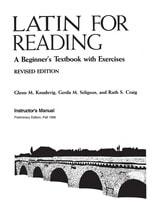
Latin for Reading
A Beginner's Textbook with Exercises, Instructor's ManualGlenn M. Knudsvig, Ruth S. Craig, and Gerda M. Seligson
University of Michigan Press, 1986
Letters and Orations
Cassandra Fedele
University of Chicago Press, 2000
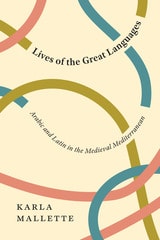
Lives of the Great Languages
Arabic and Latin in the Medieval MediterraneanKarla Mallette
University of Chicago Press, 2021
In this ambitious book, Karla Mallette studies the nature and behaviors of the medieval cosmopolitan languages of learning—classical Arabic and medieval Latin—as they crossed the Mediterranean. Through anecdotes of relationships among writers, compilers, translators, commentators, and copyists, Mallette tells a complex story about the transmission of knowledge in the period before the emergence of a national language system in the late Middle Ages and early modernity.
Mallette shows how the elite languages of learning and culture were only tenuously related to the languages of everyday life. These languages took years of study to master, marking the passage from intellectual childhood to maturity. In a coda to the book, Mallette speculates on the afterlife of cosmopolitan languages in the twenty-first century, the perils of monolingualism, and the ethics of language choice. The book offers insight for anyone interested in rethinking linguistic and literary tradition, the transmission of ideas, and cultural expression in an increasingly multilingual world.