Results by title
276 books match the query 'Legal History' and 25 start with l
Landmarked
Land Claims and Land Restitution in South AfricaCherryl Walker
Ohio University Press, 2008
The year 2008 is the deadline set by President Mbeki for the finalization of all land claims by people who were dispossessed under the apartheid and previous white governments. Although most experts agree this is an impossible deadline, it does provide a significant political moment for reflection on the ANC government’s program of land restitution since the end of apartheid.
Land reform (and land restitution within that) remains a highly charged issue in South Africa, one that deserves more in–depth analysis. Drawing on her experience as Rural Land Claims Commissioner in KwaZulu–Natal from 1995 to 2000, Professor Cherryl Walker provides a multilayered account of land reform in South Africa, one that covers general critical commentary, detailed case material, and personal narrative. She explores the master narrative of loss and restoration, which has been fundamental in shaping the restitution program; offers a critical overview of the achievements of the program as a whole; and discusses what she calls the “non–programmatic limits to land reform,” including urbanization, environmental constraints and the impact of HIV/AIDS.
Latin American Law
A History of Private Law and Institutions in Spanish AmericaBy M. C. Mirow
University of Texas Press, 2004
Private law touches every aspect of people's daily lives—landholding, inheritance, private property, marriage and family relations, contracts, employment, and business dealings—and the court records and legal documents produced under private law are a rich source of information for anyone researching social, political, economic, or environmental history. But to utilize these records fully, researchers need a fundamental understanding of how private law and legal institutions functioned in the place and time period under study.
This book offers the first comprehensive introduction in either English or Spanish to private law in Spanish Latin America from the colonial period to the present. M. C. Mirow organizes the book into three substantial sections that describe private law and legal institutions in the colonial period, the independence era and nineteenth century, and the twentieth century. Each section begins with an introduction to the nature and function of private law during the period and discusses such topics as legal education and lawyers, legal sources, courts, land, inheritance, commercial law, family law, and personal status. Each section also presents themes of special interest during its respective time period, including slavery, Indian status, codification, land reform, and development and globalization.
Latinos and American Law
Landmark Supreme Court CasesBy Carlos R. Soltero
University of Texas Press, 2006
To achieve justice and equal protection under the law, Latinos have turned to the U.S. court system to assert and defend their rights. Some of these cases have reached the United States Supreme Court, whose rulings over more than a century have both expanded and restricted the legal rights of Latinos, creating a complex terrain of power relations between the U.S. government and the country's now-largest ethnic minority. To map this legal landscape, Latinos and American Law examines fourteen landmark Supreme Court cases that have significantly affected Latino rights, from Botiller v. Dominguez in 1889 to Alexander v. Sandoval in 2001.
Carlos Soltero organizes his study chronologically, looking at one or more decisions handed down by the Fuller Court (1888-1910), the Taft Court (1921-1930), the Warren Court (1953-1969), the Burger Court (1969-1986), and the Rehnquist Court (1986-2005). For each case, he opens with historical and legal background on the issues involved and then thoroughly discusses the opinion(s) rendered by the justices. He also offers an analysis of each decision's significance, as well as subsequent developments that have affected its impact. Through these case studies, Soltero demonstrates that in dealing with Latinos over issues such as education, the administration of criminal justice, voting rights, employment, and immigration, the Supreme Court has more often mirrored, rather than led, the attitudes and politics of the larger U.S. society.
Law Collections from Mesopotamia and Asia Minor
Martha T. Roth
SBL Press, 1997

Law and Justice in the 1950s
Case Studies From a Neglected DecadeEdited by Fiona Cownie and Rosemary Auchmuty
University of London Press, 2026
The 1950s were a decade of considerable legal development in England and Wales, despite often being regarded as very conservative in contrast to the more radical 1960s and 1970s. This collection illustrates the breadth of those developments, providing a sociolegal perspective on a range of topics across criminal, property, family, commercial, environmental, and public law, as well as legal education.
Drawing on case studies from the Great London Smog in 1952, the treatment of women in the Wolfenden Report, divorce law reform, the takeover battle for the Savoy Hotel in 1953, law on the radio, and more, this book throws new light on current debates about the relationship between law and issues of justice, inclusion, and equality in different spheres of activity.
Written for historians and legal specialists alike, Law and Justice in the 1950s explores the stories behind the laws in this neglected decade. In revealing the historical context, arguments, and controversies raised at the time and the different perspectives of the parties involved, it offers a greater understanding of why we have the law we have now and of these issues as they continue to be played out in the early twenty-first century.

Law and Liberty in Early New England
Criminal Justice and Due Process, 1620-1692Edgar J. McManus
University of Massachusetts Press, 2009
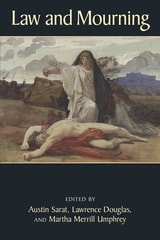
Law and Mourning
Austin Sarat
University of Massachusetts Press, 2017
In addition to the editors, the contributors include Andrea Brady, Catherine Kellogg, Shai Lavi, Ray Madoff, Ann Pelligrini, and Mark Sanders.
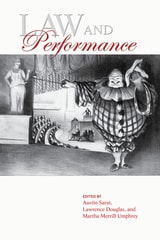
Law and Performance
Austin Sarat
University of Massachusetts Press, 2018
In considering law through the lens of performance studies, the contributors in this volume emphasize the embodied, affective, and reiterative qualities that move law off the printed page and into the thick world of lived experience. They consider the blurring of lines between performance and the enactment of law, the transformative exchanges between the law and its many and varied stagings, and the impact or resonance of performativity in situations where innocence and guilt may be determined. In addition to the editors, the contributors include Joshua Chambers-Letson, Catherine M. Cole, Ryan Hartigan, Lara D. Nielsen, Julie Stone Peters, Ann Pellegrini, and Karen Shimakawa.
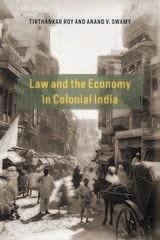
Law and the Economy in Colonial India
Tirthankar Roy and Anand V. Swamy
University of Chicago Press, 2021
Tirthankar Roy and Anand V. Swamy trace the beginnings of the current Indian legal system to the years of British colonial rule. They show how India inherited an elaborate legal system from the British colonial administration, which incorporated elements from both British Common Law and indigenous institutions. In the case of property law, especially as it applied to agricultural land, indigenous laws and local political expediency were more influential in law-making than concepts borrowed from European legal theory. Conversely, with commercial law, there was considerable borrowing from Europe. In all cases, the British struggled with limited capacity to enforce their laws and an insufficient knowledge of the enormous diversity and differentiation within Indian society. A disorderly body of laws, not conducive to production and trade, evolved over time. Roy and Swamy’s careful analysis not only sheds new light on the development of legal institutions in India, but also offers insights for India and other emerging countries through a look at what fosters the types of institutions that are key to economic growth.
Law and the Gay Rights Story
The Long Search for Equal Justice in a Divided DemocracyFrank, Walter
Rutgers University Press, 2014
In his gripping new book, Walter Frank offers an in-depth look at the court cases that were pivotal in establishing gay rights. But he also tells the story of those individuals who were willing to make waves by fighting for those rights, taking enormous personal risks at a time when the tide of public opinion was against them. Frank’s accessible style brings complex legal issues down to earth but, as a former litigator, never loses sight of the law’s human dimension and the context of the events occurring outside the courtroom.
Chronicling the past half-century of gay and lesbian history, Law and the Gay Rights Story offers a unique perspective on familiar events like the Stonewall Riots, the AIDS crisis, and the repeal of “Don’t Ask, Don’t Tell.” Frank pays special attention to the constitutional issues surrounding same-sex marriage and closely analyzes the two recent Supreme Court cases addressing the issue. While a strong advocate for gay rights, Frank also examines critiques of the movement, including some coming from the gay community itself. Comprehensive in coverage, the book explains the legal and constitutional issues involved in each of the major goals of the gay rights movement: a safe and healthy school environment, workplace equality, an end to anti-gay violence, relationship recognition, and full integration into all the institutions of the larger society, including marriage and military service. Drawing from extensive archival research and from decades of experience as a practicing litigator, Frank not only provides a vivid history, but also shows where the battle for gay rights might go from here.
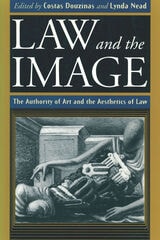
Law and the Image
The Authority of Art and the Aesthetics of LawEdited by Costas Douzinas and Lynda Nead
University of Chicago Press, 1999
The essays draw on the critical procedures of law, art history, and cultural studies in order to create a new interdisciplinary field of visual culture and law. In exploring the hidden interdependence of law and art, the writings refute the generally held conception that law is fixed and rational while the judgment of art is autonomous and ambiguous. Among the topics addressed are the history of the relationship between art and law, the ways in which the visual is made subject to the force of the law, and the complex relations between law, the image, and identity.
With its groundbreaking ideas from a variety of intellectual traditions and disciplines, this book puts law and art into a new and exciting conversation that will introduce a new field of study and spark international debate.
Contributors are: Georges Didi-Huberman, Costas Douzinas, Hal Foster, Peter Goodrich, Piyel Haldar, Martin Jay, Mandy Merck, Lynda Nead, Jonathan Ribner, Katherine Fischer Taylor.
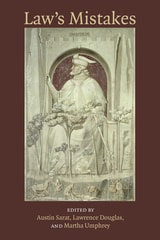
Law's Mistakes
Austin Sarat
University of Massachusetts Press, 2016
The essays in Law's Mistakes explore the things that law recognizes as errors and the way it responds to them. They identify the jurisprudential and political perspectives that underlie different understandings of what is or is not a legal mistake, and examine the fraught, contested, and evolving relationship between law and error. And they offer templates for thinking about what mistakes can tell us about the aspirations and limits of law, and for understanding how our imagining of law is enabled and shaped by its juxtaposition to a condition labeled mistake.
In addition to the volume editors, contributors include Paul Schiff Berman, Sonali Chakravarti, Jody L. Medeira, Stewart Motha, Kunal Parker, and Jordan Steiker.

Laws of Early Iceland
Gragas IAndrew Dennis
University of Manitoba Press, 2007
Laws of Early Iceland
Gragas IIAndrew Dennis
University of Manitoba Press, 2000
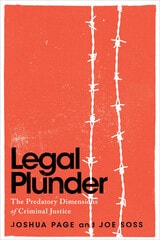
Legal Plunder
The Predatory Dimensions of Criminal JusticeJoshua Page and Joe Soss
University of Chicago Press, 2025
A searing, historically rich account of how US policing and punishment have been retrofitted over the last four decades to extract public and private revenues from America’s poorest and most vulnerable communities.
Alongside the rise of mass incarceration, a second profound and equally disturbing development has transpired. Since the 1980s, US policing and punishment have been remade into tools for stripping resources from the nation’s most oppressed communities and turning them into public and private revenues. Legal Plunder analyzes this development’s origins, operations, consequences, and the political struggles that it has created.
Drawing on historical and contemporary evidence, including original ethnographic research, Joshua Page and Joe Soss examine the predatory dimensions of criminal legal governance to show how practices that criminalize, police, and punish have been retrofitted to siphon resources from subordinated groups, subsidize governments, and generate corporate profits. As tax burdens have declined for the affluent, this financial extraction—now a core function of the country’s sprawling criminal legal apparatus—further compounds race, class, and gender inequalities and injustices. Legal Plunder shows that we can no longer afford to overlook legal plunder or the efforts to dismantle it.
Legal Plunder
The Predatory Dimensions of Criminal JusticeJoshua Page and Joe Soss
University of Chicago Press, 2025
This is an auto-narrated audiobook version of this book.
A searing, historically rich account of how US policing and punishment have been retrofitted over the last four decades to extract public and private revenues from America’s poorest and most vulnerable communities.
Alongside the rise of mass incarceration, a second profound and equally disturbing development has transpired. Since the 1980s, US policing and punishment have been remade into tools for stripping resources from the nation’s most oppressed communities and turning them into public and private revenues. Legal Plunder analyzes this development’s origins, operations, consequences, and the political struggles that it has created.
Drawing on historical and contemporary evidence, including original ethnographic research, Joshua Page and Joe Soss examine the predatory dimensions of criminal legal governance to show how practices that criminalize, police, and punish have been retrofitted to siphon resources from subordinated groups, subsidize governments, and generate corporate profits. As tax burdens have declined for the affluent, this financial extraction—now a core function of the country’s sprawling criminal legal apparatus—further compounds race, class, and gender inequalities and injustices. Legal Plunder shows that we can no longer afford to overlook legal plunder or the efforts to dismantle it.
Legal Rights
Historical and Philosophical PerspectivesAustin Sarat and Thomas R. Kearns, Editors
University of Michigan Press, 1997
Legality and Legitimacy
Carl Schmitt
Duke University Press, 2004
Legality and Legitimacy is sure to provide a compelling reference point in contemporary debates over the challenges facing constitutional democracies today. In addition to Jeffrey Seitzer’s translation of the 1932 text itself, this volume contains his translation of Schmitt’s 1958 commentary on the work, extensive explanatory notes, and an appendix including selected articles of the Weimar constitution. John P. McCormick’s introduction places Legality and Legitimacy in its historical context, clarifies some of the intricacies of the argument, and ultimately contests Schmitt’s claims regarding the inherent weakness of parliamentarism, constitutionalism, and the rule of law.
Like a Loaded Weapon
The Rehnquist Court, Indian Rights, and the Legal History of Racism in AmericaRobert Williams Jr.
University of Minnesota Press, 2005
Beginning with Chief Justice John Marshall’s foundational opinions in the early nineteenth century and continuing today in the judgments of the Rehnquist Court, Williams shows how undeniably racist language and precedent are still used in Indian law to justify the denial of important rights of property, self-government, and cultural survival to Indians. Building on the insights of Malcolm X, Thurgood Marshall, and Frantz Fanon, Williams argues that racist language has been employed by the courts to legalize a uniquely American form of racial dictatorship over Indian tribes by the U.S. government.
Williams concludes with a revolutionary proposal for reimagining the rights of American Indians in international law, as well as strategies for compelling the current Supreme Court to confront the racist origins of Indian law and for challenging bigoted ways of talking, thinking, and writing about American Indians.
Robert A. Williams Jr. is professor of law and American Indian studies at the James E. Rogers College of Law, University of Arizona. A member of the Lumbee Indian Tribe, he is author of The American Indian in Western Legal Thought: The Discourses of Conquest and coauthor of Federal Indian Law.
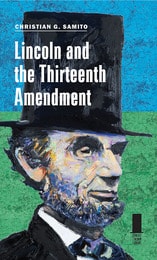
Lincoln and the Thirteenth Amendment
Christian G. Samito
Southern Illinois University Press, 2015
Long before the Civil War, Abraham Lincoln recognized the challenge American slavery posed to the ideals of the Declaration of Independence. A constitutional amendment would be the ideal solution to ending slavery, yet the idea of such an amendment conflicted with several of Lincoln’s long-held positions. In this study, Christian G. Samito examines how Lincoln’s opposition to amending the United States Constitution shaped his political views before he became president, and how constitutional arguments overcame Lincoln’s objections, turning him into a supporter of the Thirteenth Amendment by 1864.
For most of his political career, Samito shows, Lincoln opposed changing the Constitution, even to overturn Supreme Court rulings with which he disagreed. Well into his presidency, he argued that emancipation should take place only on the state level because the federal government had no jurisdiction to control slavery in the states. Between January 1863 and mid-1864, however, Lincoln came to support a constitutional amendment to abolish slavery because it worked within the constitutional structure and preserved key components of American constitutionalism in the face of Radical Republican schemes. Samito relates how Lincoln made the amendment an issue in his 1864 reelection campaign, chronicles lobbying efforts and the final vote in the House on the amendment resolution, and interrogates various charges of corruption and back-room deals. He also considers the Thirteenth Amendment in the context of the Hampton Roads conference, Lincoln’s own thoughts on the meaning of the amendment, and the impact of Lincoln’s assassination on the reading of the amendment. Samito provides the authoritative historical treatment of a story so compelling it was recently dramatized in the movie Lincoln.
Closing with a lively discussion that applies the Thirteenth Amendment to current events, this concise yet comprehensive volume demonstrates how the constitutional change Lincoln helped bring about continues to be relevant today.
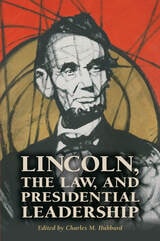
Lincoln, the Law, and Presidential Leadership
Edited by Charles M. Hubbard
Southern Illinois University Press, 2015
The volume’s contributors not only address specific situations and issues that assisted in Lincoln’s development of a new understanding of law and its application but also show Lincoln’s remarkable presidential leadership. Among the topics covered are civil liberties during wartime; presidential pardons; the law and Lincoln’s decision-making process; Lincoln’s political ideology and its influence on his approach to citizenship; Lincoln’s defense of the Constitution, the Union, and popular government; constitutional restraints on Lincoln as he dealt with slavery and emancipation; the Lieber codes, which set forth how the military should deal with civilians and with prisoners of war; the loyalty (or treason) of government employees, including Lincoln’s domestic staff; and how Lincoln’s image has been used in presidential rhetoric. Although varied in their strategies and methodologies, these essays expand the understanding of Lincoln’s vision for a united nation grounded in the Constitution.
Lincoln, the Law, and Presidential Leadership shows how the sixteenth president’s handling of complicated legal issues during the Civil War, which often put him at odds with the Supreme Court and Congress, brought the nation through the war intact and led to a transformation of the executive branch and American society.
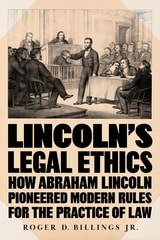
Lincoln’s Legal Ethics
How Abraham Lincoln Pioneered Modern Rules for the Practice of LawRoger D. Billings Jr.
University of Illinois Press, 2027
Roger D. Billings Jr. examines how Lincoln’s practices in Illinois helped shape the development of the legal standards that lawyers follow today. Lincoln learned the law through self-study, experience, and mentorship. Billings focuses on actual cases to show Lincoln’s ethical choices when confronted with issues like conflict of interest, client trust, and honesty with the court. In addition, the studies shine a light on the future president’s on-the-job performance. Though an imperfect practitioner, Lincoln and his energetic work on behalf of clients and way of doing business, among other practices, influenced the evolution of the ABA Model Rules of Professional Conduct in the United States.
An original study of Lincoln’s years at the bar, Lincoln’s Legal Ethics connects the self-styled country lawyer with modern legal standards.
Literary Journalism on Trial
Masson v. New Yorker and the First AmendmentKathy Roberts Forde
University of Massachusetts Press, 2008
In November 1984, Jeffrey Masson filed a libel suit against writer Janet Malcolm and the New Yorker, claiming that Malcolm had intentionally misquoted him in a profile she wrote for the magazine about his former career as a Freud scholar and administrator of the Freud archives. Over the next twelve years the case moved up and down the federal judicial ladder, at one point reaching the U.S. Supreme Court, as lawyers and judges wrestled with questions about the representation of “truth” in journalism and, by extension, the limits of First Amendment protections of free speech. Had a successful Freudian scholar actually called himself an “intellectual gigolo” and “the greatest analyst who ever lived?" Or had a respected writer for the New Yorker knowingly placed false, self-damning words in her subject's mouth?
In Literary Journalism on Trial, Kathy Roberts Forde explores the implications of Masson v. New Yorker in the context of the history of American journalism. She shows how the case represents a watershed moment in a long debate between the advocates of traditional and literary journalism and explains how it reflects a significant intellectual project of the period: the postmodern critique of objectivity, with its insistence on the instability of language and rejection of unitary truth in human affairs. The case, Forde argues, helped widen the perceived divide between ideas of literary and traditional journalism and forced the resolution of these conflicting conceptions of truth in the constitutional arena of libel law. By embracing traditional journalism's emphasis on fact and objectivity and rejecting a broader understanding of truth, the Supreme Court turned away from the First Amendment theory articulated in previous rulings, opting to value less the free, uninhibited interchange of ideas necessary to democracy and more the “trustworthiness” of public expression. The Court's decision in this case thus had implications that reached beyond the legal realm to the values and norms expressed in the triangular relationship between American democracy, First Amendment principles, and the press.
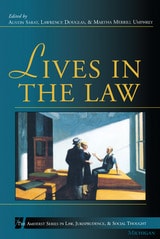
Lives in the Law
Austin Sarat, Lawrence Douglas, and Martha Merrill Umphrey, Editors
University of Michigan Press, 2002
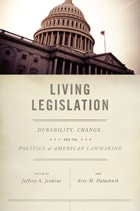
Living Legislation
Durability, Change, and the Politics of American LawmakingEdited by Jeffery A. Jenkins and Eric M. Patashnik
University of Chicago Press, 2012