155 books match the query 'Legislators' and 8 start with l
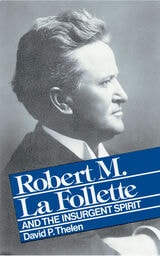
cover of La Follette Insurgent Spirit

La Follette Insurgent Spirit

David P. Thelen

University of Wisconsin Press, 1986
Robert M. La Follette and the Insurgent Spirit is a closely argued, lively, and readable biography of the central figure in the American Progressive movement. Wisconsin's “Fighting Bob” La Follette embodied the heart of Progressive sentiment and principle. He was a powerful force in shaping national political events between the eras of Populism and the New Deal
[more]
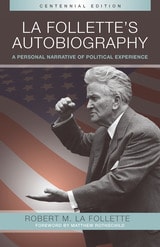
cover of La Follette’s Autobiography: A Personal Narrative of Political Experiences

La Follette’s Autobiography

A Personal Narrative of Political Experiences

Robert M. La Follette; Foreword by Matthew Rothschild

University of Wisconsin Press, 2013
Written in lucid, vigorous prose, La Follette's Autobiography is the famous Wisconsin senator's own account of his political life and philosophy. Both memoir and a history of the Progressive cause in the United States, it charts La Follette's formative years in politics, his attempts to abolish entrenched, ruthless state and corporate influences, and his embattled efforts to advance Progressive policies as Wisconsin governor and U.S. senator. With a new foreword by Matthew Rothschild, editor of The Progressive—the magazine that La Follette himself founded—the Autobiography remains a powerful reminder of the legacies of Progressivism and reform and the enduring voice of the man who fought for them.
[more]
cover of Legislative Entrepreneurship in the U.S. House of Representatives

Legislative Entrepreneurship in the U.S. House of Representatives

Gregory Wawro

University of Michigan Press, 2001
When members are elected to the House of Representatives they have a certain freedom to decide how they will act as members and how they will build their reputations. Just as in the market place entrepreneurs build businesses, so in the House of Representatives members have the freedom to choose to build legislative programs that will enhance their reputations in the institution. And yet entrepreneurship is also costly to members. Gregory Wawro explains why members of the House engage in legislative entrepreneurship by examining what motivates them to acquire policy knowledge, draft legislation, build coalitions, and push their legislation in the House. He considers what incentives members have to perform what many have perceived to be the difficult and unrewarding tasks of legislating.
This book shows how becoming a legislative entrepreneur relates to members' goals of reelection, enacting good public policy, and obtaining influence in the House. The analysis differs from previous studies of this behavior, which for the most part have employed case study methods and have relied on anecdotal evidence to support their arguments. Wawro analyzes legislative entrepreneurship in a general and systematic fashion, developing hypotheses from rational-choice-based theories and testing these hypotheses using quantitative methods.
Wawro argues that members engage in legislative entrepreneurship in order to get ahead within the House. He finds that the more legislative entrepreneurship that members engage in, the more likely it is that they will advance to prestigious positions.
This book is of interest to students of Congress, legislative behavior and institutions, elections, and campaign finance.
Gregory Wawro is Assistant Professor of Political Science, Columbia University.
[more]
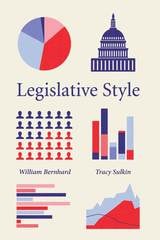
cover of Legislative Style

Legislative Style

William Bernhard and Tracy Sulkin

University of Chicago Press, 2018

Once elected, members of Congress face difficult decisions about how to allocate their time and effort. On which issues should they focus? What is the right balance between working in one’s district and on Capitol Hill? How much should they engage with the media to cultivate a national reputation? William Bernhard and Tracy Sulkin argue that these decisions and others define a “legislative style” that aligns with a legislator’s ambitions, experiences, and personal inclinations, as well as any significant electoral and institutional constraints.

Bernhard and Sulkin have developed a systematic approach for looking at legislative style through a variety of criteria, including the number of the bills passed, number of speeches given, amount of money raised, and the percentage of time a legislator voted in line with his or her party. Applying this to ten congresses, representing twenty years of congressional data, from 1989 to 2009, they reveal that legislators’ activity falls within five predictable styles. These styles remain relatively consistent throughout legislators’ time in office, though a legislator’s style can change as career goals evolve, as well as with changes to individual or larger political interests, as in redistricting or a majority shift. Offering insight into a number of enduring questions in legislative politics, Legislative Style is a rich and nuanced account of legislators’ activity on Capitol Hill.
 
[more]
cover of Legislators and Politicians: Iowa's Women Lawmakers

Legislators and Politicians

Iowa's Women Lawmakers

Suzanne O'Dea Schenken

University of Iowa Press, 1995
[more]
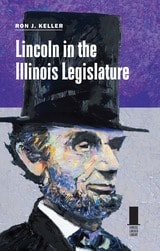
cover of Lincoln in the Illinois Legislature

Lincoln in the Illinois Legislature

Ron J Keller

Southern Illinois University Press, 2019

In this indispensable account of Abraham Lincoln’s earliest political years, Ron J. Keller reassesses Lincoln’s arguably lackluster legislative record during four terms in the Illinois House of Representatives to reveal how the underpinnings of his temperament, leadership skills, and political acumen were bolstered on the statehouse floor.
 
Due partly to Lincoln’s own reserve and partly to an unimpressive legislative tally, Lincoln’s time in the state legislature has been largely neglected by historians more drawn to other early hallmarks of his life, including his law career, his personal life, and his single term as a U.S. congressman in the 1840s. Of about sixteen hundred bills, resolutions, and petitions passed from 1834 to 1842, Lincoln introduced only about thirty of them. The issue he most ardently championed and shepherded through the legislature—the internal improvements system—left the state in debt for more than a generation.
 
Despite that spotty record, Keller argues, it was during these early years that Lincoln displayed and honed the traits that would allow him to excel in politics and ultimately define his legacy: honesty, equality, empathy, and leadership. Keller reanimates Lincoln’s time in the Illinois legislature to reveal the formation of Lincoln’s strong character and political philosophy in those early years, which allowed him to rise to prominence as the Whig party’s floor leader regardless of setbacks and to build a framework for his future.
 
Lincoln in the Illinois Legislature details Lincoln’s early political platform and the grassroots campaigning that put him in office. Drawing on legislative records, newspaper accounts, speeches, letters, and other sources, Keller describes Lincoln’s positions on key bills, highlights his colleagues’ perceptions of him, and depicts the relationships that grew out of his statehouse interactions. Keller’s research delves into Lincoln’s popularity as a citizen of New Salem, his political alliances and victories, his antislavery stirrings, and his personal joys and struggles as he sharpened his political shrewdness.
 
Keller argues Lincoln’s definitive political philosophies—economic opportunity and the right to rise, democratic equality, and to a lesser extent his hatred of slavery—took root during his legislative tenure in Illinois. Situating Lincoln’s tenure and viewpoints within the context of national trends, Keller demonstrates that understanding Lincoln’s four terms as a state legislator is vital to understanding him as a whole.
 
[more]
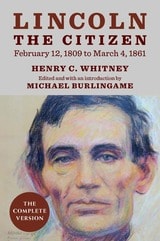
cover of Lincoln the Citizen, February 12, 1809 to March 4, 1861: The Complete Version

Lincoln the Citizen, February 12, 1809 to March 4, 1861

The Complete Version

Henry C. Whitney. Edited and with an introduction by Michael Burlingame

University of Illinois Press, 2025

Written by a longtime friend and ally, Lincoln the Citizen offers a rare character study and insightful biography of Lincoln before he became president. Michael Burlingame restores material cut by editors of the original 1907 publication to present Henry Clay Whitney’s work in full.

Whitney’s work reveals the legal and political spheres where Lincoln moved while providing eyewitness accounts and intimate stories shared by Lincoln himself. Whitney’s unique vantage point informs analyses of everything from Lincoln’s melancholic temperament to his colorful early career to views on his marriage and family life. Burlingame places Whitney’s singular contributions within Lincoln studies but also weighs criticisms of the book and disputes over what information the author may or may not have invented.

A restored edition of an invaluable memoir, Lincoln the Citizen presents a wealth of overlooked biographical detail by one of the people who knew Lincoln best.
[more]
cover of Lister Hill: Statesman from the South

Lister Hill

Statesman from the South

Virginia Van der Veer Hamilton

University of Alabama Press, 2004

"Hamilton makes clear in this intelligent and sensitive biography [that] Hill, whose 45 years in Congress spanned the presidents from Calvin Coolidge to Lyndon Johnson, deserves to be remembered, both for the impressive legislative record he compiled and for the light he shed on southern liberalism in the 20th century." -- Journal of Southern History "Hamilton's fine book is based on extensive research [and] it will be of interest to a general audience as well as to scholars." -- Journal of American History "This is an important work about a highly influential lawmaker." Choice Virginia Van der Veer Hamilton is Professor Emerita of History at The University of Alabama at Birmingham and author of Hugo Black: The Alabama Years.
[more]