Results by title
85 books match the query 'Literature and history' and 2 start with l
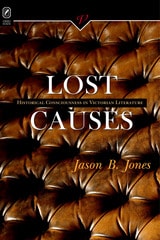
LOST CAUSES
Historical Consciousness in Victorian LiteratureJason B. Jones
The Ohio State University Press, 2006
What if we didn’t always historicize when we read Victorian fiction?
Lost Causes shows that Victorian writers frequently appear to have a more supple and interesting understanding of the relationship between history, causality, and narrative than the one typically offered by readers who are burdened by the new historicism. As a return to these writers emphasizes, the press of modern historicism deforms Victorian novels, encouraging us to read deviations from strict historical accuracy as ideological bad faith. By contrast, Jason B. Jones argues through readings of works ranging from The French Revolution to Middlemarch that literature’s engagement with history has to be read otherwise.Perhaps perversely, Lost Causes suggests simultaneously that psychoanalysis speaks pressingly to the vexed relationship between history and narrative, and that the theory is neither a- nor anti-historical. Through his readings of Victorian fiction addressing the recent past, Jones finds in psychoanalysis not a set of truths, but rather a method for rhetorical reading, ultimately revealing how its troubled account of psychic causality can help us follow literary language’s representation of the real. Victorian narratives of the recent past and psychoanalytic interpretation share a fascination with effects that persist despite baffling, inexplicable, or absent causes.
In chapters focusing on Thomas Carlyle, Charles Dickens, Charlotte Brontë, and George Eliot, Lost Causes demonstrates that history can carry an ontological, as well as an epistemological, charge—one that suggests a condition of being in the world as well as a way of knowing the world as it really is. From this point of view, Victorian fiction that addresses the recent past is not a failed realism, as it is so frequently claimed, but rather an exploration of possibility in history.
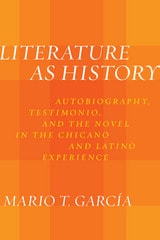
Literature as History
Autobiography, Testimonio, and the Novel in the Chicano and Latino ExperienceMario T. García
University of Arizona Press, 2016
Literature as History offers a critical new path for Chicano and Latino history. Historian Mario T. García analyzes prominent works of Chicano fiction, nonfiction, and autobiographical literature to explore how they can sometimes reveal even more about ordinary people’s lives. García argues that this approach can yield personal insights into historical events that more formal documents omit, lending insights into such diverse issues as gender identity, multiculturalism, sexuality, and the concerns of the working class.
In a stimulating and imaginative look at the intersection of history and literature, García discusses the meaning and intent of narratives. Literature as History represents a unique way to rethink history. García, a leader in the field of Chicano history and one of the foremost historians of his generation, explores how Chicano historians can use Chicano and Latino literature as important historical sources. Autobiography, testimonio, and fiction are the genres the author researches to obtain new and insightful perspectives on Chicano history at the personal and grassroots levels. Breaking the boundaries between history and literature, García provides a thought-provoking discussion of what constitutes a historical source.