Results by title
100 books match the query 'London' and 10 start with l
London Voices, 1820–1840
Vocal Performers, Practices, HistoriesEdited by Roger Parker and Susan Rutherford
University of Chicago Press, 2019
It is the London of this period that editors Roger Parker and Susan Rutherford pinpoint in this book, which chooses one broad musical category—voice—and engages with it through essays on music of the streets, theaters, opera houses, and concert halls; on the raising of voices in religious and sociopolitical contexts; and on the perception of voice in literary works and scientific experiments with acoustics. Emphasizing human subjects, this focus on voice allows the authors to explore the multifaceted issues that shaped London, from the anxiety surrounding the city’s importance in the musical world at large to the changing vocal imaginations that permeated the epoch. Capturing the breadth of sonic stimulations and cultures available—and sometimes unavoidable—to residents at the time, London Voices, 1820–1840 sheds new light on music in Britain and the richness of London culture during this period.

London and beyond
Essays in honour of Derek KeeneEdited by Matthew Davies and James A. Galloway
University of London Press, 2012
London in His Own Time
A Biographical Chronicle of His Life, Drawn from Recollections, Interviews, and Memoirs by Family, Friends, and AssociatesJeanne Reesman
University of Iowa Press, 2020
Everyone knows Jack London for his tales of adventure in Alaska and the Canadian Yukon. With his work translated into more than 100 languages, London is one of the most popular American writers in the world, alongside Mark Twain. Yet for the reader tackling The Call of the Wild or White Fang, or perhaps his most often-anthologized short story “To Build a Fire,” many misconceptions about his life confuse his legacy.
London in His Own Time is based on Jeanne Reesman’s nearly thirty-five years of archival research. The book offers surprising perspectives on Jack London’s many sides by family, friends, fellow struggling young writers, business associates, high school and college classmates, interviewers, editors, coauthors, visitors to his Sonoma Valley Beauty Ranch in Glen Ellen, California, and more.
People who have commented on and discussed the mercurial genius include Joseph Conrad, Theodore Dreiser, Upton Sinclair, Sinclair Lewis, Ambrose Bierce, and Mary Austin, as well as his half-sister, Eliza London Shepard, and his first wife, Elizabeth Bess “Bessie” Maddern London. There are a few Klondike pals he kept in touch with, and some fellow writers such as Cloudesley Johns, but many of those closest to him truly demonstrate his wide range of friends: barman Johnny Heinold; his second wife, Charmian, whom he called “Mate Woman”; his daughters, Joan and Becky; his lover, Anna Strunsky; his closest friends, especially the poet George Sterling; his former crewmate on the Snark, Martin Johnson; and his valet/memoirist, Yoshimatsu Nakata. Reesman also includes dozens of entries from Bay-area socialists, friends in Hawai’i and the South Seas, fellow war correspondents, neighbors like Luther Burbank, and his long-time editor at Macmillan, George Brett.
London in Quotations
Compiled by Jaqueline Mitchell
Bodleian Library Publishing, 2014
“When a man is tired of London, he is tired of life; for there is in London all that life can afford.” Samuel Johnson spoke highly of London in Boswell’s famous biography, but not all have shared his enthusiasm. Since, the capital has been characterized as a “riddle,” a “cesspool,” and a “modern Babylon”—the last by none other than Prime Minister Benjamin Disraeli. No tribute to the city would be complete without reference to the notoriously inclement weather, which caused Jane Austen to complain that, “in London it is always a sickly season.”
For fans, foes, and those planning a trip to the city in the hopes of forming an opinion, this collection will be welcomed.
London in a Box
Englishness and Theatre in Revolutionary AmericaOdai Johnson
University of Iowa Press, 2017
If one went looking for the tipping point in the prelude to the American Revolution, it would not be the destruction of the tea in Boston Harbor, or the blockade of Boston by British warships, or even the gathering of the first Continental Congress; rather, it was the Congress’s decision in late October of 1774 to close the theatres. In this remarkable feat of historical research, Odai Johnson pieces together the surviving fragments of the story of the first professional theatre troupe based in the British North American colonies. In doing so, he tells the story of how colonial elites came to decide they would no longer style themselves British gentlemen, but instead American citizens.
London in a Box chronicles the enterprise of David Douglass, founder and manager of the American Theatre, from the 1750s to the climactic 1770s. The ambitious Scotsman’s business was teaching provincial colonials to dress and behave as genteel British subjects. Through the plays he staged, the scenery and costumes, and the bearing of his actors, he displayed London fashion and London manners. He counted among his patrons the most influential men in America, from British generals and governors to local leaders, including the avid theatre-goers George Washington and Thomas Jefferson. By 1774, Douglass operated a monopoly of theatres in six colonies and the Anglophone Caribbean, from Jamaica to Charleston and northward to New York City. (Boston remained an impregnable redoubt against theatre.)
How he built this network of patrons and theatres and how it all went up in flames as the revolution began is the subject of this witty history. A treat for anyone interested in the world of the American Revolution and an important study for historians of the period.
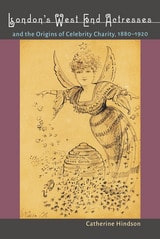
London's West End Actresses and the Origins of Celebrity Charity, 1880-1920
Catherine Hindson
University of Iowa Press, 2016
In the late nineteenth century, theatre’s fundraising for charitable causes shifted from male-dominated and private to female-directed and public. Although elite women had long been involved in such enterprises, they took on more authority in this period. At the same time, regular, high-profile public charity events became more important and much more visible than private philanthropy. Actresses became key figures in making the growing number of large and heavily publicized fundraisers successful. By 1920, the attitude was “Get an actress first. If you can’t get an actress, then get a duchess.” Actresses’ star power, their ability to orchestrate large events quickly, and their skill at performing a kind of genteel extortion made them essential to this model of charity. Actresses also benefited from this new role. Taking a prominent, public, offstage position was crucial in making them, individually and collectively, respectable professionals.
Author Catherine Hindson reveals this history by examining the major types of charity events at the turn of the twentieth century, including fundraising matinees, charity bazaars and costume parties, theatrical tea and garden parties, and benefit performances. Her study concludes with a look at the involvement of actresses in raising funds for British soldiers serving in the Anglo-Boer War and the First World War.
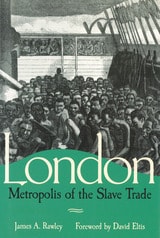
London, Metropolis of the Slave Trade
James A. Rawley & Foreword by David Eltis
University of Missouri Press, 2003
"The recognition that ordinary people could and did trade in slaves, as well as the fact that ordinary people became slaves, is, indeed, the beginning of comprehending the enormity of the forced migration of eleven million people and the attendant deaths of many more."
Rawley draws on material from the year 1700 to the American Civil War as he explores the role of London in the trade. He covers its activity as a port of departure for ships bound for Africa; its continuing large volume after the trade extended to Bristol and Liverpool; and the controversy between London’s parliamentary representatives, who defended the trade, and the abolitionist movement that was quartered there.
Sweeping in scope and thorough in its analysis, this collection of essays from a seasoned scholar will be welcomed by historians concerned with slavery and the slave trade, as well as by students just beginning their exploration of this subject.
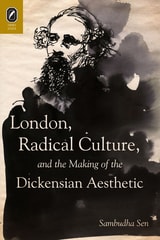
London, Radical Culture, and the Making of the Dickensian Aesthetic
Sambudha Sen
The Ohio State University Press, 2012
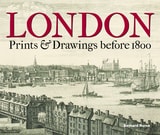
London
Prints & Drawings before 1800Bernard Nurse
Bodleian Library Publishing, 2017
This book presents more than a hundred images of Greater London from before 1800, all from the Gough Collection of the Bodleian Library. We see prints of London before and after the Great Fire, images of the 1780 tornado, panoramas of the Thames, depictions of the building and destruction of landmark bridges, and much more. Making brilliant use of the most extensive collection of London images amassed by any private collector of the period, the book will be essential to anyone delving into the history of the city.
London
The Selden Map and the Making of a Global City, 1549-1689Robert K. Batchelor
University of Chicago Press, 2013