Results by title
58 books match the query 'Margins' and 4 start with l
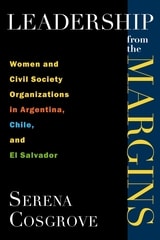
Leadership From the Margins
Women and Civil Society Organizations in Argentina, Chile, and El SalvadorCosgrove, Serena
Rutgers University Press, 2010
Leadership from the Margins describes and analyzes the unique leadership styles and challenges facing the women leaders of CSOs in Argentina, Chile, and El Salvador. Based on ethnographic research, Serena Cosgrove's analysis offers a nuanced account of the distinct struggles facing women, and how differences of class, political ideology, and ethnicity have informed their outlook and organizing strategies. Using a gendered lens, she reveals the power and potential of women's leadership to impact the direction of local, regional, and global development agendas.
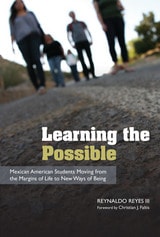
Learning the Possible
Mexican American Students Moving from the Margins of Life to New Ways of BeingReynaldo Reyes III; Foreword by Christian J. Faltis
University of Arizona Press, 2013
Laura, Christina, Luz, Maria, and Ruben, as the author calls them, had daunting challenges: difficulties with English, extremely low self-confidence, teenage motherhood, conflict between gender roles and personal desires, and a history of gang membership. Focusing on the importance of constructing a new identity as a successful student, Reynaldo Reyes III shares with readers the experiences of these marginalized students. Their stories, coupled with perspectives from instructors, CAMP staff and counselors, and the author’s own observations, illustrate the influence of past schooling, the persistence of culture, and the tensions and challenges inherent in developing a new identity.
This is a study of students who came from the margins and, in a very short time, moved toward the mainstream. In the micro view, it provides extraordinarily useful case studies of a successful intervention program in process. In the larger scope, it is a look at the socially constructed nature of possibility, hope, and success.
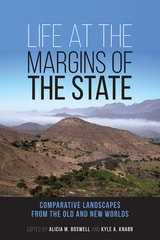
Life at the Margins of the State
Comparative Landscapes from the Old and New WorldsAlicia M. Boswell
University Press of Colorado, 2022
Case studies from the New and Old Worlds—including historic California, medieval Iceland, ancient Mesoamerica, ancient Nubia, colonial El Salvador, the prehistoric Levant, pre-Columbian Amazon, Africa’s historic central Sahel, and ancient Peru—offer novel perspectives on how borderland societies adapted to the unique human and natural environments of these liminal spaces. Contributors draw on archaeological evidence as well as historical documents and linguistic data to facilitate the documentation of local histories and the strategies employed by communities living in or near ancient states and empires.
This close study of groups on the margins shows that peripheral polities are not simply the by-products of complexity emanating from a political core and demonstrates that traditional assumptions and models need to be reconsidered.
Contributors:
Tara D. Carter, Mikael Fauvelle, Elena A.A. Garcea, Esteban Gomez, Scott MacEachern, Claire Novotny, Bradley J Parker, Erin Smith, John H. Walker
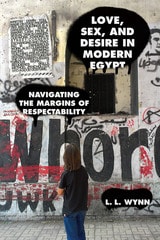
Love, Sex, and Desire in Modern Egypt
Navigating the Margins of RespectabilityBy L. L. Wynn
University of Texas Press, 2018
Cairo is a city obsessed with honor and respectability—and love affairs. Sara, a working-class woman, has an affair with a married man and becomes pregnant, only to be abandoned by him; Ayah and Zeid, a respectably engaged couple, argue over whether Ayah’s friend is a prostitute or a virgin; Malak, a European belly dancer who sometimes gets paid for sex, wants to be loved by a man who won’t treat her like a whore just because she’s a dancer; and Alia, a Christian banker who left her abusive husband, is the mistress of a wealthy Muslim man, Haroun, who encourages business by hosting risqué parties for other men and their mistresses.
Set in transnational Cairo over two decades, Love, Sex, and Desire in Modern Egypt is an ethnography that explores female respectability, male honor, and Western theories and fantasies about Arab society. L. L. Wynn uses stories of love affairs to interrogate three areas of classic anthropological theory: mimesis, kinship, and gift. She develops a broad picture of how individuals love and desire within a cultural and political system that structures the possibilities of, and penalties for, going against sexual and gender norms. Wynn demonstrates that love is at once a moral horizon, an attribute that “naturally” inheres in particular social relations, a social phenomenon strengthened through cultural concepts of gift and kinship, and an emotion deeply felt and desired by individuals.