Results by title
175 books match the query 'Mayas' and 7 start with l
Land, Labor, and Capital in Modern Yucatan
Essays in Regional History and Political EconomyJeffrey T. Brannon
University of Alabama Press, 1991
Owing to Yucatan’s relative isolation, many assume that the history and economy of the peninsula have evolved in a distinctive way, apart from the central government in Mexico City and insulated from world social and economic factors. The essays in this volume suggest that this has not been the case: the process of development in Yucatan has been linked firmly to national and global forces of change over the past two centuries. The essays are by U.S., Mexican, Canadian, and Belizean social scientists representing both well-established and younger scholars. The result is a perspective on Yucatan’s historical development that is at once international, interdisciplinary, and intergenerational.
Last Rites for the Tipu Maya
Genetic Structuring in a Colonial CemeteryKeith Jacobi
University of Alabama Press, 2000
Jacobi's groundbreaking osteology study uncovers the history of the Tipu Maya of Belize and their subsequent contact with the Spanish conquistadores and missionaries.
Two cultures collided at Tipu, Belize, in the 1600s: that of the native Maya and that of the Spanish missionaries, who arrived with an agenda of religious subjugation and, ultimately, political control. Combining historical documentation with the results of an archaeological exploration of a Tipu cemetery, Keith Jacobi provides an account of the meshing of these two cultures and the assimilation of Catholic practices by the Tipu.
In particular, Jacobi focuses on the dental remains recovered at this site. A tooth may be the last tangible evidence of a living creature, so teeth can reveal information about an individual's health, diet, cosmetic alteration, trauma, and genetic structure. From the genetic structure the researcher can learn information about an individual's relationship to others in a particular population and between populations.
Jacobi's research reveals how these European and Spanish Catholic practices were assimilated by the Tipu Maya and enables the first description of the prevalent attitudes toward death and burial customs. Through this study of Tipu Maya dentition changes through time, Jacobi sheds light on Spanish intermarriage, Maya familial relationships, and the Tipu genetic affinity with other prehistoric, historic, and modern Maya.
Life and Politics at the Royal Court of Aguateca
Artifacts, Analytical Data, and SynthesisTakeshi Inomata
University of Utah Press, 2014
Because of the surprise nature of the attack, most artifacts were left in their original locations, providing unprecedented views of the daily life of the Classic Maya. Detailed analyses of these objects and their distribution has shown that Mayan elites stored some of their food in their residences and that they also conducted various administrative duties there. The presence of numerous precious ornaments indicates that many of the Maya elite were also skilled craft producers.
Life and Politics at the Royal Court of Aguateca is the third and final volume of the monograph series on Aguateca. It presents the analyses of items not covered in the first two volumes, including figurines, ceramic laminates and masks, spindle whorls, ground stone, and bone artifacts, as well as hieroglyphic texts and plant and animal remains. It discusses the broad implications of this remarkable data set and provides a summation of the project.
Lifeways in the Northern Maya Lowlands
New Approaches to Archaeology in the Yucatán PeninsulaEdited by Jennifer P. Mathews and Bethany A. Morrison
University of Arizona Press, 2006
By exploring various social and political levels of Maya society through a broad expanse of time, Lifeways in the Northern Maya Lowlands not only reconstructs a little-known past, it also suggests the broad implications of archaeology for related studies of tourism, household economies, and ethnoarchaeology. It is a benchmark work that pointedly demonstrates the need for researchers in both north and south to ignore modern geographic boundaries in their search for new ideas to further their understanding of the ancient Maya.
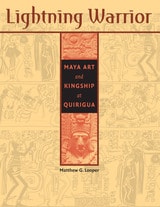
Lightning Warrior
Maya Art and Kingship at QuiriguaBy Matthew G. Looper
University of Texas Press, 2003
The ancient Maya city of Quirigua occupied a crossroads between Copan in the southeastern Maya highlands and the major centers of the Peten heartland. Though always a relatively small city, Quirigua stands out because of its public monuments, which were some of the greatest achievements of Classic Maya civilization. Impressive not only for their colossal size, high sculptural quality, and eloquent hieroglyphic texts, the sculptures of Quirigua are also one of the few complete, in situ series of Maya monuments anywhere, which makes them a crucial source of information about ancient Maya spirituality and political practice within a specific historical context.
Using epigraphic, iconographic, and stylistic analyses, this study explores the integrated political-religious meanings of Quirigua's monumental sculptures during the eighth-century A.D. reign of the city's most famous ruler, K'ak' Tiliw. In particular, Matthew Looper focuses on the role of stelae and other sculpture in representing the persona of the ruler not only as a political authority but also as a manifestation of various supernatural entities with whom he was associated through ritual performance. By tracing this sculptural program from its Early Classic beginnings through the reigns of K'ak' Tiliw and his successors, and also by linking it to practices at Copan, Looper offers important new insights into the politico-religious history of Quirigua and its ties to other Classic Maya centers, the role of kingship in Maya society, and the development of Maya art.
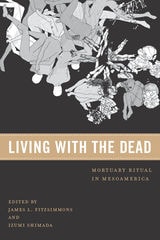
Living with the Dead
Mortuary Ritual in MesoamericaEdited by James L. Fitzsimmons and Izumi Shimada
University of Arizona Press, 2011
This book results from a symposium organized by the editors for an annual meeting of the Society for American Archaeology. The contributors employ historical sources, comparative art history, anthropology, and sociology, as well as archaeology and anthropology, to uncover surprising commonalities across cultures, including the manner in which the dead were politicized, the perceptions of reciprocity between the dead and the living, and the ways that the dead were used by the living to create, define, and renew social as well as family ties. In exploring larger issues of a “good death” and the transition from death to ancestry, the contributors demonstrate that across Mesoamerica death was almost never accompanied by the extinction of a persona; it was more often the beginning of a social process than a conclusion.
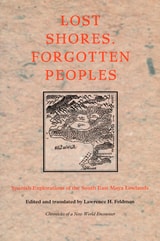
Lost Shores, Forgotten Peoples
Spanish Explorations of the South East Maya LowlandsLawrence H. Feldman, ed. and translator
Duke University Press, 2000
In these narratives—primary documents written by missionaries and conquistadors—vivid details of these little known Mayan cultures are revealed, answering how and why lowlanders were able to evade Spanish conquest while similar civilizations could not. Fascinating tales of the journey from Europe are included, involving unknown islands, lost pilots, life aboard a galleon fleet, political intrigue, cannibals, and breathtaking natural beauty. In short, these forgotten manuscripts—translations of the papers of the past—provide an unforgettable look at an understudied chapter in the age of exploration.
Lost Shores, Forgotten Peoples will appeal to archaeologists, anthropologists, and historians interested in Central America, the Maya, and the Spanish Conquest.