Results by title
129 books match the query 'Mind, Body, Spirit' and 3 start with l
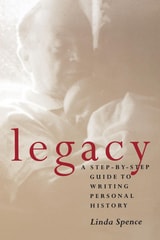
Legacy
A Step-By-Step Guide To Writing Personal HistoryLinda Spence
Ohio University Press, 1997
When Linda Spence asked her aging mother to write her life story, her mother stared at a blank sheet of paper and asked—“How? Where do I begin?” In this practical guide to capturing those memories that have been stored away, Linda Spence provides the questions that are the keys to unlocking the memories that make up a life.
Beyond the vital statistics are the personal stories that tell what it was like, what we did, and why we did it, how we feel about our choices, and what our circumstances were. Through encouraging coaching, shared memories, and open-ended questions, the process of producing a personal history becomes intriguing and engaging.
With Legacy the possibilities expand: a personal record is preserved—with its myths, traditions, joys, pains, gains, and losses; a family opens a potential dialogue that will last for generations; the writer has an opportunity for insight and resolution; the culture of a time and place is noted; the tradition of personal story is revitalized, and our present and future find nourishment and knowledge in the past.
Either as a gift that can act as a shared experience as the memories are recounted or as a personal way to take account of one’s experiences, often long since forgotten, Legacy is indeed a way to get one’s story down.

Lives of the Psychics
The Shared Worlds of Science and MysticismFred M. Frohock
University of Chicago Press, 2000
Lives of the Psychics, a journey through the terrain of psychic phenomena, tries to answer these questions through interviews with practicing psychics, a survey of the heroic attempts of researchers to test psychic abilities in controlled experiments, and an exploration of out-of-body, near-death, and mystical experiences. Fred M. Frohock brings together a wide variety of psychic claims and examines them with a rich set of materials—interviews, critical anecdotes, history, multiple theories of the paranormal—that allows him to use whatever tools are necessary to illuminate beliefs in the supernatural. He relates real-life events to scientific studies, so the reader is a party not only to fantastic experiences and first-hand stories of the paranormal but also to the rationales for these experiences proposed by scientists. There is no more rewarding guide to the limits and powers of science in explaining psychic phenomena.
To a field filled with uncertainty and suspicion, Frohock brings a discerning eye, a critical sensibility, and a fundamental sense of curiosity about the role of mysticism in science. Even skeptics will be intrigued.
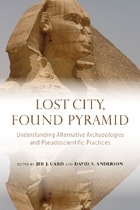
Lost City, Found Pyramid
Understanding Alternative Archaeologies and Pseudoscientific PracticesEdited by Jeb J. Card and David S. Anderson
University of Alabama Press, 2016
A critical investigation into how modern myths shape interpretations of the ancient past.
Lost City, Found Pyramid delves into the fascinating world of sensational “pseudoarchaeology,” from perennial discoveries of lost pyramids or civilizations to contemporary ghost-hunting and reality TV. It examines how nonscientific pursuit of myths and legends warps both public perceptions of archaeology and of human history itself.
A collection of twelve engaging and insightful essays, Lost City, Found Pyramid does far more than argue for the simple debunking of false archaeology. Rather, it brings into focus the value of understanding how and why pseudoarchaeology captures the public imagination. By comprehending pseudoarchaeology’s appeal as a media product, cultural practice, and communication strategy, archaeologists can enhance and enliven how they communicate about real archaeology in the classroom and in the public arena.
The first part of Lost City, Found Pyramid provides numerous case studies. Some examine the work of well-intentioned romantics who project onto actual archaeological data whimsical interpretative frameworks or quixotic “proofs” that confirm legends, such as that of the Lost White City of Honduras, or other alternative claims. Other case studies lay bare how false claims may inadvertently lead to the perpetuation of ethnic stereotypes, economic exploitation, political adventurism, and a misunderstanding of science.
Offering much of interest to scholars and students of archaeology, archaeology buffs, as well as policy-makers involved in the discovery, curation, and care of archaeological sites and relics, Lost City, Found Pyramid provides an invaluable corrective and hopeful strategy for engaging the public’s curiosity with the compelling world of archaeological discovery.