Results by title
225 books match the query 'Modernism' and 4 start with l

Landscapes
Photographs 1926-1946August Sander
University of Chicago Press, 2016
These photographs showcase a variety of scenes, from a sunrise over Cologne to the slopes of the Rhine valley. The Rhine River flows through many of these pictures, its dynamic curves and lively current leading the eye through an intriguing mix of natural and urban landscapes. A new essay by art historian Wolfgang Kemp provides context for Sander’s work while introducing his contemporaries, including the writer Hans Ludwig Mathar and the painter Franz M. Jansen. Also explored are the ties between Sander’s landscapes and his portrait photography, which is celebrated worldwide. Crucially, Kemp highlights the need to consider the Rhineland’s unique political situation in the 1920s and 1930s for any discussion of Sander’s artistic approach.
Shining welcome light on the full range of Sander’s practice, this book offers a glorious journey through the landscapes that most affected him.
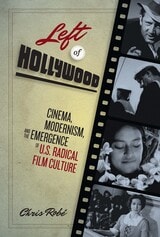
Left of Hollywood
Cinema, Modernism, and the Emergence of U.S. Radical Film CultureBy Chris Robé
University of Texas Press, 2010
In the 1930s as the capitalist system faltered, many in the United States turned to the political Left. Hollywood, so deeply embedded in capitalism, was not immune to this shift. Left of Hollywood offers the first book-length study of Depression-era Left film theory and criticism in the United States. Robé studies the development of this theory and criticism over the course of the 1930s, as artists and intellectuals formed alliances in order to establish an engaged political film movement that aspired toward a popular cinema of social change. Combining extensive archival research with careful close analysis of films, Robé explores the origins of this radical social formation of U.S. Left film culture.
Grounding his arguments in the surrounding contexts and aesthetics of a few films in particular—Sergei Eisenstein's Que Viva Mexico!, Fritz Lang's Fury, William Dieterle's Juarez, and Jean Renoir's La Marseillaise—Robé focuses on how film theorists and critics sought to foster audiences who might push both film culture and larger social practices in more progressive directions. Turning at one point to anti-lynching films, Robé discusses how these movies united black and white film critics, forging an alliance of writers who championed not only critical spectatorship but also the public support of racial equality. Yet, despite a stated interest in forging more egalitarian social relations, gender bias was endemic in Left criticism of the era, and female-centered films were regularly discounted. Thus Robé provides an in-depth examination of this overlooked shortcoming of U.S. Left film criticism and theory.
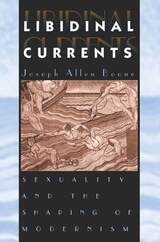
Libidinal Currents
Sexuality and the Shaping of ModernismJoseph Allen Boone
University of Chicago Press, 1997
Challenging overarching theories of the novel by carefully mapping the historical contexts that have influenced modern experimental narratives, Boone constructs a model for interpreting sexuality that reaches from Freud's theory of the libidinal instincts to Foucault's theory of sexual discourse. The most ambitious study yet written on the links between literary modernity and the psychology of sex, Boone's Libidinal Currents will be a landmark book in the study of modernist fiction, gay studies/queer theory, feminist criticism, and studies in sexuality and gender.
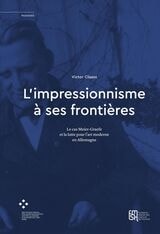
L’impressionnisme à ses frontières
Le cas Meier-Graefe et la lutte pour l’art moderne en AllemagneVictor Claass
Diaphanes, 2023
Par ses écrits pionniers sur l’histoire du développement de l’art moderne, le critique d’art allemand Julius Meier-Graefe (1867-1935) joua un rôle décisif pour la canonisation de l’impressionnisme dans l’Europe de 1900. En défendant avec subversion et énergie la peinture de Manet, Renoir ou Cézanne outre-Rhin, il se mit à dos les élites conservatrices de l’Empire, qui observaient avec méfiance la propagation des valeurs de la modernité artistique. Tout au long de sa trajectoire franco-allemande, ponctuée de virulentes polémiques et cisaillée par le surgissement de la Première Guerre mondiale, Meier-Graefe lutta contre l’emprise d’un nationalisme obtus sur les récits artistiques. Son projet de régénération de la culture allemande fut ainsi indissociable de ses efforts pour la fédération d’une Europe pacifiée des images.
Si le progressisme francophile tout comme le vitalisme de son approche de la peinture ont parfois été soulignés, l’étude de son implication dans les débats politico-culturels de son temps révèle une personnalité plus nuancée. Ce livre analyse ainsi les surprenants à-coups et paradoxes ayant émaillé la carrière transnationale de Meier-Graefe, où alternèrent phases d’enthousiasme débridé et d’intense désillusion. Le personnage s’y dévoile comme un penseur du déclin et le chantre d’une modernité idéalisée, dont l’impressionnisme représentait à la fois la quintessence et le chant du cygne.