Results by title
100 books match the query 'Monographs' and 6 start with l
Lake|Flato Houses
Embracing the LandscapeLake|Flato Architects
University of Texas Press, 2014

Leigh Bowery
Performative Costuming and Live ArtSofia Vranou
Intellect Books, 2025
Leigh Bowery: Performative Costuming and Live Art is a critical exploration of the creative practice, social-historical context, and cultural impact of the late London-based artist Leigh Bowery. The diversity of Bowery’s work and his marginality as an artist who emerged during the 1980s from a subcultural milieu complicated and thwarted his cultural value, hindering his incorporation into art institutions and performance art narratives for some time. Drawing on a variety of disciplines and challenging research contexts, Sofia Vranou seeks to historicize Bowery’s multifaceted body of work and critically situate it within the expanded fields of visual culture and performance studies.
Through close analysis of Bowery’s key looks and non-theatrical performances, the book investigates the implications of his work in dominant histories of performance art and urgent discourses surrounding normativity, representations of illness, and identity politics. Thought-provoking and engaging, it focuses on Bowery’s costuming as a performative strategy that effectively blurs the boundaries between art and life; delves into his aesthetics of freakishness and narcissistic desire, reflects on his involvement with BDSM practices and the performance of extremity, and unpacks the posttranssexual ethos behind his hybrid embodiments and trans-queer visual language.
Leon Bibel
Forgotten Artist of the New DealRichard Haw
Rutgers University Press, 2025
Honorable Mention for the 2025 New Deal Book Award
Leon Bibel (1913–1995) was a prolific modern American artist who painted, printed, stamped, etched, sketched, and carved. He produced pieces that ranged from social realism to dreamy expressionism and was an aesthetic experimentalist, never working for too long in any medium or style. And despite Bibel's obvious talent, his work would have languished in obscurity were it not for the New Deal programs like the Federal Art Project and Public Works of Art Project.
Leon Bibel, the first biography of this eclectic artist, recounts his life from his birth in Szczebrzeszyn, Poland, in 1913, to his death in New Jersey in 1995. After immigrating to the United States in the 1920s, Bibel came of age during the Great Depression, when New Deal agencies recognized his abilities and supported his artistic endeavors. Working-class artists faced challenges after these programs folded, and Bibel would later spend twenty years as a New Jersey chicken farmer before resurrecting his art career in the 1960s.
Historian Richard Haw shows how Bibel's life was defined by the New Deal, his visionary artwork shaped by the era's commitment to social and economic justice. With reproductions of more than 240 of Bibel's works, most in vivid color, this book reveals how he depicted everything from the trauma of unemployment to the dignity of work, from the horrors of lynching to the pleasures of everyday life.
Liu Shiming
Sculpting EmpathyRichard Vine
Rutgers University Press, 2026
Liu Shiming (1926–2010) is a revered Chinese artist whose works have had a distinct impact on the course of modern Chinese sculpture. Born in Tianjin in 1926, Shiming attended the prestigious Central Academy of Fine Arts (CAFA) in Beijing, where he was part of the first generation of sculptors trained by the People’s Republic of China to study both traditional Chinese art and French modernist principles. Shiming received early recognition for his work, and his student project Measuring Land (1950) was one of the first works exhibited abroad following the establishment of the People’s Republic of China.
Though well respected in China, the sculptor, who died in 2010 at the age of eighty-four, is only now beginning to win the wider recognition he deserves. Meanwhile, contemporary competitors are numberless, most of them Instagram-friendly, while art history tends to focus on towering names and indisputably major movements and events: Braque and Picasso inventing Cubism, Duchamp’s readymades redefining art itself, Warhol’s mind-bending Brillo Boxes, and so on. So why examine an artist in the middle ground? Perhaps, first, because that is where the vast majority of us live, trying to make sense of our lives and grateful for the occasional insight, release, or enrichment that visual art can bring us. Second, because the story of Liu Shiming reveals a great deal about the forces that have shaped postwar art worldwide. He was a man who sought to lead a simple life, dedicated entirely to art, in the midst of China’s epochal, dangerously complex twentieth-century social and political changes.
Louis I. Kahn
The Nordic LatitudesPer Olaf Fjeld
University of Arkansas Press, 2019
Kahn’s Nordic and European ties are emphasized in this study that also covers his early childhood in Estonia, his travels, and his relationships with other architects, including the Norwegian architect Arne Korsmo.
The authors have gathered personal reflections, archival material, and other student work to offer insight into the wisdom that Kahn imparted to his students in his famous masterclass. Louis I. Kahn: The Nordic Latitudes addresses Kahn’s legacy both personally and in terms of the profession, documents a research trip the University of Pennsylvania’s Louis I. Kahn Collection, and confronts the affiliation of Kahn’s work with postmodernism.
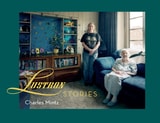
Lustron Stories
Charles Mintz
The Ohio State University Press, 2016
A remarkable cross section of individuals and families live in these modest (~1100 sq. ft.) homes. While certainly diverse in age and place in life, the homeowners are still firmly working class. Everyone who lives in a Lustron home has an opinion about it. The material is miserable to cut or drill into. Repairs are more about metalworking and enamel finishing than carpentry or house painting. And magnets tend to be a popular solution for hanging objects inside and outside the steel walls.
Four years ago, Charles Mintz set out to photograph the people living in these homes. The residents, owners, or both were photographed outside and occasionally inside. Mintz used a large format wooden camera and available light. This book features 65 of the resulting photographs and essays from Shannon Thomas Perich, Curator of the Photographic History Collection at Smithsonian’s National Museum of American History, and Jeffrey Head, author and architecture critic.