Results by title
50 books match the query 'Music and race' and 2 start with l

Lion's Share
Remaking South African CopyrightVeit Erlmann
Duke University Press, 2022
In the aftermath of apartheid, South Africa undertook an ambitious revision of its intellectual property system. In Lion’s Share Veit Erlmann traces the role of copyright law in this process and its impact on the South African music industry. Although the South African government tied the reform to its postapartheid agenda of redistributive justice and a turn to a postindustrial knowledge economy, Erlmann shows how the persistence of structural racism and Euro-modernist conceptions of copyright threaten the viability of the reform project. In case studies ranging from antipiracy police raids and the crafting of legislation to protect indigenous expressive practices to the landmark lawsuit against Disney for its appropriation of Solomon Linda’s song "Mbube" for its hit “The Lion Sleeps Tonight” from The Lion King, Erlmann follows the intricacies of musical copyright through the criminal justice system, parliamentary committees, and the offices of a music licensing and royalty organization. Throughout, he demonstrates how copyright law is inextricably entwined with race, popular music, postcolonial governance, indigenous rights, and the struggle to create a more equitable society.
[more]
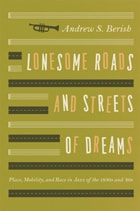
Lonesome Roads and Streets of Dreams
Place, Mobility, and Race in Jazz of the 1930s and '40sAndrew S. Berish
University of Chicago Press, 2012
Any listener knows the power of music to define a place, but few can describe the how or why of this phenomenon. In Lonesome Roads and Streets of Dreams: Place, Mobility, and Race in Jazz of the 1930s and ’40s, Andrew Berish attempts to right this wrong, showcasing how American jazz defined a culture particularly preoccupied with place. By analyzing both the performances and cultural context of leading jazz figures, including the many famous venues where they played, Berish bridges two dominant scholarly approaches to the genre, offering not only a new reading of swing era jazz but an entirely new framework for musical analysis in general, one that examines how the geographical realities of daily life can be transformed into musical sound.
Focusing on white bandleader Jan Garber, black bandleader Duke Ellington, white saxophonist Charlie Barnet, and black guitarist Charlie Christian, as well as traveling from Catalina Island to Manhattan to Oklahoma City, Lonesome Roads and Streets of Dreams depicts not only a geography of race but how this geography was disrupted, how these musicians crossed physical and racial boundaries—from black to white, South to North, and rural to urban—and how they found expression for these movements in the insistent music they were creating.
[more]