Results by title
99 books match the query 'National' and 2 start with l
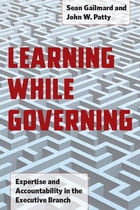
Learning While Governing
Expertise and Accountability in the Executive BranchSean Gailmard and John W. Patty
University of Chicago Press, 2013
Although their leaders and staff are not elected, bureaucratic agencies have the power to make policy decisions that carry the full force of the law. In this groundbreaking book, Sean Gailmard and John W. Patty explore an issue central to political science and public administration: How do Congress and the president ensure that bureaucratic agencies implement their preferred policies?
The assumption has long been that bureaucrats bring to their positions expertise, which must then be marshaled to serve the interests of a particular policy. In Learning While Governing, Gailmard and Patty overturn this conventional wisdom, showing instead that much of what bureaucrats need to know to perform effectively is learned on the job. Bureaucratic expertise, they argue, is a function of administrative institutions and interactions with political authorities that collectively create an incentive for bureaucrats to develop expertise. The challenge for elected officials is therefore to provide agencies with the autonomy to do so while making sure they do not stray significantly from the administration’s course. To support this claim, the authors analyze several types of information-management processes. Learning While Governing speaks to an issue with direct bearing on power relations between Congress, the president, and the executive agencies, and it will be a welcome addition to the literature on bureaucratic development.
[more]
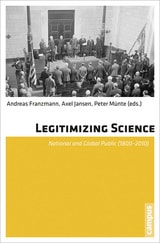
Legitimizing Science
National and Global Public (1800-2010)Edited by Axel Jansen, Andreas Franzmann, and Peter Münte
Campus Verlag, 2015
Since the founding in 1660 of the Royal Society, London, scientists engaging in experimental research have sought to establish a base for exploratory work in communities and their political institutions. This connection between science and the national state has only grown stronger during the past two centuries. Here, historians, sociologists, and jurists discuss the history of that relationship since 1800, asking such key questions as how have scientists conceived of the national setting for their transnational work in the past, and how do they situate their work in the context of globalization? Taken together, the essays reveal that while nineteenth-century scientists in many countries felt they had to fight for public recognition of their work, the twentieth century witnessed the national endorsement and planning of science. With essays ranging from an analysis of speeches by nineteenth-century German university presidents to the state of science in the context of European integration, this book will appeal to anyone interested in the public and political role of science and its institutions in the past, present, and future.
[more]