Results by title
65 books match the query 'Netherlands' and 4 start with l
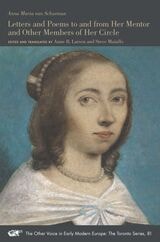
Letters and Poems to and from Her Mentor and Other Members of Her Circle
Anna Maria van Schurman
Iter Press, 2021
Anna Maria van Schurman was widely regarded as the most erudite woman in seventeenth-century Europe. As “the Star of Utrecht,” she was active in a network of learning that included the most renowned scholars of her time. Known for her extensive learning and her defense of the education of women, she was the first woman to sit in on lectures at a university in the Netherlands and to advocate that women be admitted into universities. She was proficient in fourteen languages, including Latin, Greek, Hebrew, Arabic, Syriac, Aramaic, Persian, Samaritan, and Ethiopian, as well as several vernacular European languages.
This volume presents in translation a remarkable collection of her letters and poems—many of which were previously unpublished—that span almost four decades of her life, from 1631 to 1669.
This volume presents in translation a remarkable collection of her letters and poems—many of which were previously unpublished—that span almost four decades of her life, from 1631 to 1669.
[more]
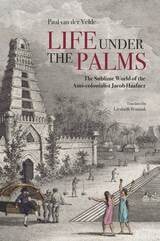
Life Under the Palms
The Sublime World of the Anti-colonialist Jacob HaafnerPaul van der Velde
National University of Singapore Press, 2019
Jacob Gotfried Haafner (1754–1809) was one of the most popular European travel writers of the early nineteenth century, writing in the Romantic mode. A Dutch citizen, Haafner spent more than twenty years of his early life living outside of Europe, in India, Ceylon, Mauritius, Java, and South Africa. Books like his popular Travels in a Palanquin were translated into the major European languages, and his essays against the work of Christian missionaries in Asia stirred up great controversy. Haafner worked to spread understanding of the cultures he’d come to know in his journeys, promoting European understanding of Indian literature, myth, and religion, translating the Ramayana into Dutch.
With the help of generous excerpts from Haafner's own writings, including material newly translated into English, Paul van der Velde tells an affecting story of a young man who made a world for himself along the Coromandel Coast, in Ceylon and Calcutta, but who returned to Europe to live the last years of his life in Amsterdam, suffering an acute nostalgia for Asia. This will be compelling reading for anyone interested in European response to the cultures of Asia.
With the help of generous excerpts from Haafner's own writings, including material newly translated into English, Paul van der Velde tells an affecting story of a young man who made a world for himself along the Coromandel Coast, in Ceylon and Calcutta, but who returned to Europe to live the last years of his life in Amsterdam, suffering an acute nostalgia for Asia. This will be compelling reading for anyone interested in European response to the cultures of Asia.
[more]
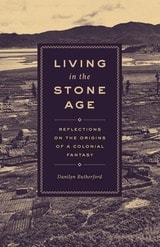
Living in the Stone Age
Reflections on the Origins of a Colonial FantasyDanilyn Rutherford
University of Chicago Press, 2018
In 1961, John F. Kennedy referred to the Papuans as “living, as it were, in the Stone Age.” For the most part, politicians and scholars have since learned not to call people “primitive,” but when it comes to the Papuans, the Stone-Age stain persists and for decades has been used to justify denying their basic rights. Why has this fantasy held such a tight grip on the imagination of journalists, policy-makers, and the public at large?
Living in the Stone Age answers this question by following the adventures of officials sent to the New Guinea highlands in the 1930s to establish a foothold for Dutch colonialism. These officials became deeply dependent on the good graces of their would-be Papuan subjects, who were their hosts, guides, and, in some cases, friends. Danilyn Rutherford shows how, to preserve their sense of racial superiority, these officials imagined that they were traveling in the Stone Age—a parallel reality where their own impotence was a reasonable response to otherworldly conditions rather than a sign of ignorance or weakness. Thus, Rutherford shows, was born a colonialist ideology.
Living in the Stone Age is a call to write the history of colonialism differently, as a tale of weakness not strength. It will change the way readers think about cultural contact, colonial fantasies of domination, and the role of anthropology in the postcolonial world.
[more]
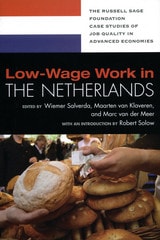
Low-Wage Work in the Netherlands
Weimer Salverda
Russell Sage Foundation, 2008
The Dutch economy has often been heralded for accomplishing solid employment growth within a generous welfare system. In recent years, the Netherlands has seen a rise in low-wage work and has maintained one of the lowest unemployment rates in the European Union. Low-Wage Work in the Netherlands narrows in on the causes and consequences of this new development. The authors find that the increase in low-wage work can be partly attributed to a steep rise in the number of part-time jobs and non-standard work contracts—46 percent of Dutch workers hold part-time jobs. The decline in full-time work has challenged historically powerful Dutch unions and has led to a slow but steady dismantling of many social insurance programs from 1979 onward. At the same time, there are hopeful lessons to be gleaned from the Dutch model: low-wage workers benefit from a well-developed system of income transfers, and many move on to higher paying jobs. Low-Wage Work in the Netherlands paints a nuanced picture of the Dutch economy by analyzing institutions that both support and challenge its low-wage workforce. A Volume in the Russell Sage Foundation Case Studies of Job Quality in Advanced Economies
[more]