Results by title
226 books match the query 'New Jersey' and 8 start with l
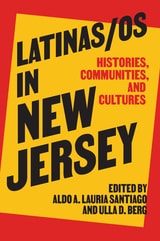
Latinas/os in New Jersey
Histories, Communities, and CulturesAldo A. Lauria Santiago
Rutgers University Press, 2025
Contributors: Yamil Avivi; Jennifer Ayala; Ulla D. Berg; Giovani Burgos; Elsa Candelario; Laura Curran; Lilia Fernández; Ismael García Colón; Olga Jiménez de Wagenheim; Benjamin Lapidus; Aldo A. Lauria Santiago; Johana Londoño; Kathleen Lopez; Giancarlo Muschi; Melanie Z. Plasencia; Ana Y. Ramos-Zayas; Elena Sabogal; Raymond Sanchez Mayers; William Suárez Gómez; Alex F. Trillo; Daniela Valdez; Anil Venkatesh; Lyna L. Wiggins

Lies About My Family
A MemoirAmy Hoffman
University of Massachusetts Press, 2013
All of Amy Hoffman's grandparents came to the United States during the early twentieth century from areas in Poland and Russia that are now Belarus and Ukraine. Like millions of immigrants, they left their homes because of hopeless poverty, looking for better lives or at the least a chance of survival. Because of the luck, hard work, and resourcefulness of the earlier generations, Hoffman and her five siblings grew up in a middle-class home, healthy, well fed, and well educated. An American success story? Not quite—or at least not quite the standard version. Hoffman's research in the Ellis Island archives along with interviews with family members reveal that the real lives of these relatives were far more complicated and interesting than their documents might suggest.
Hoffman and her siblings grew up as observant Jews in a heavily Catholic New Jersey suburb, as political progressives in a town full of Republicans, as readers in a school full of football players and their fans.
As a young lesbian, she distanced herself from her parents, who didn't understand her choice, and from the Jewish community, with its organization around family and unquestioning Zionism. However, both she and her parents changed and evolved, and by the end of this engaging narrative, they have come to new understandings, of themselves and one another.
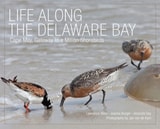
Life Along the Delaware Bay
Cape May, Gateway to a Million ShorebirdsNiles, Lawrence
Rutgers University Press, 2012
The Delaware Bay is the second largest and most diverse bay on the East Coast. It has a rich cultural history, has played an important role in the region’s commerce and tourism, and has spectacular and vital natural resources. Birdwatchers gather along its shores to watch the spectacle of thousands of spawning horseshoe crabs, the dense flocks of migrant shorebirds, the fall hawk migration, and the huge migration of monarch butterflies.
Life Along the Delaware Bay focuses on the area as an ecosystem, the horseshoe crab as a keystone species within that system, and the crucial role that the bay plays in the migratory ecology of shorebirds. An abundance of horseshoe crabs spawning on the Delaware Bay beaches results in an abundance of eggs brought to the surface, providing a source of high-quality food and bringing hundreds of thousands of shorebirds to the bay to forage in late May and early June. A dramatic decline in horseshoe crabs has resulted in a rapid and dramatic decline in birds, particularly the red knot. This decline has sounded an alarm throughout the world, prompting a host of biologists to converge on the bay each spring, to understand the biology and conservation of red knots and other shorebirds.
Lawrence Niles, Joanna Burger, and Amanda Dey examine current efforts to protect the bay and identify new efforts that must take place to ensure it remains an intact ecological system. Over three hundred stunning color photographs and maps capture the beauty and majesty of this unique treasure—one that must be protected today and for generations to come.

Life beside Bars
Confinement and Capital in an American Prison TownHeath Pearson
Duke University Press, 2024

Living with the New Jersey Shore
Karl Nordstrom, Paul A. Garés, Norbert P. Psuty, Orrin H. Pilkey Jr., William Neal, and Orrin H. Pilkey Sr.
Duke University Press, 1986
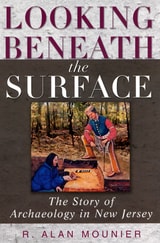
Looking Beneath the Surface
The Story of Archaeology in New JerseyMounier, R. Alan
Rutgers University Press, 2002
For more than ten thousand years, humans have lived in New Jersey. From Summit to Cape May, from Trenton to the Jersey Shore, the state is a treasure trove of archaeological artifacts, revealing much about those who occupied the region prior to European settlement. As a rule, only the most durable of human creations¾items of stone and pottery¾survive the ravages of time. To complicate matters, the onslaught of our own culture and the indiscriminate looting of sites by greedy collectors have further diminished the cultural materials left behind. The task of the archaeologist is to gather and interpret these scraps for the benefit of science and the public. But digging up relics is a trivial pursuit if the only outcome is a collection of artifacts, however attractive or valuable they may be. Understanding what those relics mean in human terms is crucial.
In Looking beneath the Surface, R. Alan Mounier looks at the human past of New Jersey. With particular focus on the ancient past and native cultures, the author tells the story of archaeology in the state as it has unfolded, and as it continues to unfold. New investigations and discoveries continually change our views and interpretations of the past. In jargon-free language, Mounier provides an in-depth introduction offering information to understand general archaeological practices as well as research in New Jersey. Subsequent chapters describe artifact types, archaeological settlements, and burial practices in detail. He concludes with vignettes of twenty-one archaeological investigations throughout the state to illustrate the variability of sites and the accomplishments of dedicated archaeologists, both professional and amateur.
Looking for America on the New Jersey Turnpike, Second Edition
Angus Kress Gillespie
Rutgers University Press, 2024
When Angus Gillespie and Michael Rockland wrote Looking for America on the New Jersey Turnpike in 1989, they simply wanted to express their fascination with a road that many commuters regarded with annoyance or indifference. Little did they expect that it would be hailed as a classic, listed by the state library alongside works by Whitman and Fitzgerald as one of the ten best books ever written about New Jersey or by a New Jerseyan.
Now Looking for America on the New Jersey Turnpike is back in a special updated and expanded edition, examining how this great American motorway has changed over the past thirty-five years. You’ll learn how the turnpike has become an icon inspiring singers and poets. And you’ll meet the many people it has affected, including the homeowners displaced by its construction, the highway patrol and toll-takers who work on it, and the drivers who speed down its lanes every day.

Louis Bamberger
Department Store Innovator and PhilanthropistLinda B. Forgosh
Brandeis University Press, 2016