Results by title
110 books match the query 'New Mexico' and 7 start with l

La Partera
Story of a MidwifeFran Leeper Buss
University of Michigan Press, 2001
Jesusita Aragon earned the title "la partera," or midwife, at the age of fourteen. Apprenticed to her grandmother, she learned the traditional Hispanic methods of assisting childbirth. She won the coveted title by performing her first delivery when an expectant mother went into labor in her grandmother's absence. In the years that followed, she was often the only source of medical care available in an isolated, mountainous area of New Mexico. Jesusita was so prized for her medical wisdom that she came to deliver more than 12,000 babies in the course of her career.
This is Jesusita's story, told in her own words. She describes her early training as a midwife, her forced departure from home due to two unmarried pregnancies, and her solitary struggle to support her children. La Partera tells how she gradually emerged as a leader in her community, painstakingly building by hand a small maternity center for her patients while gaining the respect of the Anglo medical community.
As Jesusita's story unfolds, so too does the story of the women of the region. Supplemental sections by the author illuminate Jesusita's culture and past, along with a historical account of the network of medical care provided by Hispanic and Anglo female healers. Illustrated with photographs of both people and places, La Partera reflects the culture of an era through the prism of Jesusita's hard and useful life.
Fran Leeper Buss lives and teaches in Tucson, Arizona.
[more]
La Partera
Story of a MidwifeFran Leeper Buss
University of Michigan Press, 1980
Jesusita Aragon earned the title "la partera," or midwife, at the age of fourteen. Apprenticed to her grandmother, she learned the traditional Hispanic methods of assisting childbirth. She won the coveted title by performing her first delivery when an expectant mother went into labor in her grandmother's absence. In the years that followed, she was often the only source of medical care available in an isolated, mountainous area of New Mexico. Jesusita was so prized for her medical wisdom that she came to deliver more than 12,000 babies in the course of her career.This is Jesusita's story, told in her own words. She describes her early training as a midwife, her forced departure from home due to two unmarried pregnancies, and her solitary struggle to support her children. La Partera tells how she gradually emerged as a leader in her community, painstakingly building by hand a small maternity center for her patients while gaining the respect of the Anglo medical community.As Jesusita's story unfolds, so too does the story of the women of the region. Supplemental sections by the author illuminate Jesusita's culture and past, along with a historical account of the network of medical care provided by Hispanic and Anglo female healers. Illustrated with photographs of both people and places, La Partera reflects the culture of an era through the prism of Jesusita's hard and useful life.
[more]
Land Uprising
Native Story Power and the Insurgent Horizons of Latinx IndigeneitySimón Ventura Trujillo
University of Arizona Press, 2020
Land Uprising reframes Indigenous land reclamation as a horizon to decolonize the settler colonial conditions of literary, intellectual, and activist labor. Simón Ventura Trujillo argues that land provides grounding for rethinking the connection between Native storytelling practices and Latinx racialization across overlapping colonial and nation-state forms.
Trujillo situates his inquiry in the cultural production of La Alianza Federal de Mercedes, a formative yet understudied organization of the Chicanx movement of the 1960s and 1970s. La Alianza sought to recover Mexican and Spanish land grants in New Mexico that had been dispossessed after the Mexican-American War. During graduate school, Trujillo realized that his grandparents were activists in La Alianza. Written in response to this discovery, Land Uprising bridges La Alianza’s insurgency and New Mexican land grant struggles to the writings of Leslie Marmon Silko, Ana Castillo, Simon Ortiz, and the Zapatista Uprising in Chiapas, Mexico. In doing so, the book reveals uncanny connections between Chicanx, Latinx, Latin American, and Native American and Indigenous studies to grapple with Native land reclamation as the future horizon for Chicanx and Latinx indigeneities.
Trujillo situates his inquiry in the cultural production of La Alianza Federal de Mercedes, a formative yet understudied organization of the Chicanx movement of the 1960s and 1970s. La Alianza sought to recover Mexican and Spanish land grants in New Mexico that had been dispossessed after the Mexican-American War. During graduate school, Trujillo realized that his grandparents were activists in La Alianza. Written in response to this discovery, Land Uprising bridges La Alianza’s insurgency and New Mexican land grant struggles to the writings of Leslie Marmon Silko, Ana Castillo, Simon Ortiz, and the Zapatista Uprising in Chiapas, Mexico. In doing so, the book reveals uncanny connections between Chicanx, Latinx, Latin American, and Native American and Indigenous studies to grapple with Native land reclamation as the future horizon for Chicanx and Latinx indigeneities.
[more]
Landscapes of Social Transformation in the Salinas Province and the Eastern Pueblo World
Edited by Katherine A. Spielmann
University of Arizona Press, 2017
In the 1100s most Pueblo peoples lived in small, dispersed settlements and moved frequently, but by the mid-1400s they had aggregated into large villages. The majority of these villages were still occupied at Spanish contact and conquest, by which time most Pueblo peoples had completely transformed their perception and experience of village life. Other changes were taking place on a broader regional scale, and the migrations from the Colorado Plateau and the transformation of Chaco initiated myriad changes in ritual organization and practice.
Landscapes of Social Transformation in the Salinas Province and the Eastern Pueblo World investigates relationships between diverse regional and local changes in the Rio Grande and Salinas areas from 1100 to 1500 C.E. The contributing authors draw on the results of sixteen seasons of archaeological survey and excavation in the Salinas Province of central New Mexico. The chapters offer cross-scale analyses to compare broad perspectives in well-researched southwestern culture changes to the finer details of stability and transformation in Salinas. This stability—which was unusual in the Pueblo Southwest—from the 1100s until its abandonment in the 1670s provides an interesting contrast to migration-based transformations studied elsewhere in the Rio Grande region.
CONTRIBUTORS
Patricia Capone
Matthew Chamberlin
Tiffany C. Clark
William M. Graves
Cynthia L. Herhahn
Deborah Huntley
Keith Kintigh
Ann Kinzig
Jeannette L. Mobley-Tanaka
Alison E. Rautman
Jonathan Sandor
Grant Snitker
Julie Solometo
Katherine A. Spielmann
Colleen Strawhacker
Maryann Wasiolek
[more]
Late Prehistoric Bison Procurement in Southeastern New Mexico
The 1977 Season at the Garnsey SiteJohn D. Speth and William J. Parry
University of Michigan Press, 1978
Archaeologists John D. Speth and William J. Parry present the results of the first season of excavation at the Garnsey site, a bison kill site in southeastern New Mexico.
[more]
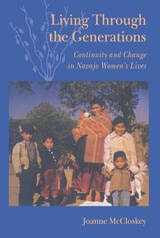
Living Through the Generations
Continuity and Change in Navajo Women’s LivesJoanne McCloskey
University of Arizona Press, 2007
Navajo women’s lives reflect the numerous historical changes that have transformed “the Navajo way.” At the same time, in their behavior, beliefs, and values, women preserve the legacy of Navajo culture passed down through the generations. By comparing and contrasting three generations of Navajo women—grandmothers, mid-life mothers, and young mothers—similarities and differences emerge in patterns of education, work, family life, and childbearing. Women’s roles as mothers and grandmothers are central to their respected position in Navajo society. Mothers bestow membership in matrilineal clans at birth and follow the example of the beloved deity Changing Woman. As guardians of cultural traditions, grandmothers actively plan and participate in ceremonies such as the Kinaaldá, the puberty ceremony, for their granddaughters.
Drawing on ethnographic interviews with 77 women in Crownpoint, New Mexico, and surrounding chapters in the Eastern Navajo Agency, Joanne McCloskey examines the cultural traditions evident in Navajo women’s lives. Navajo women balance the demands of Western society with the desire to preserve Navajo culture for themselves and their families.
Drawing on ethnographic interviews with 77 women in Crownpoint, New Mexico, and surrounding chapters in the Eastern Navajo Agency, Joanne McCloskey examines the cultural traditions evident in Navajo women’s lives. Navajo women balance the demands of Western society with the desire to preserve Navajo culture for themselves and their families.
[more]
Living and Dying on the Periphery
The Archaeology and Human Remains from Two 13th-15th Century AD Villages in Southeastern New MexicoJamie L. Clark and John D. Speth
University of Utah Press, 2022
The phrase "southwestern US/northwestern Mexico archaeology" tends to evoke images of multistoried villages and cliff dwellings. But on the eastern periphery of the Southwest, where mesas and mountains give way to vast grasslands, other types of villages once thrived. In this volume, archaeologists Jamie Clark and John Speth document the lives and lifeways of the people who inhabited two of these villages: Henderson and Bloom Mound. The villagers hunted bison on the plains and exchanged meat and hides with Puebloan peoples for pottery, turquoise, marine shells, and other goods. The origins of these close social and economic ties between bison hunters and village farmers, often referred to as “Plains-Pueblo interaction,” have intrigued anthropologists for generations. The excavations at Henderson and Bloom Mound provide fascinating new insights into when, how, and why these relationships came about.
Summarizing results from eight seasons of research, Clark and Speth document human burials and associated grave offerings from the two sites. They discuss evidence for pathologies and trauma, raising questions about the nature and causes of violence that led to the demise of Henderson and Bloom Mound, and the abandonment of many other farming-hunting communities in the surrounding region.
Summarizing results from eight seasons of research, Clark and Speth document human burials and associated grave offerings from the two sites. They discuss evidence for pathologies and trauma, raising questions about the nature and causes of violence that led to the demise of Henderson and Bloom Mound, and the abandonment of many other farming-hunting communities in the surrounding region.
[more]