Results by title
52 books match the query 'Noncitizens' and 3 start with l
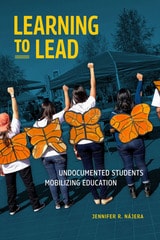
Learning to Lead
Undocumented Students Mobilizing EducationJennifer R. Nájera
Duke University Press, 2024
In Learning to Lead, Jennifer R. Nájera explores the intersections of education and activism among undocumented students at the University of California, Riverside. Taking an expansive view of education, Nájera shows how students’ experiences in college—both in and out of the classroom—can affect their activism and advocacy work. Students learn from their families, communities, peers, and student and political organizations. In these different spaces, they learn how to navigate community and college life as undocumented people. Students are able to engage campus organizations where they can cultivate their leadership skills and—importantly—learn that they are not alone. These students embody and mobilize their education through both large and small political actions such as protests, workshops for financial aid applications, and Know Your Rights events. As students create community with each other, they come to understand that their individual experiences of illegality are part of a larger structure of legal violence. This type of education empowers students to make their way to and through college, change their communities, and ultimately assert their humanity.
[more]
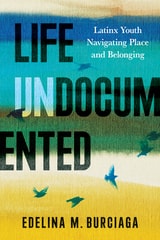
Life Undocumented
Latinx Youth Navigating Place and BelongingEdelina M. Burciaga
University of Arizona Press, 2025
Life Undocumented captures the compelling stories of Latinx undocumented young adults growing up and living in two distinct sociopolitical contexts: California, which provides legal pathways into higher education for undocumented youth, and Georgia, which does not.
The book is about how undocumented young adults in these two contexts navigate the pathway to and through adulthood, and the powerful role state laws and policies play in shaping their prospects for social mobility and their sense of belonging. Edelina M. Burciaga examines how state laws and policies in California and Georgia shape the pathways to adulthood for these individuals. California, with its supportive legal frameworks, contrasts sharply with Georgia’s restrictive environment, highlighting the significant impact of state-level immigration policies.
The book highlights the complexities and contradictions that emerge from these distinct legal ecologies, which include the intersections of federal, state, local, familial, and individual dynamics, and shape the daily lives and future orientations of undocumented young adults. This book underscores the resilience and agency of undocumented youth as they confront and resist the structural constraints imposed by immigration laws, offering a vivid portrayal of their emotional and social journeys. This book is a vital resource for anyone committed to creating equitable and inclusive systems for undocumented students.
[more]
Limits of Citizenship
Migrants and Postnational Membership in EuropeYasemin Nuhoglu Soysal
University of Chicago Press, 1994
In many Western countries, rights that once belonged solely to citizens are being extended to immigrants, a trend that challenges the nature and basis of citizenship at a time when nation-states are fortifying their boundaries through restirictive border controls and expressions of nationalist ideologies. In this book, Yasemin Soysal compares the different ways European nations incorporate immigrants, how these policies evolved, and how they are influenced by international human rights discourse.
Soysal focuses on postwar international migration, paying particular attention to "guestworkers." Taking an in-depth look at France, Germany, the Netherlands, Sweden, Switzerland, and the United Kingdom, she identifies three major patterns that reflect the varying emphasis particular states place on individual versus corporate groups as the basis for incorporation. She finds that the global expansion and intensification of human rights discourse puts nation-states under increasing outside pressure to extend membership rights to aliens, resulting in an increasingly blurred line between citizen and noncitizen. Finally, she suggests a possible accommodation to these shifts: specifically, a model of post-national membership that derives its legitimacy from universal personhood, rather than national belonging.
This fresh approach to the study of citizenship, rights, and immigration will be invaluable to anyone involved in issues of human rights, international migration, and transnational cultural interactions, as well as to those who study the contemporary transformation of the nation-state, nationalism, and globalization.
[more]