Results by title
71 books match the query 'North Carolina' and 3 start with l
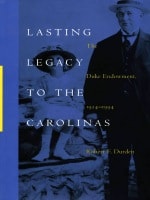
Lasting Legacy to the Carolinas
The Duke Endowment, 1924–1994Robert F. Durden
Duke University Press, 1998
In this volume, Robert F. Durden explores how the propriety of linking together a tax-free foundation and an investor-owned, profit-seeking business like the Duke Power Company has significantly changed over the course of the century. Explaining the implications of the Tax Reform Act of 1969 for J. B. Duke’s dream, Durden shows how the philanthropist’s plan to have the Duke Endowment virtually own and ultimately control Duke Power (which, in turn, would supply most of the Endowment’s income) dissolved after the death of daughter Doris Duke in 1993, when the trustees of the Endowment finally had the unanimous votes needed to sever that tie. Although the Endowment’s philanthropic projects—higher education (including Duke University), hospitals and health care, orphan and child care in both North and South Carolina, and the rural Methodist church in North Carolina—continue to be served, this study explains the impact of a century of political and social change on one man’s innovative charitable intentions. It is also a testimony to the many staff members and trustees who have invested their own time and creative energies into further benefiting these causes, despite decades of inevitable challenges to the Endowment.
This third volume of Durden’s trilogy relating to the Dukes of Durham will inform not only those interested in the continuing legacy of this remarkable family but also those involved with philanthropic boards, charitable endowments, medical care, child-care institutions, the rural church, and higher education.
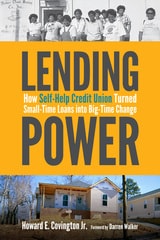
Lending Power
How Self-Help Credit Union Turned Small-Time Loans into Big-Time ChangeHoward E. Covington Jr.
Duke University Press, 2017
In Lending Power journalist and historian Howard E. Covington Jr. narrates the compelling story of Self-Help's founders and coworkers as they built a progressive and community-oriented financial institution. First established to assist workers displaced by closed furniture and textile mills, Self-Help created a credit union that expanded into providing home loans for those on the margins of the financial market, especially people of color and single mothers.
Using its own lending record, Self-Help convinced commercial banks to follow suit, extending its influence well beyond North Carolina. In 1999 its efforts led to the first state law against predatory lending. A decade later, as the Great Recession ravaged the nation's economy, its legislative victories helped influence the Dodd-Frank Wall Street Reform and Consumer Protection Act and the formation of the Consumer Financial Protection Bureau. Self-Help also created a federally chartered credit union to expand to California and later to Illinois and Florida, where it assisted ailing community-based credit unions and financial institutions.
Throughout its history, Self-Help has never wavered from its mission to use Dr. Martin Luther King Jr.'s vision of justice to extend economic opportunity to the nation's unbanked and underserved citizens. With nearly two billion dollars in assets, Self-Help also shows that such a model for nonprofits can be financially successful while serving the greater good. At a time when calls for economic justice are growing ever louder, Lending Power shows how hard-working and dedicated people can help improve their communities.

Love Valley
An American UtopiaConrad Ostwalt
University of Wisconsin Press, 1998
The town boasts a saloon, general store, hitching posts, and rodeos. Yet, above all of this stands a little church—the heart of what Barker conceived as his Christian utopia. This unique combination has led to more than forty years of philanthropic ventures, controversial events such as the Love Valley Rock Festival, stories and legends, and political ambition. Love Valley: An American Utopia captures the history of this town in narrative form while arguing that Love Valley’s founders were motivated by utopian goals.