Results by title
117 books match the query 'Opera' and 8 start with l

La Cenerentola, ossia La bonta in trionfo
Melodramma giocoso In two acts by Jacopo FerrettiGioachino Rossini
University of Chicago Press, 1998
For the hastily-prepared premiere of La Cenerentola in Rome in 1817 a collaborator wrote the simple recitatives, a chorus, and arias for Alidoro (the Prince's tutor) and Clorinda (a stepsister). The chorus was soon dropped, and in 1821 Rossini wrote a new aria for Alidoro. This critical edition provides all the music for the first version, including variants for Clorinda. Appendixes include Rossini's own aria for Alidoro and his variations for Cinderella's final Rondo.

La gazzetta
Dramma (giocoso) in Two Acts by Giuseppe Palomba, revised by Andrea Leone TottolaGioachino Rossini
University of Chicago Press, 2003

La scala di seta
Farsa comica in One Act by Giuseppe FoppaGioachino Rossini
University of Chicago Press, 1991
La traviata
Melodramma in Three Acts, Libretto by Francesco Maria PiaveGiuseppe Verdi
University of Chicago Press, 1997
This critical edition presents the 1854 version as the main score, and also makes available for the first time in full score the original 1853 settings of the revised pieces. For this edition Fabrizio della Seta used not only the composer's autograph and many secondary sources, but also Verdi's previously unknown sketches. These sketches helped corroborate the original readings and illuminate the work's compositional stages. The editor's wide-ranging introduction traces the opera's genesis, sources, performance history and practices, and a detailed critical commentary discusses source problems and ambiguities.
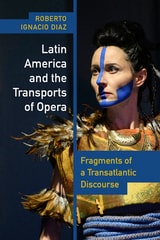
Latin America and the Transports of Opera
Fragments of a Transatlantic DiscourseRoberto Ignacio Díaz
Vanderbilt University Press, 2023
Latin America and the Transports of Opera studies a series of episodes in the historical and textual convergence of a hallowed art form and a part of the world often regarded as peripheral. Perhaps unexpectedly, the archives of opera generate new arguments about several issues at the heart of the established discussion about Latin America: the allure of European cultural models; the ambivalence of exoticism; the claims of nationalism and cosmopolitanism; and, ultimately, the place of the region in the global circulation of the arts. Opera’s transports concern literal and imagined journeys as well as the emotions that its stories and sounds trigger as they travel back and forth between Europe—the United States, too—and Latin America.
Focusing mostly on librettos and other literary forms, this book analyzes Calderón de la Barca’s baroque play on the myth of Venus and Adonis, set to music by a Spanish composer at Lima’s viceregal court; Alejo Carpentier’s neobaroque novella on Vivaldi’s opera about Moctezuma; the entanglements of opera with class, gender, and ethnicity throughout Cuban history; music dramas about enslaved persons by Carlos Gomes and Hans Werner Henze, staged in Rio de Janeiro and Copenhagen; the uses of Latin American poetry and magical realism in works by John Adams and Daniel Catán; and a novel by Manuel Mujica Lainez set in Buenos Aires’s Teatro Colón, plus a chamber opera about Victoria Ocampo with a libretto by Beatriz Sarlo. Close readings of these texts underscore the import and meanings of opera in Latin American cultural history.
This book is the recipient of the 2024 Norman L. and Roselea J. Goldberg Prize from Vanderbilt University Press for the best book in the area of art or medicine.

Le trouvère
Opera in Four Acts by Salvadore Cammarano, French Translation by Émilien PaciniGiuseppe Verdi
University of Chicago Press, 2025
By the time Le trouvère premiered at the Paris Opéra in 1857, Giuseppe Verdi had first-hand knowledge of the unique demands of French theater. He had adapted his earlier work I Lombardi alla prima crociata (La Scala, 1843) as Jérusalem in 1847, and in 1855 he composed Les vêpres siciliennes, especially for the Opéra. Il trovatore, set in Spain against the backdrop of civil unrest, was especially suited to Parisian tastes, which required spectacular performances with plenty of choreography. Verdi expanded the score with a four-part ballet in the third act and rewrote the ending, where he introduced a reprise of his celebrated “Miserere,” which is first heard at the start of the fourth act. By all accounts, the resulting work displayed extraordinary musical and dramatic efficacy and, after a successful premiere, Le trouvère remained in the Opéra repertory through the opening decades of the twentieth century.
There is no extant autograph manuscript for Le trouvère. This critical edition is based primarily on a manuscript full score used at the premiere and during rehearsals, preserved at the Bibliothèque de l’Opéra in Paris. Editor David Lawton’s introduction to this edition discusses the origins, rehearsals, and reception of Le trouvère, the numerous sources preserved in French, Belgian, Italian, and British archives, and performance issues including staging, vocal style, and orchestral considerations.
Luisa Miller
Melodramma tragico in Three Acts by Salvadore CammaranoGiuseppe Verdi
University of Chicago Press, 1992
Luisa Miller, a milestone in the maturation of Verdi's style, is the fifth work to be published in The Works of Giuseppe Verdi. Following the strict requirements of the series, this edition is based on Verdi's autograph and other authentic sources, and has been reviewed by a distinguished editorial board—Philip Gossett (general editor), Julian Budden, Martin Chusid, Francesco Degrada, Ursula Günter, Giorgio Pestelli, and Pierluigi Petrobelli. It is available as a two-volume set: a full orchestral score and a critical commentary. The newly set score is printed on acid-free paper and beautifully bound in an oversized format. The introduction to the score discusses the work's genesis, sources, and performance history as well as performance practice, instrumentation, and problems of notation. The critical commentary discusses editorial decisions and identifies the sources of alternate readings of the music and libretto.
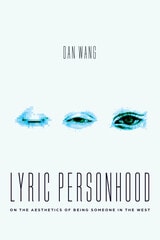
Lyric Personhood
On the Aesthetics of Being Someone in the WestDan Wang
University of Chicago Press, 2025
What does it mean to be a person? One might think of the possession of certain rights, having the capacity for love, or being self-determined. But if words like “person” or “love” seem to carry an internal meaning, where does this meaningfulness come from? Lyric Personhood contends that to be encultured in the modern West is to learn, on top of everything else, an unspoken and mostly felt sense of what it means to be someone, a sense transmitted not only in language but also through encounters with aesthetic form. Through close readings that span nineteenth-century European opera, commercial cinema, and amateur YouTube proposal videos, Dan Wang shows that a “person” has become an aesthetic concept—and not just a legal, moral, political, or philosophical one—in the last two hundred years of Western culture.
It’s hard to let go of the organizing promise of romantic love, the dream of therapeutic “health,” and the aspiration to belong to national culture, Wang argues, because these longings have been shaped by an archive of sentimental and melodramatic works that trains people's expectations for life, genre, and even the knowing promised in theory itself. Tracing a surprisingly continuous imagination of personhood through opera and film aesthetics, Lyric Personhood introduces modes of reading audiovisual works that allow a longer story to be told about the forms that make personhood sensible in the West.