Results by title
194 books match the query 'People' and 7 start with l
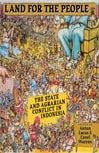
Land for the People
The State and Agrarian Conflict in IndonesiaAnton Lucas
Ohio University Press, 2013
Half of Indonesia’s massive population still lives on farms, and for these tens of millions of people the revolutionary promise of land reform remains largely unfulfilled. The Basic Agrarian Law, enacted in the wake of the Indonesian revolution, was supposed to provide access to land and equitable returns for peasant farmers. But fifty years later, the law’s objectives of social justice have not been achieved.
Land for the People provides a comprehensive look at land conflict and agrarian reform throughout Indonesia’s recent history, from the roots of land conflicts in the prerevolutionary period and the Sukarno and Suharto regimes, to the present day, in which democratization is creating new contexts for people’s claims to the land. Drawing on studies from across Indonesia’s diverse landscape, the contributors examine some of the most significant issues and events affecting land rights, including shifts in policy from the early postrevolutionary period to the New Order; the Land Administration Project that formed the core of land policy during the late New Order period; a long-running and representative dispute over a golf course in West Java that pitted numerous local farmers against the government and local elites; Suharto’s notorious “million hectare” project that resulted in loss of access to land and resources for numerous indigenous farmers in Kalimantan; and the struggle by Bandung’s urban poor to be treated equitably in the context of commercial land development. Together, these essays provide a critical resource for understanding one of Indonesia’s most pressing and most influential issues.
Contributors: Afrizal, Dianto Bachriadi, Anton Lucas, John McCarthy, John Mansford Prior, Gustaaf Reerink, Carol Warren, and Gunawan Wiradi.
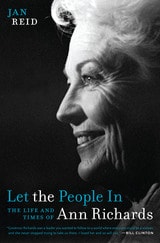
Let the People In
The Life and Times of Ann RichardsBy Jan Reid
University of Texas Press, 2012
Winner, Coral Horton Tullis Memorial Prize, Texas State Historical Association, 2012
Liz Carpenter Award for Research in the History of Women, Texas State Historical Association, 2012
When Ann Richards delivered the keynote of the 1988 Democratic National Convention and mocked President George H. W. Bush—“Poor George, he can’t help it. He was born with a silver foot in his mouth”—she instantly became a media celebrity and triggered a rivalry that would alter the course of American history. In 1990, Richards won the governorship of Texas, upsetting the GOP’s colorful rancher and oilman Clayton Williams. The first ardent feminist elected to high office in America, she opened up public service to women, blacks, Hispanics, Asian Americans, gays, and the disabled. Her progressive achievements and the force of her personality created a lasting legacy that far transcends her rise and fall as governor of Texas.
In Let the People In, Jan Reid draws on his long friendship with Richards, interviews with her family and many of her closest associates, her unpublished correspondence with longtime companion Bud Shrake, and extensive research to tell a very personal, human story of Ann Richards’s remarkable rise to power as a liberal Democrat in a conservative Republican state. Reid traces the whole arc of Richards’s life, beginning with her youth in Waco, her marriage to attorney David Richards, her frustration and boredom with being a young housewife and mother in Dallas, and her shocking encounters with Lyndon Johnson and Jimmy Carter. He follows Richards to Austin and the wild 1970s scene and describes her painful but successful struggle against alcoholism. He tells the full, inside story of Richards’s rise from county office and the state treasurer’s office to the governorship, where she championed gun control, prison reform, environmental protection, and school finance reform, and he explains why she lost her reelection bid to George W. Bush, which evened his family’s score and launched him toward the presidency. Reid describes Richards’s final years as a world traveler, lobbyist, public speaker, and mentor and inspiration to office holders, including Hillary Clinton. His nuanced portrait reveals a complex woman who battled her own frailties and a good-old-boy establishment to claim a place on the national political stage and prove “what can happen in government if we simply open the doors and let the people in.”

Letters from the Leelanau
Essays of People and PlaceKathleen Stocking
University of Michigan Press, 1990
Listening to People
A Practical Guide to Interviewing, Participant Observation, Data Analysis, and Writing It All UpAnnette Lareau
University of Chicago Press, 2021
In-depth interviews and close observation are essential to the work of social scientists, but inserting one’s researcher-self into the lives of others can be daunting, especially early on. Esteemed sociologist Annette Lareau is here to help. Lareau’s clear, insightful, and personal guide is not your average methods text. It promises to reduce researcher anxiety while illuminating the best methods for first-rate research practice.
As the title of this book suggests, Lareau considers listening to be the core element of interviewing and observation. A researcher must listen to people as she collects data, listen to feedback as she describes what she is learning, listen to the findings of others as they delve into the existing literature on topics, and listen to herself in order to sift and prioritize some aspects of the study over others. By listening in these different ways, researchers will discover connections, reconsider assumptions, catch mistakes, develop and assess new ideas, weigh priorities, ponder new directions, and undertake numerous adjustments—all of which will make their contributions clearer and more valuable.
Accessibly written and full of practical, easy-to-follow guidance, this book will help both novice and experienced researchers to do their very best work. Qualitative research is an inherently uncertain project, but with Lareau’s help, you can alleviate anxiety and focus on success.
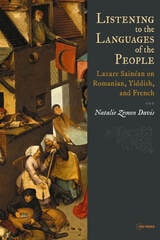
Listening to the Languages of the People
Lazare Sainéan on Romanian, Yiddish, and FrenchNatalie Zemon Davis
Central European University Press, 2022
This tale of great achievements and great disappointments offers a fresh perspective on the interplay between scholarship and political sentiment in the late nineteenth and early twentieth centuries.
Lazăr Șăineanu (1859-1934), linguist and folklorist, was a pioneer in his native Romania, seeking out the popular elements in culture along with high literary ones. He was among the first to publish a study of Yiddish as a genuine language, and he uncovered Turkish features in Romanian language and customs. He also made an index of hundreds of Romanian folktales. Yet when he sought Romanian citizenship and a professorship, he was blocked by powerful figures who thought Jews could not be Romanians and who fancied the origins of Romanian culture to be wholly Latin. Faced with anti-Semitism, some of his friends turned to Zionism. Instead he tried baptism, which brought him only mockery and shame.
Hoping to find a polity to which he could belong, Șăineanu moved with his family to Paris in 1900 and became Lazare Sainéan. There he made innovative studies of French popular speech and slang, culminating in his great work on the language of Rabelais. Once again, he was contributing to the development of a national tongue. Even then, while welcomed by literary scholars, Sainéan was unable to get a permanent university post. Though a naturalized citizen of France, he felt himself a foreigner, an “intruder,” into his old age.
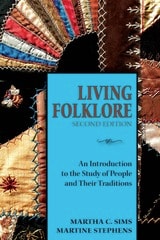
Living Folklore, 2nd Edition
An Introduction to the Study of People and Their TraditionsMartha Sims and Martine Stephens
Utah State University Press, 2011
Living Folklore is a comprehensive, straightforward introduction to folklore as it is lived, shared and practiced in contemporary settings. Drawing on examples from diverse American groups and experiences, this text gives the student a strong foundation—from the field's history and major terms to theories and interpretive approaches.
Living Folklore moves beyond genres and classifications, and encourages students who are new to the field to see the study of folklore as a unique approach to understanding people, communities, and day-to-day artistic communication.
This revised edition incorporates new examples, research, and theory along with added discussion of digital and online folklore.
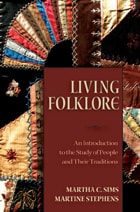
Living Folklore
Introduction to the Study of People and their TraditionsMartha Sims and Martine Stephens
Utah State University Press, 2005
Living Folklore is a comprehensive, straightforward introduction to folklore as it is lived, shared and practiced in contemporary settings. Drawing on examples from diverse American groups and experiences, this text gives the student a strong foundation—from the field’s history and major terms to theories, interpretive approaches, and fieldwork.
Many teachers of undergraduates find the available folklore textbooks too complex or unwieldy for an introductory level course. It is precisely this criticism that Living Folklore addresses; while comprehensive and rigorous, the book is specifically intended to meet the needs of those students who are just beginning their study of the discipline. Its real strength lies in how it combines carefully articulated foundational concepts with relevant examples and a student-oriented teaching philosophy.