Results by title
68 books match the query 'Performance art' and 4 start with l
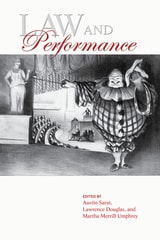
Law and Performance
Austin Sarat
University of Massachusetts Press, 2018
Drawing on the rich field of performance studies, this volume, the most recent contribution to the distinguished Amherst Series in Law, Jurisprudence, and Social Thought, offers fresh insights and a provocative mix of multidisciplinary topics and methodologies to explore the theatricality and performativity of law as more than a metaphor.
In considering law through the lens of performance studies, the contributors in this volume emphasize the embodied, affective, and reiterative qualities that move law off the printed page and into the thick world of lived experience. They consider the blurring of lines between performance and the enactment of law, the transformative exchanges between the law and its many and varied stagings, and the impact or resonance of performativity in situations where innocence and guilt may be determined. In addition to the editors, the contributors include Joshua Chambers-Letson, Catherine M. Cole, Ryan Hartigan, Lara D. Nielsen, Julie Stone Peters, Ann Pellegrini, and Karen Shimakawa.
In considering law through the lens of performance studies, the contributors in this volume emphasize the embodied, affective, and reiterative qualities that move law off the printed page and into the thick world of lived experience. They consider the blurring of lines between performance and the enactment of law, the transformative exchanges between the law and its many and varied stagings, and the impact or resonance of performativity in situations where innocence and guilt may be determined. In addition to the editors, the contributors include Joshua Chambers-Letson, Catherine M. Cole, Ryan Hartigan, Lara D. Nielsen, Julie Stone Peters, Ann Pellegrini, and Karen Shimakawa.
[more]
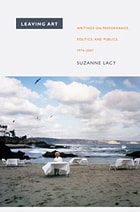
Leaving Art
Writings on Performance, Politics, and Publics, 1974-2007Suzanne Lacy
Duke University Press, 2010
Since the 1970s, the performance and conceptual artist Suzanne Lacy has explored women’s lives and experiences, as well as race, ethnicity, aging, economic disparities, and violence, through her pioneering community-based art. Combining aesthetics and politics, and often collaborating with other artists and community organizations, she has staged large-scale public art projects, sometimes involving hundreds of participants. Lacy has consistently written about her work: planning, describing, and analyzing it; advocating socially engaged art practices; theorizing the relationship between art and social intervention; and questioning the boundaries separating high art from popular participation. By bringing together thirty texts that Lacy has written since 1974, Leaving Art offers an intimate look at the development of feminist, conceptual, and performance art since those movements’ formative years. In the introduction, the art historian Moira Roth provides a helpful overview of Lacy’s art and writing, which in the afterword the cultural theorist Kerstin Mey situates in relation to contemporary public art practices.
[more]
Liquor Store Theatre
Maya Stovall
Duke University Press, 2020
For six years Maya Stovall staged Liquor Store Theatre, a conceptual art and anthropology video project---included in the Whitney Biennial in 2017---in which she danced near the liquor stores in her Detroit neighborhood as a way to start conversations with her neighbors. In this book of the same name, Stovall uses the project as a point of departure for understanding everyday life in Detroit and the possibilities for ethnographic research, art, and knowledge creation. Her conversations with her neighbors—which touch on everything from economics, aesthetics, and sex to the political and economic racism that undergirds Detroit's history—bring to light rarely acknowledged experiences of longtime Detroiters. In these exchanges, Stovall enacts an innovative form of ethnographic engagement that offers new modes of integrating the social sciences with the arts in ways that exceed what either approach can achieve alone.
[more]
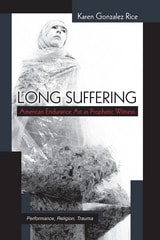
Long Suffering
American Endurance Art as Prophetic WitnessKaren Gonzalez Rice
University of Michigan Press, 2016
Long Suffering productively links avant-garde performance practices with religious histories in the United States, setting contemporary performances of endurance art within a broader context of prophetic religious discourse in the United States. Its focus is on the work of Ron Athey, Linda Montano, and John Duncan, American artists whose performances involve extended periods of suffering. These unsettling performances can disturb, shock, or frighten audiences, leaving them unsure how to respond. The book examines how these artists work at the limits of the personal and the interpersonal, inflicting suffering on themselves and others, transforming audiences into witnesses, straining social relations, and challenging definitions of art and of ethics. By performing the death of self at the heart of trauma, strategies of endurance signal artists’ attempts to visualize, legitimize, and testify to the persistent experience of being wounded. The artworks discussed find their foundations in artists’ early experiences of religion and connections with the work of reformers from Angelina Grimké to Rev. Martin Luther King, Jr., who also used suffering as a strategy to highlight social injustice and call for ethical, social, and political renewal.
[more]