Results by title
426 books match the query 'Philosophy & Social Aspects' and 6 start with l

Language, Mind, and Knowledge
Keith Gunderson, Editor
University of Minnesota Press, 1975
Language, Mind, and Knowledge was first published in 1975. Minnesota Archive Editions uses digital technology to make long-unavailable books once again accessible, and are published unaltered from the original University of Minnesota Press editions.
This is Volume VII of the Minnesota Studies in the Philosophy of Science, a series published in cooperation with the Minnesota Center for Philosophy of Science at the University of Minnesota and edited by Herbert Feigl and Grover Maxwell. Professor Maxwell is the present director of the Center. Some of the papers in this volume were presented at or grew out of a conference on the philosophy of language which was held at the Center under the direction of Professor Gunderson. Others were written independently.
The aim of the book, like that of the conference, is to assemble a wide variety of approaches to issues in the philosophy of language with emphasis on the ways in which the issues involved have bearing on other matters such as linguistic theory, cognitive psychology, the philosophy of mind, and epistemology.
There are twelve papers by eleven contributors: "Languages and Language" by David Lewis; "Logic and Language: An Examination of Recent Criticisms of Internationalism" by Jerrold J. Katz; "The Meaning of 'Meaning'" by Hilary Putnam; "Reference and Context" by Charles Chastain; "Language, Thought, and Communication" by Gilbert Harman; "Knowledge of Language" by Noam Chomsky; "Language, Rules, and Complex Behavior" by Michael D. Root; "A Taxonomy of Illocutionary Acts" by John R. Searle; "On What We Know" by Zeno Vendler; "Vendler on Knowledge and Belief" by Bruce Aune; "Reply to Professor Aune" by Zeno Vendler; "Brain Writing and Mind Reading" by D.C. Dennett.

Life
A Modern InventionDavide Tarizzo
University of Minnesota Press, 2017
The word “biology” was first used to describe the scientific study of life in 1802, and as Davide Tarizzo demonstrates in his reconstruction of the genealogy of the concept of life, our understanding of what being alive means is an equally recent invention. Focusing on the histories of philosophy, science, and biopolitics, he contends that biological life is a metaphysical concept, not a scientific one, and that this notion has gradually permeated both European and Anglophone traditions of thought over the past two centuries.
Building on the work undertaken by Foucault in the 1960s and ‘70s, Tarizzo analyzes the slow transformation of eighteenth-century naturalism into a nineteenth-century science of life, exploring the philosophical landscape that engendered biology and precipitated the work of such foundational figures as Georges Cuvier and Charles Darwin.
Tarizzo tracks three interrelated themes: first, that the metaphysics of biological life is an extension of the Kantian concept of human will in the field of philosophy; second, that biology and philosophy share the same metaphysical assumptions about life originally advanced by F. W. J. Schelling and adopted by Darwin and his intellectual heirs; and third, that modern biopolitics is dependent on this particularly totalizing view of biological life.
Circumventing tired debates about the validity of science and the truth of Darwinian evolution, this book instead envisions and promotes a profound paradigm shift in philosophical and scientific concepts of biological life.
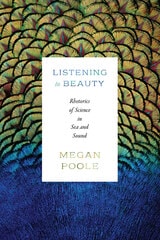
Listening to Beauty
Rhetorics of Science in Sea and SoundMegan Poole
University of Chicago Press, 2025
Our attempts to understand the world are always more than simply rational. Our bodies learn through lived experience, our natural environments challenge what we think we know, and we take lessons from our nonhuman kin. Even scientists, often considered paragons of rationality, frequently describe their findings in the language of beauty. For rhetorician Megan Poole, beauty is integral to how scientific research works.
Drawing on interviews with leading biologists, Poole explores what happens when scientists set aside objectivity and listen for beauty around them. The wonder we feel at the plumage of birds, the melodies of whales, or the caretaking of elephants may not help us (on its own) to isolate a given fact, but such encounters may teach us to open ourselves to a different way of knowing entirely. Through stories about researchers’ encounters with wonder, Listening to Beauty reveals how scientific discovery happens sometimes unsystematically, sometimes incoherently, often beautifully.
Live Dead
The Grateful Dead, Live Recordings, and the Ideology of LivenessJohn Brackett
Duke University Press, 2023

Lively Capital
Biotechnologies, Ethics, and Governance in Global MarketsKaushik Sunder Rajan, ed.
Duke University Press, 2012
Contributors. Timothy Choy, Joseph Dumit, Michael M. J. Fischer, Kim Fortun, Mike Fortun, Donna Haraway, Sheila Jasanoff, Wen-Hua Kuo, Andrew Lakoff, Kristin Peterson, Chloe Silverman, Elta Smith, Kaushik Sunder Rajan, Travis J. Tanner
Logical Empiricism in North America
Gary L. Hardcastle
University of Minnesota Press, 2003
This latest volume in the longest-standing and most influential series in the field of the philosophy of science extends and expands on the discipline’s recent historical turn. These essays take up the historical, sociological, and philosophical questions surrounding the particular intellectual movement of logical empiricism—both its emigration from Europe to North America in the 1930s and 1940s and its development in North America through the 1940s and 1950s. With an introduction placing them in their philosophical and historical context, these essays bear witness to the fact that the history of the philosophy of science, far more than a mere repository of anecdote and chronology, might be able to produce a decisive transformation in the philosophy of science itself.
Contributors: Richard Creath, Arizona State U; Michael Friedman, Stanford U; Rudolf Haller, U of Graz; Don Howard, Notre Dame; Diederick Raven, U of Utrecht; George Reisch; Thomas Ricketts, Northwestern U; Friedrich K. Stadler, U of Vienna; Thomas E. Uebel, U of Manchester.