Results by title
187 books match the query 'Place' and 7 start with l
Language and Death
The Place of NegativityGiorgio Agamben
University of Minnesota Press, 2006
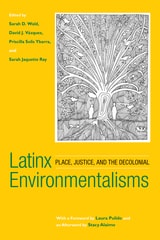
Latinx Environmentalisms
Place, Justice, and the DecolonialSarah D. Wald
Temple University Press, 2019
The whiteness of mainstream environmentalism often fails to account for the richness and variety of Latinx environmental thought. Building on insights of environmental justice scholarship as well as critical race and ethnic studies, the editors and contributors to Latinx Environmentalisms map the ways Latinx cultural texts integrate environmental concerns with questions of social and political justice.
Original interviews with creative writers, including Cherríe Moraga, Helena María Viramontes, and Héctor Tobar, as well as new essays by noted scholars of Latinx literature and culture, show how Latinx authors and cultural producers express environmental concerns in their work. These chapters, which focus on film, visual art, and literature—and engage in fields such as disability studies, animal studies, and queer studies—emphasize the role of racial capitalism in shaping human relationships to the more-than-human world and reveal a vibrant tradition of Latinx decolonial environmentalism.
Latinx Environmentalisms accounts for the ways Latinx cultures are environmental, but often do not assume the mantle of “environmentalism.”
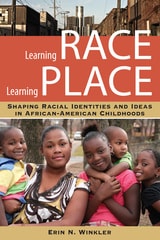
Learning Race, Learning Place
Shaping Racial Identities and Ideas in African American ChildhoodsWinkler, Erin N
Rutgers University Press, 2012
In an American society both increasingly diverse and increasingly segregated, the signals children receive about race are more confusing than ever. In this context, how do children negotiate and make meaning of multiple and conflicting messages to develop their own ideas about race? Learning Race, Learning Place engages this question using in-depth interviews with an economically diverse group of African American children and their mothers.
Through these rich narratives, Erin N. Winkler seeks to reorient the way we look at how children develop their ideas about race through the introduction of a new framework—comprehensive racial learning—that shows the importance of considering this process from children’s points of view and listening to their interpretations of their experiences, which are often quite different from what the adults around them expect or intend. At the children’s prompting, Winkler examines the roles of multiple actors and influences, including gender, skin tone, colorblind rhetoric, peers, family, media, school, and, especially, place. She brings to the fore the complex and understudied power of place, positing that while children’s racial identities and experiences are shaped by a national construction of race, they are also specific to a particular place that exerts both direct and indirect influence on their racial identities and ideas.
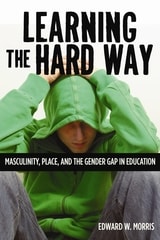
Learning the Hard Way
Masculinity, Place, and the Gender Gap in EducationMorris, Edward
Rutgers University Press, 2012
An avalanche of recent newspapers, weekly newsmagazines, scholarly journals, and academic books has helped to spark a heated debate by publishing warnings of a “boy crisis” in which male students at all academic levels have begun falling behind their female peers. In Learning the Hard Way, Edward W. Morris explores and analyzes detailed ethnographic data on this purported gender gap between boys and girls in educational achievement at two low-income high schools—one rural and predominantly white, the other urban and mostly African American. Crucial questions arose from his study of gender at these two schools. Why did boys tend to show less interest in and more defiance toward school? Why did girls significantly outperform boys at both schools? Why did people at the schools still describe boys as especially “smart”?
Morris examines these questions and, in the process, illuminates connections of gender to race, class, and place. This book is not simply about the educational troubles of boys, but the troubled and complex experience of gender in school. It reveals how particular race, class, and geographical experiences shape masculinity and femininity in ways that affect academic performance. His findings add a new perspective to the “gender gap” in achievement.
Letters from the Leelanau
Essays of People and PlaceKathleen Stocking
University of Michigan Press, 1990
Living Off the Country
Essays on Poetry and PlaceJohn Haines
University of Michigan Press, 1981
We live on the surface, he discovered. It is the land that makes people. If a poet will see, will feel, will interpret his place and then relate that experience to what he knows of the world at large, he will have a life in imagination, a vitality beyond appearances.
John Haines is author of At the End of Summer: Poems 1948-1954; Fables and Distances: New and Selected Essays; and The Owl in the Mask of the Dreamer. He received the Lenore Marshall Poetry Prize in 1991.
Lonesome Roads and Streets of Dreams
Place, Mobility, and Race in Jazz of the 1930s and '40sAndrew S. Berish
University of Chicago Press, 2012